Kodable vs Codestronauts: what comes after Kodable for your 8–12-year-old?
Kodable turns puzzles into first programs. Codestronauts turns typed lines into a story.
Short answer
Kodable is a coding, typing and STEM app suite for kids 4 to 10, from $119.99 a year in November 2026.[1]
 Codestronauts is a self-paced, story-driven coding course for kids 8–12.
If your kid has played Kodable since kindergarten, let it carry the early grades. When they're ready to type real code, Star Catcher is the next step. Episode 1 is free, no card.

No card needed. Episode 1, “Wake Up, Cody,” takes about 15 minutes.
At a glance
| Codestronauts | Kodable | |
|---|---|---|
| What it is | Story-driven coding course. Star Catcher: five episodes, about two hours. | Coding, typing and STEM app suite: four apps, one plan.[1] |
| Price | Episode 1 free, then $29.99 once for the rest of Star Catcher | $24.99 a month, $119.99 a year or $199.99 once, Nov 5, 2026.[1] |
| What the kid types | Real JavaScript, typed from line one. | Drag-and-drop puzzles first, then real JavaScript.[1] |
| Ages | 8–12. | 4 to 10.[1] |
| Best for | Kids 8–12 ready to type real code and finish a story | First steps in coding, with an app for pre-readers from 4.[1] |
| What comes next | The next episode, which answers the last cliffhanger. | The next level, unlocked as they go.[2] |
| What they make | Their own arcade game: score, levels and a boss they design. | Their own games, designed in Kodable Creator.[1] |
| Help when stuck | Hints first; her last hint says the line, and they type it. | A Personalized AI Tutor in Kodable Creator.[1] |
| Where it runs | Phones, laptops and computers, in a web browser. Nothing to install | iPad, iPhone and the web, progress synced across devices.[1] |
| Who's in charge | Parents, behind a Parent Corner PIN. No ads or stranger chats. | Parents, through a progress dashboard. No ads or in-app purchases.[1] |
| Who makes it | Jonathan Greene, dad of two, inventor on 50+ U.S. patents. | SurfScore, Inc. (Kodable), founded by Jon Mattingly and Grechen Huebner.[3] |
No card needed
Checked Nov 5, 2026. Every fact about Kodable carries its source, listed under Sources.
The map
Kodable from kindergarten, Star Catcher once they type
Kodable takes kids 4 to 10 from drag-and-drop puzzles to real JavaScript, one level at a time. Codestronauts is an epic for kids 8 to 12, typed in real JavaScript and told one mission at a time.
Placed from each program's own pages, checked Nov 5, 2026.
| Real coding skill | |||
|---|---|---|---|
| How likely they stick with it | Learns the ideas in blocks | Moves from blocks to typing | Types real code, like the pros |
| A story to finish, inside an epic |  Codestronauts | ||
| A level to beat or people to share with | Scratch codeSpark | Kodable | CodeCombat Roblox Studio CodeMonkey |
| The next lesson or class | Code.org Tynker Minecraft Education | Khan Academy | |
- → Real code from day one: no wall when the blocks run out.
- ↑ They finish what they start, and finishing builds real skill.
Kodable since kindergarten. What should come next?
Typing real code comes next. Kodable says over 50% of elementary schools in the United States use it.[3] A kid can start at 4 with Kodable Basics, made for pre-readers, and still be playing at 10.[1]
Its own path ends in typed code. Bug World takes on object-oriented JavaScript in a strategy game.[1]
Common Sense Media names two next steps once kids have mastered Kodable: Hopscotch and MIT's Scratch.[2] We compare Scratch with Codestronauts on its own page. Star Catcher is the typed step, made for 8 to 12. Your kid writes JavaScript from the first line, inside a story.
Is Kodable good for kids?
Yes, and it looks after parents too. Common Sense Media calls it "fun programming logic for kids, great resources for parents".[2] It says the materials for parents set Kodable apart.[2]
One plan covers coding, typing, STEM and online safety.[1] Kids can start and progress entirely on their own.[1] Its typing app teaches home row fundamentals through play.[1] That practice is a head start in a course where kids type their code.
Coming from Kodable? What carries over
The ideas carry over; the arrows turn into words. Common Sense Media says Kodable teaches sequential steps, if/then conditions and loops.[2]
In Kodable's Intro to Coding, the fuzz follows the arrows in the bar, one after another. Our lines run in order the same way, top to bottom. A Kodable loop repeats a step. every(1000, () => { spawnStar(); }); repeats one too: a new star every second.
Run it here
The same idea, spelled out
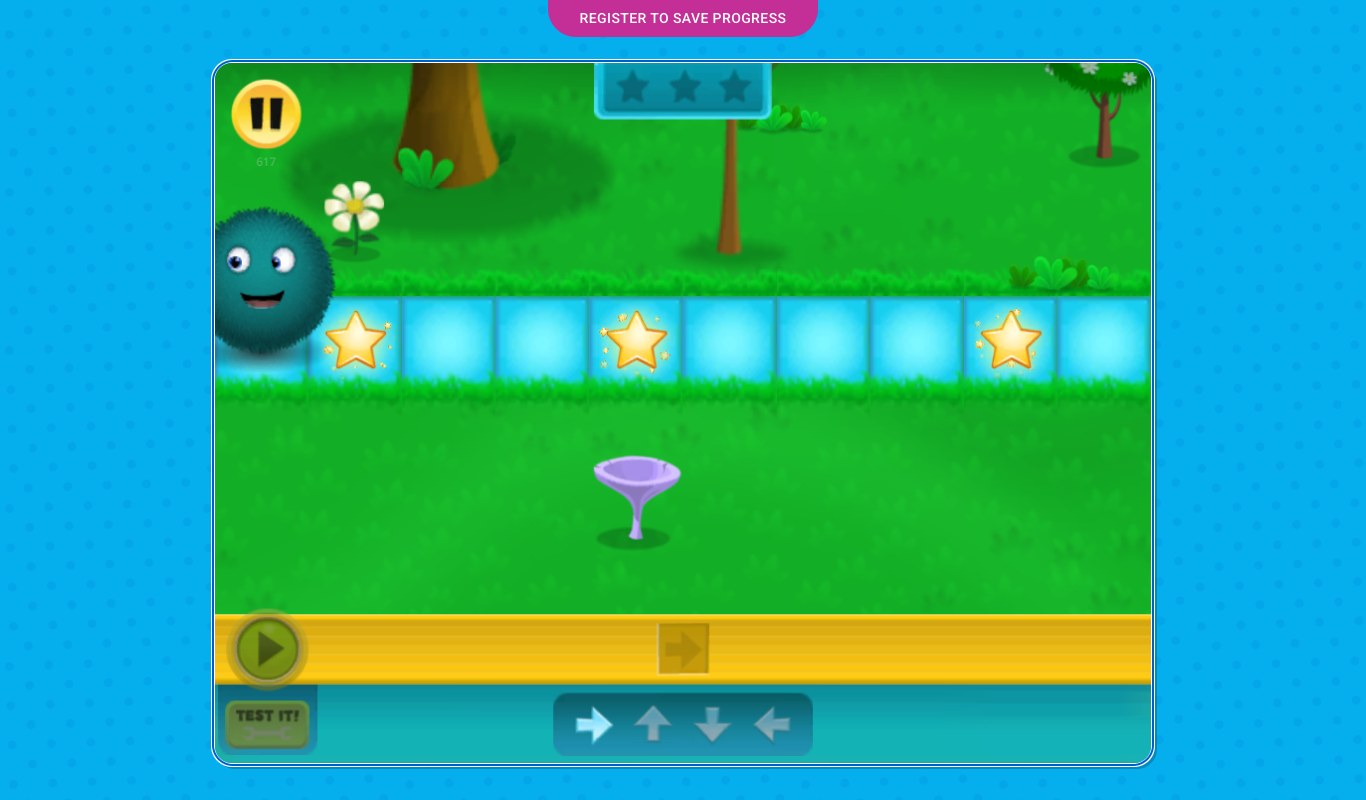
Kodable's first level: the bar waits for its first arrow, the arrows below.Screenshot of Kodable's Intro to Coding Hour of Code activity, kodable.com, taken Nov 5, 2026.
// 🚀 THE HULL
makeRocket({ color: "blue" });

// 🌟 STARLIGHT SCANNER
every(1000, () => {
  spawnStar();
});
Change blue to red, or 1000 to 100, and press Run.
Press ▶ Run
That's Episode 1's real game engine, running your edit on this page.
No card needed. Episode 1, “Wake Up, Cody,” takes about 15 minutes.
So a Kodable kid isn't starting over. They're spelling out moves they already plan. Kodable can stay on the iPad for a younger brother or sister.
What keeps a 9-year-old typing?
A reason to type the next line. Diana Cordova and Mark Lepper tested three ways to make learning more inviting, with 72 fourth and fifth graders.[4] They tried a setting, personal touches and choices. All three raised the kids' motivation and engagement in learning.[4]
Star Catcher is built on all three. The setting is a broken starship and a robot who needs your kid. The final game carries their name, and its boss is one they design.
What's the first session like in each?
Both start small. We opened Kodable's Intro to Coding on November 5, 2026.[5]
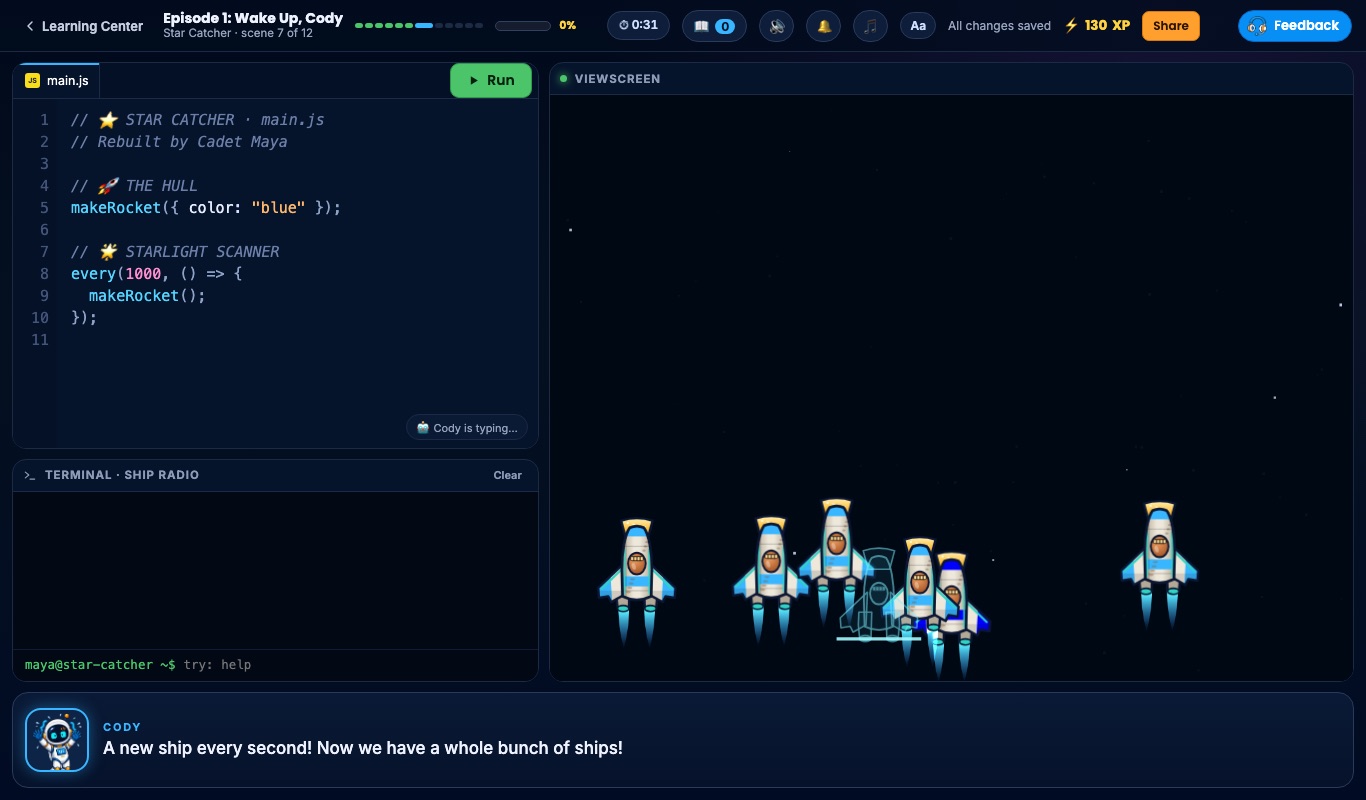
Our Episode 1 opens with a press of Run, and Cody wakes. The first line your kid types builds the ship.
Mistakes are part of the show. Wrong code plays out on the viewscreen, and Cody explains what happened.
What do parents see, and what's the cost?
Both show you progress; the bills work differently. Kodable gives you a parent dashboard to check in whenever you want.[1]
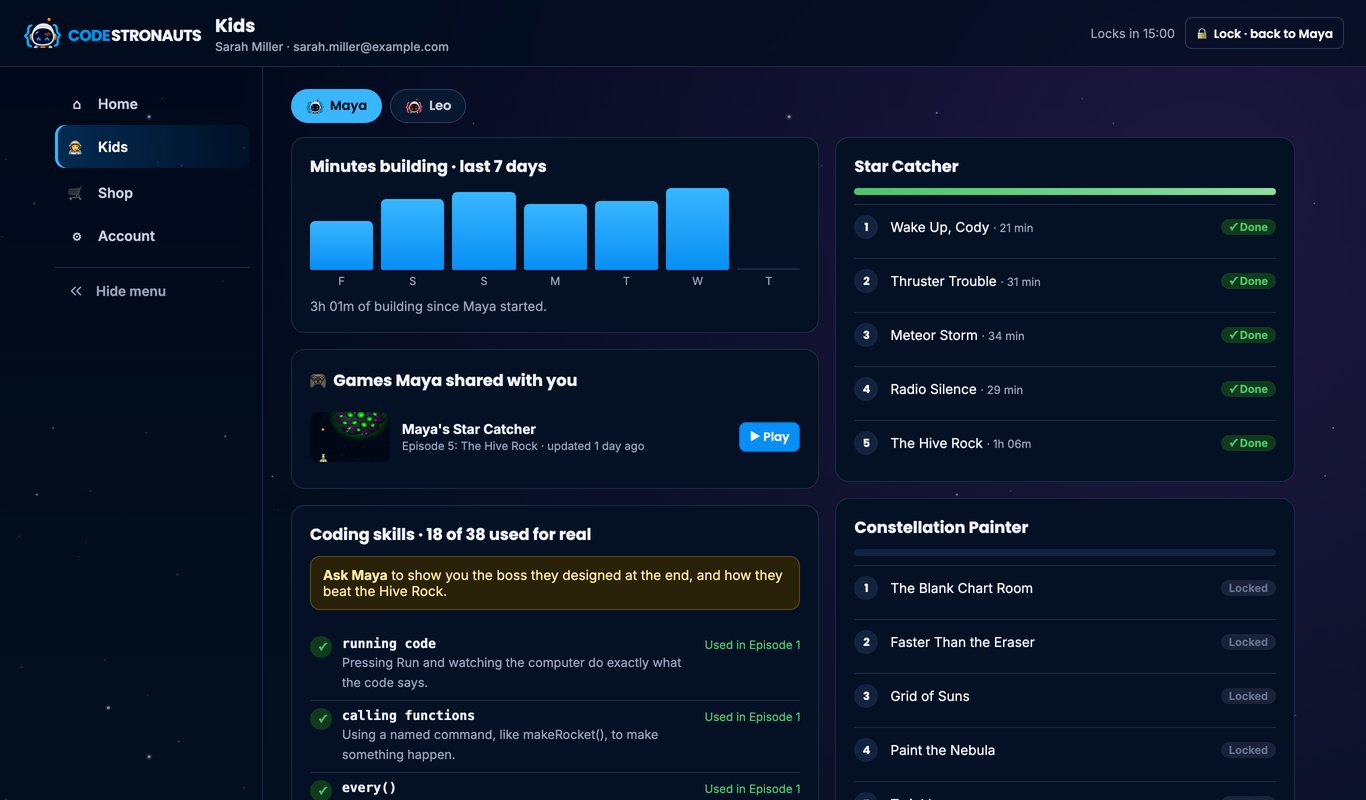
Ours is the Parent Corner, behind your PIN. You see every step and sign-in, and you approve every purchase. Signing up takes your email, a password, a PIN and your kid's first name. No card, and no email for your kid.
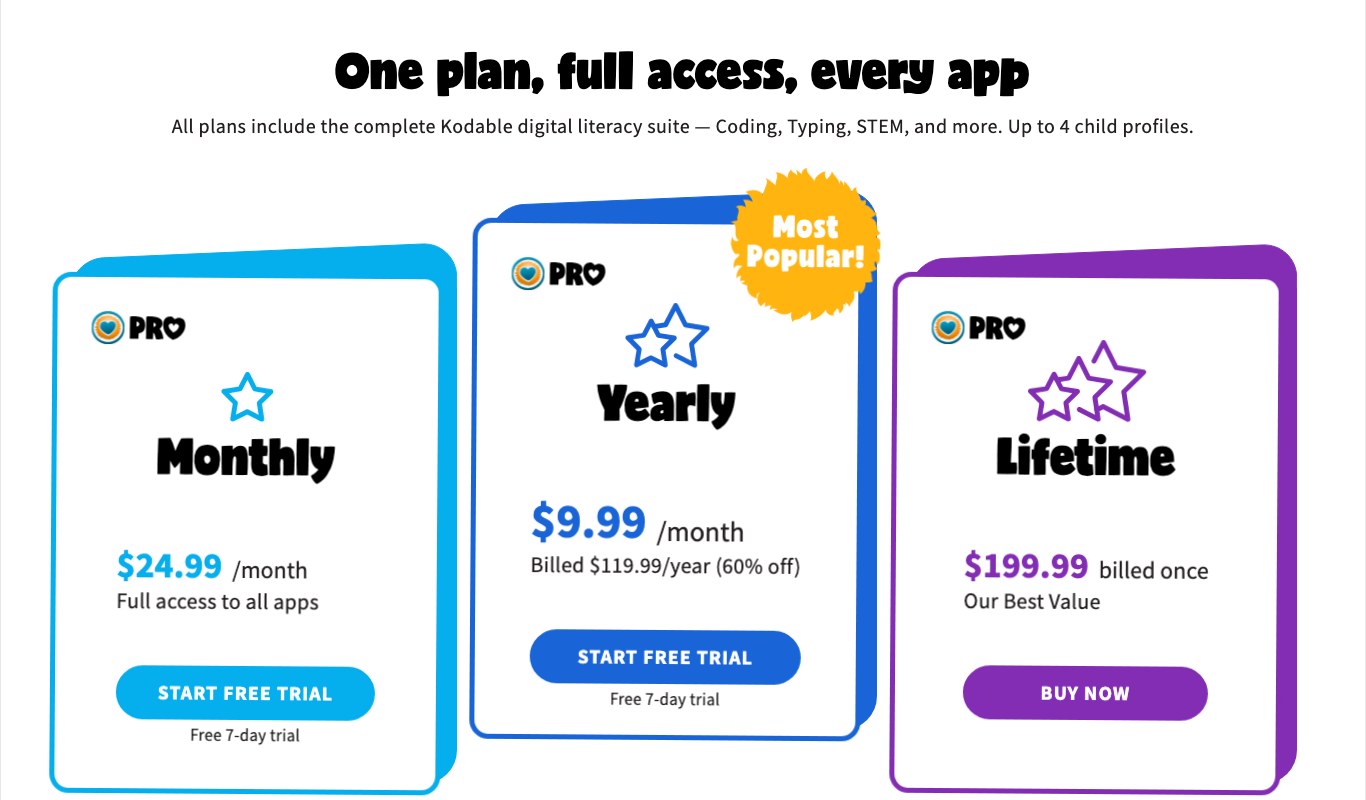
A year of Kodable is $119.99 on the yearly plan.[1] The monthly plan, at $24.99, comes to $299.88 over twelve months.[1] Lifetime is $199.99, billed once.[1] Every plan covers up to four child profiles.[1]
Star Catcher's Episode 1 is free. The rest is $29.99 once, nothing renews, and siblings share it. Each later mission is its own purchase, one whole story.
Whichever you choose, a month in, ask your kid for two things. Show me something you made. Now explain one arrow or one line of it.
Questions parents ask
What age is Kodable for?
Is Kodable free?
Does Kodable teach real coding?
Yes. Kids start with drag-and-drop puzzles and progress to writing real JavaScript.[1]
Is my 10-year-old too old for Kodable?
No. Kodable runs to age 10, with a track for ages 8 to 10.[1] At 8 to 12, Star Catcher is a next step in typed JavaScript.
What comes after Star Catcher?
Mission 2, Constellation Painter. The Glitch wiped the star charts, and your kid redraws them so the Starbase can find its way.
Where Codestronauts fits
From arrows to an arcade game they typed
Star Catcher is Codestronauts' first mission. Your kid wakes a robot named Cody and rebuilds her starship, one typed line at a time. By The Hive Rock, they've built an arcade game with a score, levels, sound and a boss of their own.
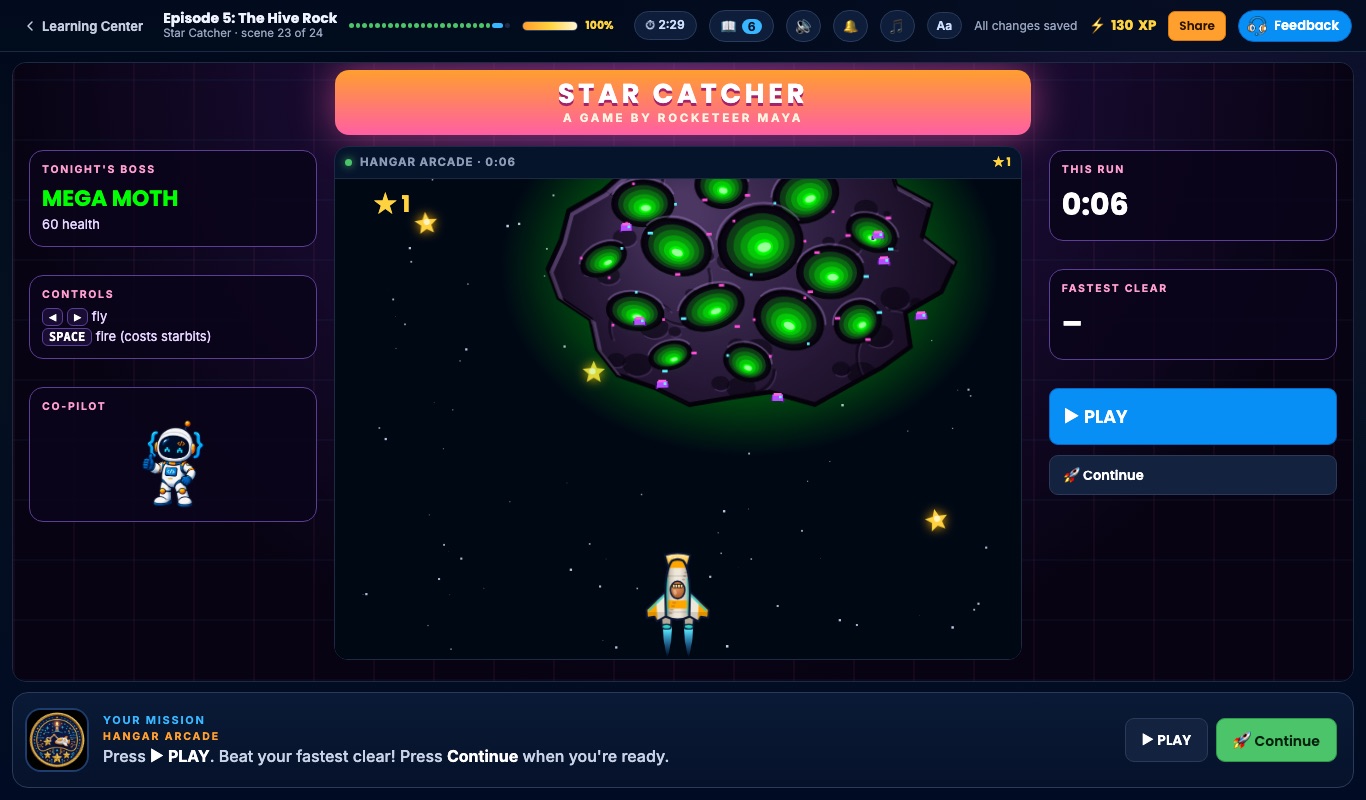
Every Codestronaut starts with Episode 1, and it's free. No card needed.
Was this answer helpful?
What was missing?
Kodable alternatives parents also weigh
Scratch Code.org Tynker CodeCombat Roblox Studio Coding tutor Coding camps Live coding classes Khan Academy CodeMonkey codeSpark Minecraft EducationAll fourteen side by side
From the blog
All answers SchoolMy 9-year-old can swipe through an iPad but can barely type on a laptop. When should kids learn to type?Start now. "Most research supports starting students on formal keyboarding around grade 4," says occupational therapist Theresa Tovey, and fourth-graders are 9 or 10.
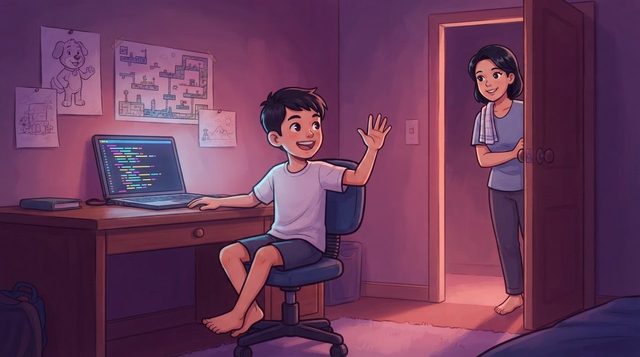 CodingMy 10-year-old has outgrown Scratch. What should he learn next?Typed code, in a tool that keeps giving him things to show. Python is the usual answer, and a good one. For a ten-year-old game builder we'd pick JavaScript, because his games open in any web browser.
How we compared
We make Codestronauts. We opened each product and took these screens on the dates shown. Each fact about the other program links to its own pages. Something out of date? Write to hello@codestronauts.com and we'll fix it. Kodable belongs to its owner, which has no tie to Codestronauts.
Sources
- Coding & Typing Apps for Kids Ages 4-10 | Kodable, Kodable. Read Nov 5, 2026 ↩
- Kodable - Parents' Guide & App Review, Common Sense Media. Read Nov 5, 2026 ↩
- About Us | Kodable, Kodable. Read Nov 5, 2026 ↩
- Intrinsic Motivation and the Process of Learning: Beneficial Effects of Contextualization, Personalization, and Choice (Journal of Educational Psychology, 1996), ERIC (U.S. Department of Education), on Cordova and Lepper. Read Nov 5, 2026 ↩
- Intro to Coding (Pre-readers welcome) | Kodable, Kodable. Read Nov 5, 2026 ↩
- Scratch | Scratch Foundation, Scratch Foundation. Read Nov 5, 2026
- Computer Science for Students | Learn, Explore, and Create with CodeAI, CodeAI (formerly Code.org). Read Nov 5, 2026
- Coding For Kids, Kids Online Coding Classes & Games | Tynker, Tynker. Read Nov 5, 2026
- About CodeCombat, CodeCombat. Read Nov 5, 2026
- Luau, Roblox Creator Hub. Read Nov 5, 2026
- Introducing Khan Academy's New Intro to Computer Science Course with Python, Khan Academy Blog. Read Nov 5, 2026
- Coding for Kids | Game-Based Programming, CodeMonkey. Read Nov 5, 2026
- codeSpark, the #1 Learn-to-Code App for Kids 3-10, Begin (codeSpark). Read Nov 5, 2026
- Computer Science | Minecraft Education, Minecraft Education (Mojang and Microsoft). Read Nov 5, 2026