How do I AI-proof my 10-year-old when nobody knows which jobs will exist?
Short answer
Bet on the skills under every job, since nobody can pick the jobs.
The World Economic Forum's Future of Jobs Report 2025 says workers can expect 39% of their skills to be transformed or outdated by 2030, while seven in 10 companies call analytical thinking essential.1
At 10, that means practice breaking problems down, testing ideas and fixing what broke.
Why does every list of AI-proof jobs leave me more worried?
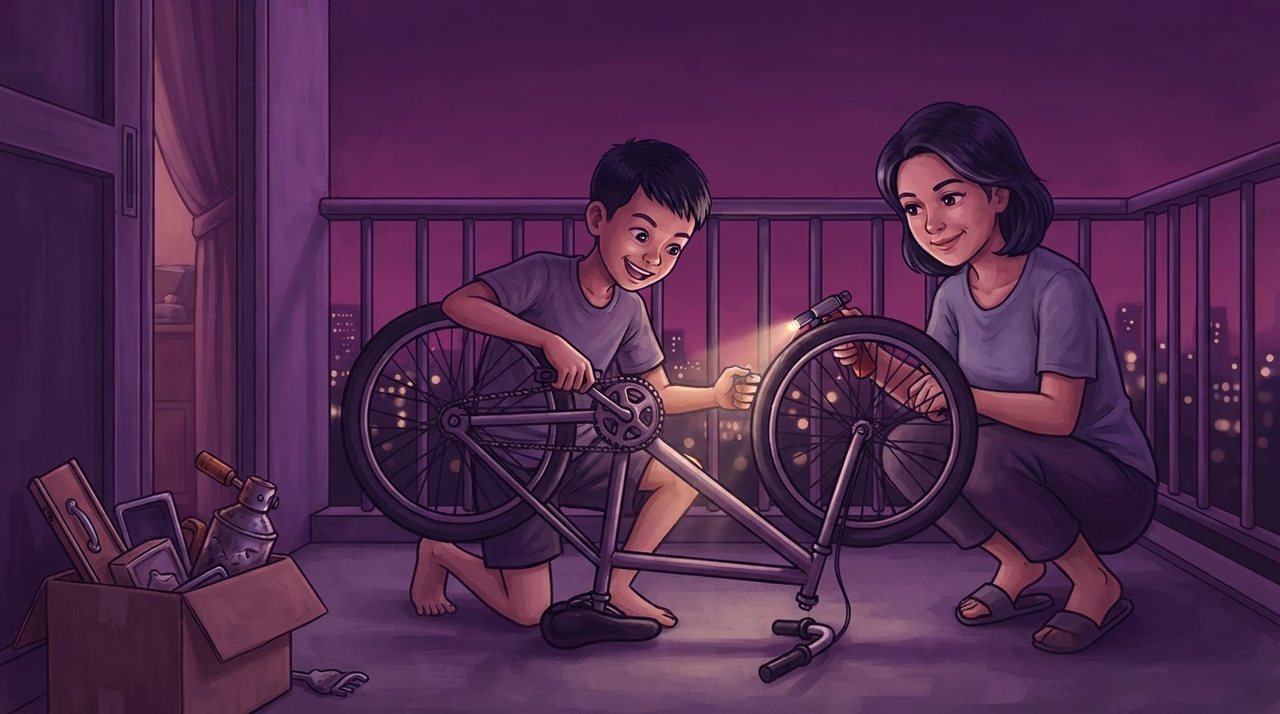
Because each list contradicts the last one, and your kid's own list changes every few months. This year alone he wanted to be a vet in the spring and a YouTuber by the summer, and now it's something to do with drones. Meanwhile the headlines say software can already prepare tax returns, design logos and read X-rays, and that plumbers are safe until robots get hands. Late one night you type "how to AI proof your kids" into a search bar and get a list of soft skills and a list of trades, and neither tells you what to do with a 10-year-old on a Tuesday.
You have company. In a Harris Poll for Credit Karma in April 2026, of 921 US parents of kids from kindergarten through 11th grade,2 69% said thinking about their child's future career feels more stressful than it used to because of AI.2 And 76% worried that by the time their child starts work, the education, skills and experience traditionally needed for a stable, good-paying job will have changed.2
The computer scientist Jeannette Wing offered a steadier way to look at it years before ChatGPT. "To reading, writing, and arithmetic, we should add computational thinking to every child's analytical ability," she wrote in the summary of a 2015 talk posted by Microsoft Research.3 She meant a way of thinking that serves any career: "Computational thinking involves solving problems, designing systems, and understanding human behavior by drawing on the concepts that are fundamental to computer science."3
If nobody can predict the jobs, what can I bet on?
The habits that sit under jobs that look nothing alike, because the jobs themselves will keep moving. Extrapolating from what employers told it, the World Economic Forum expects jobs created and destroyed between 2025 and 2030 to add up to 22% of today's jobs.1 The fastest-declining roles in that 2025 report include postal service clerks, bank tellers and data entry clerks.1 Read that list and you see jobs built on set routines. And where software takes over a task, someone still has to check its work and catch what it got wrong.
Three habits sit under nearly all of it, and a 10-year-old can practise every one:
- Breaking a problem down until each piece is small enough to do.
- Testing an idea instead of guessing, then reading what actually happened.
- Fixing what broke, one likely cause at a time.
Computer science educators already use code to teach two of them by name. In a 2021 paper in Frontiers in Psychology, Ronny Scherer of the University of Oslo and his co-authors noted that educators consider coding a vehicle for teaching computational thinking,4 listing among its parts "problem decomposition" and "debugging and systematic error detection."4 Wing made the same point from the other side: "Thinking like a computer scientist means more than being able to program a computer."3 Your kid doesn't need to become a programmer for the habits to pay off. Code is where they get practised daily, with a computer that does exactly what he typed and can't be talked round.
What does a kid miss if he's always handed the steps?
He gets very good at the part of work that's shrinking. School rewards a kid for following the steps on the worksheet, and plenty of bright 10-year-olds master it. Hand that same kid a problem with no steps, a bike chain that keeps slipping or a game that won't start, and he freezes or asks you for the answer. That reflex is what the shrinking clerk jobs above were built on.
You can turn this around, and ten is a fine time to begin. These are habits, and habits grow from repetitions, a few at a time. At home a failed attempt costs him nothing but a laugh, which makes the kitchen table the cheapest place he'll ever have to practise getting things wrong. And the moves travel: the decomposition and debugging that educators teach through code are the same moves he'll later use on a science project, a budget or a job that hasn't been invented.
Why don't the usual ways of AI-proofing a kid work at 10?
Most of them aim at a future you can't see, when what you can build is a habit this week.
- Steering him toward a "safe" career. The safe list changes with every headline, and a 10-year-old's dream changes faster. Training for one job title bets on the very thing nobody can predict.
- Stacking classes and tutoring. More hours of being taught still leaves him following someone else's steps. The skill you want appears when nobody hands him the steps.
- Soft-skills advice. Communication, creativity and resilience deserve every word written about them, yet school rarely gives a kid a way to practise them daily, and advice with no practice attached fades by Friday.
- Teaching him the AI tools. Under 13 he shouldn't be using a chatbot on his own, and prompting tricks age as fast as the apps do.
- "Learn to code so he can get a coding job." That's the wrong reason, whatever AI does to programming jobs. Choose code for the practice instead: typed code is still the cheapest daily gym for breaking problems down and fixing them, whatever he ends up doing.
What works has a short spec. It's small and frequent: a few problems most days, rather than one big course a term. It gives a clear result right away: the thing works or it doesn't, so he tests instead of guessing and nobody has to grade him. And it moves across subjects: the same three moves on a bike, a lunch plan and a program, because a habit he has used on five kinds of problem is one he'll carry into a job nobody has named yet.
What can we start this week, with or without a course?
Seven habits, all cheap, and none needs you to write a line of code yourself.
- Ask about puzzles instead of careers. Give "what do you want to be?" a month off. Ask "what's something you'd like to figure out?" and keep his answers on a sticky note by the door. Practice starts with problems, and the job title can wait.
- Hand him a real job and make him shrink it. Saturday lunch for the family, packing for a weekend away, rearranging his shelves. He writes the plan as steps, and any step that would take longer than ten minutes gets split again. Then he runs it, and afterwards you ask which step he'd change.
- Bet, then test. Before any small experiment (which paper plane fold flies farther, whether ice melts faster in salty water), he writes his guess down. Three tries each, a scoreboard, and the evidence decides. Losing a bet to the evidence gracefully is the habit you're after.
- Keep a broken box. A squeaky drawer, a bike chain that slips, a torch that won't switch on. He names the symptom, lists two possible causes and tests one at a time while you hold the torch.
- Give him typed code most days. Twenty minutes is plenty. Khan Academy's programming course runs JavaScript drawings right in the browser. Have him type
rect(80, 120, 240, 160);and see a box appear, then say out loud which way it will move before he changes one number. - Let someone poke holes in his plan. Once a week he shows a grandparent or a sibling something he planned or fixed and answers their questions. Explaining it to someone who wasn't there is how he finds the gaps, and it's the talking-and-listening half of every job.
- Keep chatbots on your account. Under 13, he doesn't use one on his own. When one comes into the house, you do the asking, and his job is to check its answer against something he can test.
How might a month of this go for a 10-year-old who can't pick a dream job?
To show the steps above at work, here is an example boy and an example month. He's ten, he has settled on four different careers since New Year, and his parents had been quietly reading up on which of them AI would erase. They stop doing that and start a broken box instead.
First up is his bike, whose chain keeps slipping. He guesses the chain is too loose, tests it and is wrong. On his second guess he turns the pedals slowly backward, watches the chain go round and finds one stiff link, which he shows the whole family at dinner.
On school nights he does his twenty minutes of typed code. In the second week his rocket drawing comes out with its fins floating above the body. He reads his lines one at a time, sees he typed 120 where he meant 210, and fixes it before anyone looks over. That Saturday he plans lunch in nine steps, splits the one called "make the sauce" into four, and serves it only a little late.
He still changes his mind about what he'll be. His parents still don't know which jobs will exist when he's twenty-five, and they've stopped needing to.
Where does Star Catcher fit for a 10-year-old building these habits?
Codestronauts is a story kids 8 to 12 code their way through, and Star Catcher, the mission kids start with, is a good place for these habits to begin. He wakes Cody, a nervous, fully voiced robot, rebuilds a starship with her and heads off to light the Great Beacon again, typing real JavaScript the whole way, never dragged blocks. Every line he types pushes that story along, and the five episodes each stop at a cliffhanger, which lets the story itself pull him back for the next one.
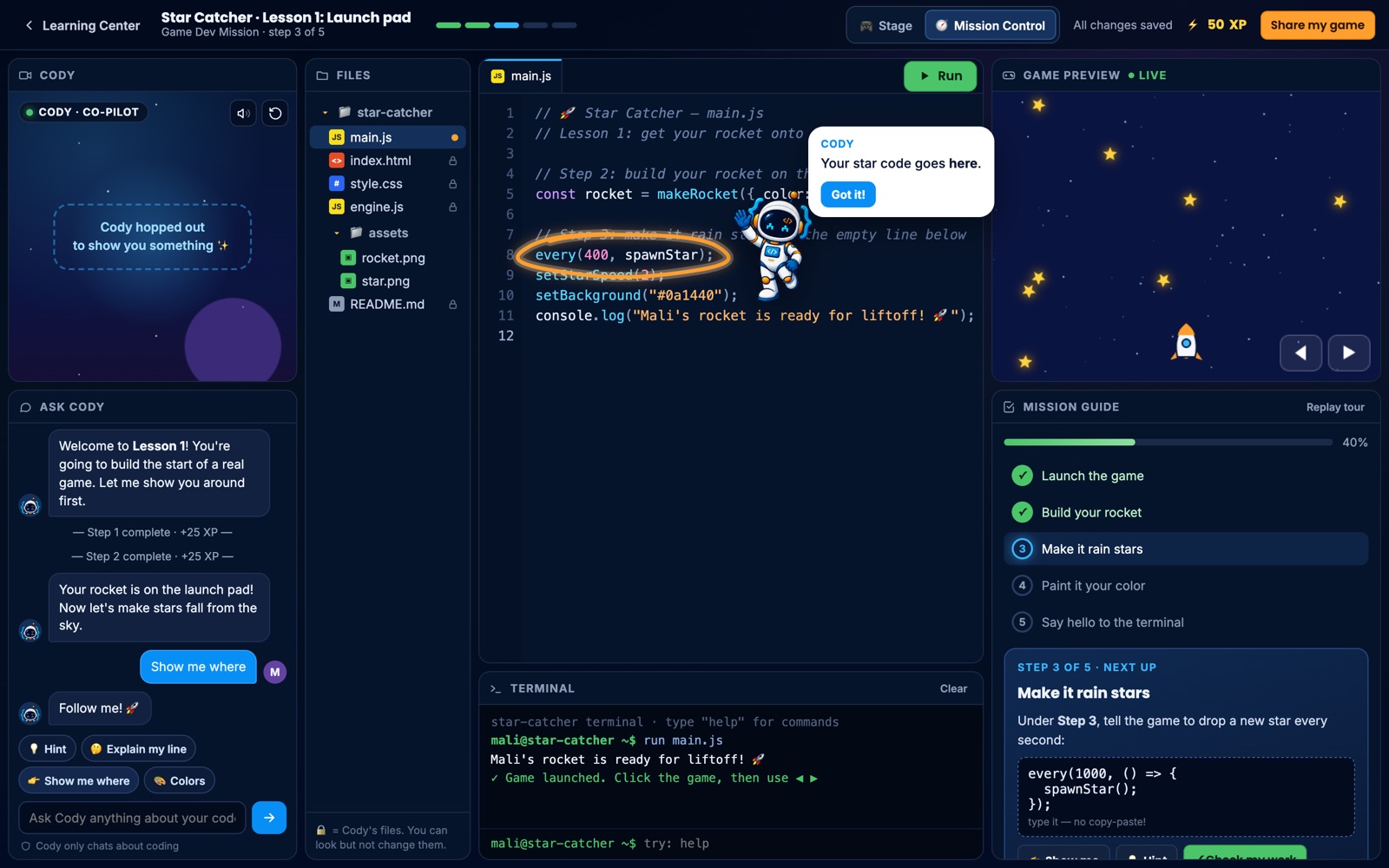
The testing and fixing start for real here. When he gets a line wrong, he watches the mistake happen in the game, which is often funny, and then Cody explains why it went that way. She offers hints instead of answers, points him to the line that needs another look, and helps less as he gets stronger. By the end he has put together an arcade game of his own, one piece at a time: arrow-key controls, a running score, sound effects, several levels and a boss he designed himself. There's nothing to install: he plays it in a web browser at his own pace, about two hours across the five episodes. You own the account behind a PIN-locked Parent Corner that shows you each step he takes. Cody talks only about coding, the game carries no ads, and nobody can chat with strangers in it. The whole mission is $29.99, paid once with nothing renewing, and his brothers and sisters can use it too.
Take a look at the mission: Star Catcher, the starship he'd rebuild with Cody, and the price of the whole thing.
See how Star Catcher worksQuestions parents also ask
Which jobs will be safest from AI by the time my kid grows up?
Nobody can name them with confidence. The World Economic Forum's 2025 report lists AI and big data as the fastest-growing skills, followed by networks and cybersecurity and technology literacy,1 but its forecast runs to 2030, when today's 10-year-old will still be in school. Bet on what carries from job to job: breaking a problem down, testing an idea, fixing what broke, and explaining his thinking to other people.
My son isn't a computer kid. Does any of this apply to him?
Yes, because the habits are the point and code is only the practice ground. A kid who loves animals, drawing or football still plans, tests and fixes; code just tells him fast and plainly whether his plan worked. Notice what he drifts toward, whether that's building things, people, stories or science, and give him early, hands-on experience of it alongside the daily reps.
Should my 10-year-old learn to use ChatGPT so he isn't left behind?
Not on his own. Under 13, a kid doesn't use a chatbot alone; if one comes in, it runs on your account with you beside him. The skill to build first is judging a machine's answer, and he learns that by writing and fixing his own work. The tools will look different by the time he's 13, and the checking habit will fit whatever they become.
How much time does this take each day?
Less than you'd expect. Twenty minutes of typed code on school nights, plus one real family job a week that he plans and runs, covers it. Short and steady works better than a long weekend session, because the habit grows from many small rounds of trying, checking and fixing. If he asks for more time, let him have it.
Was this answer helpful?
What was missing?
Sources
- The Future of Jobs Report 2025 (the World Economic Forum's digest, reprinted), World Economic Forum, reprinted by Hellenic Shipping News ↩
- How AI is reshaping how parents think about their kids' futures, Intuit Credit Karma (The Harris Poll), via Stacker ↩
- Computational Thinking (Jeannette Wing, Microsoft Research talk, February 9, 2015), Microsoft Research ↩
- Some Evidence on the Cognitive Benefits of Learning to Code (Scherer, Siddiq and Sánchez-Scherer, Frontiers in Psychology, 2021), Frontiers in Psychology, via PubMed Central ↩
Keep reading
More in AI and the future AIIs it still worth it for kids to learn coding now that AI can write code?Yes. AI now writes code in seconds, and a lot of it is almost right. In Stack Overflow's 2025 survey, the frustration developers cited most, at 66%, was "AI solutions that are almost right, but not quite".
 PotentialMy 9-year-old daughter wants to be a doctor. Should she learn to code?Yes. Medicine runs on software now, and she'll spend her working life inside it. In one study, family doctors spent nearly 6 hours of an 11.4-hour workday in the electronic health record.
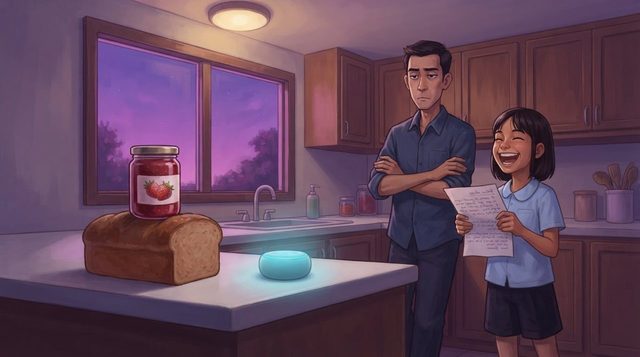 AIHow do I explain how AI works to my 9-year-old?Give your 9-year-old three plain ideas: a computer does exactly what it's told, AI is a program that learned to guess from millions of examples, and a person still directs it and checks its guesses.
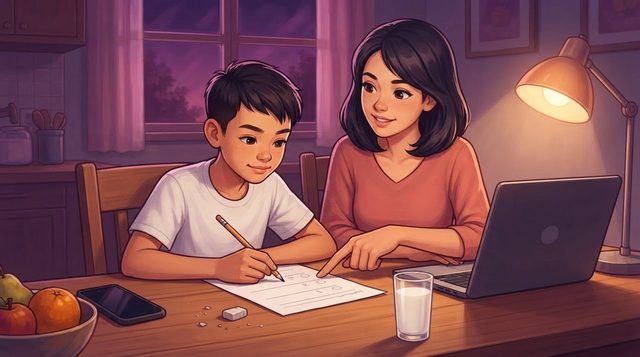 AII think my 11-year-old is letting AI do his homework, and he isn't learning anything.You're probably right, and it's fixable. In a Wharton-led study of nearly 1,000 high schoolers, students who practiced math with a plain chatbot scored 17% worse than classmates with no AI once it was gone.