Should kids use AI for homework?
Short answer
Only with you, and only for hints.
In a 2025 UK survey, 42% of children aged 9 to 17 who had used a chatbot had used it for schoolwork.1
Under 13, a kid shouldn't have an account of their own, so the chatbot is yours, you read it together, and the kid always writes the last step.
Why are so many parents worried about AI and homework right now?
Because the chatbot is already in the house, often before anyone decided it should be. It answers at the top of a search page, it lives on a big sibling's phone, and it turns up inside apps you already use. The worry tends to arrive in a parent's own words: I'm scared he's letting AI do his homework and isn't actually learning anything. There's usually a moment behind it. A book summary comes home in words your child never says out loud. A page of long division is done in the time it takes to heat up dinner. Ask about it and you hear that everyone uses it.
In Internet Matters' 2025 survey of UK children aged 9 to 17, 58% of those who had used a chatbot said they think using one is better than searching for themselves.1 So the real question at the kitchen table is what job AI is allowed to do.
At what age can kids use ChatGPT and other chatbots?
It depends on the chatbot, and for the two best known the answer at 8 to 12 is no. ChatGPT's terms set the minimum age at 13, and Common Sense Media's guide for parents says kids under 13 "should not use it at all".2 Anthropic's terms put Claude's minimum at 18.3 A 10-year-old with a personal ChatGPT or Claude account has borrowed someone's login or typed a fake birthday. Google's Gemini is the exception: a parent has to switch on access before a child under 13 can use it, through a supervised Family Link account.4
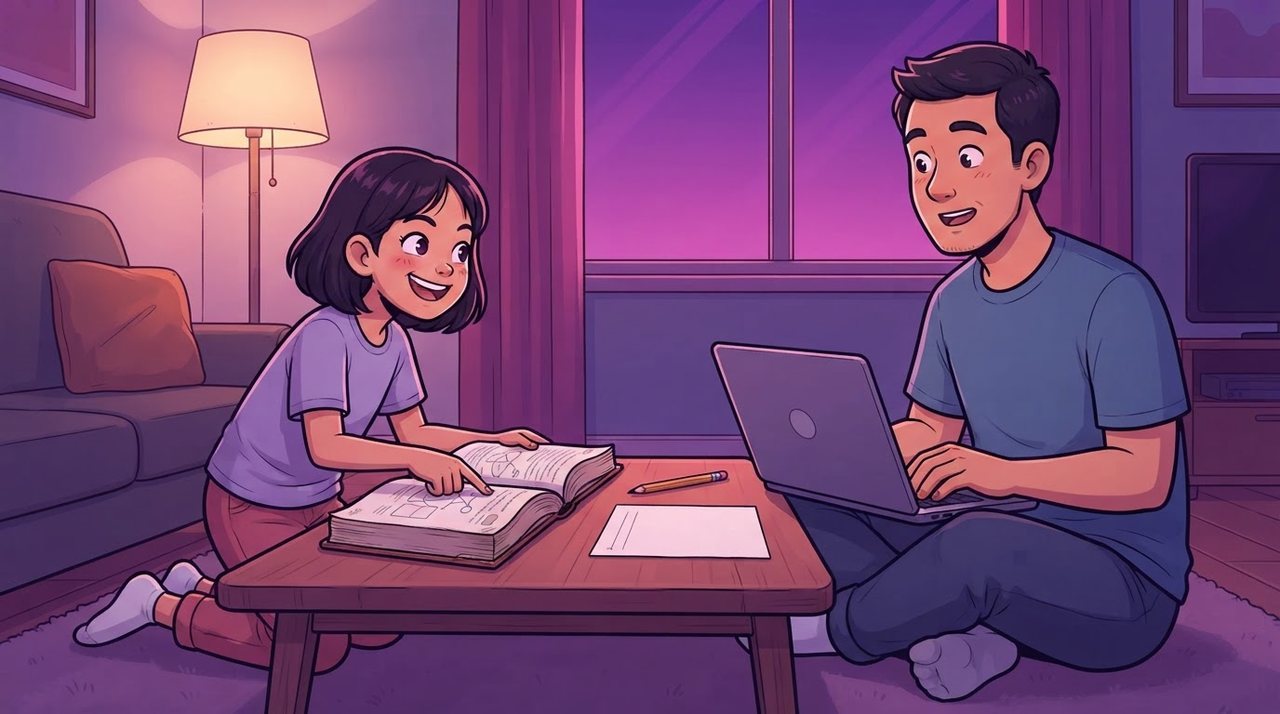
Whatever the chatbot allows, our rule for 8 to 12 is that AI homework help happens with a parent sitting beside the kid. That turns the question around for younger kids. "Should my kid use AI for homework?" becomes "should I use AI to help with my kid's homework, and how?" Our answer is yes, now and then, when the help is the right kind. Telling the right kind from the wrong kind is what the rest of this page is about.
What does AI-written homework cost a kid, and is there a way back?
They lose the practice, which is the whole reason homework exists. A handed-over answer skips the thinking and still looks finished on the page. Some homework is safe from a chatbot: it can't memorize spelling words or times tables for your child, and a painting still needs a brush. Writing and math are different, because a chatbot can produce both in seconds.
The clearest test of the cost so far ran with nearly 1,000 high school math students in Turkey, written up by Wharton in 2024.5 Students who had practiced with an ordinary chatbot scored 17% lower than classmates with no AI once it was taken away for the exam.5 The researchers' reading was that those students leaned on the software to solve problems and didn't learn the math underneath well enough for the exam.5
The same study also shows the way back: a third group used a chatbot built to guide them with hints rather than give answers, and they scored about the same on the exam as the no-AI group.5 The harm came from the answers, and a helper that holds the answer back avoided it. That's good news for any family, because what a helper gives is something a parent can control.
Where is the line between help and cheating, and what are schools saying?
The answer is where students come closest to calling it cheating. In RAND's survey of US students from middle school through college, published in March 2026, 45% said getting direct answers to homework counts as cheating, and nearly 80% said using AI to understand an assignment doesn't.6 Their schools mostly haven't drawn the line for them. Only about a third of those students said their school had a schoolwide policy, and many said the rules varied by teacher.6 Children in the UK survey said teachers' advice on AI could contradict itself.1
So waiting for the school's rule can mean waiting a long time. The strictest advice going around says no AI for schoolwork at all, and a stuck kid asks a person instead. That gets the danger right and stops short of a fix, because people hand over answers too. A classmate's finished worksheet photographed into the group chat, or a grandparent who writes out the sum neatly to save everyone time, skips the same practice a chatbot's answer does.
The rule we'd hold any helper to is short: hints first, and the kid takes the last step. An explanation, a smaller example, or a question that points at the mistake all count as help. The final number, the sentence that goes on the page and the fix belong to the kid. The rule works because a hint leaves a gap, and closing that gap is the practice homework was meant to give.
How do I set up AI homework help at home?
Start before anyone opens a chatbot, and keep the setup simple enough to last a school year.
- Find out each teacher's rule. Send one line: what is AI allowed for in this class, and what isn't? Rules can vary from teacher to teacher,6 so ask every one, and check the school's own policy if there is one.2
- Sort tonight's homework by kind. Memorizing is your kid's alone. Writing starts as their own draft before any helper sees it. Math starts with their own try on paper. A chatbot can only join after a real attempt.
- Use your own account, set to hints. Sit beside your kid at the family computer and read each reply out loud together. ChatGPT's study mode is a drop-down option designed to encourage learning rather than hand over answers,7 and you can set it to your kid's grade and subject.7 Ordinary ChatGPT stays one click away, so choosing study mode each time is your job.7
- Ask for a cousin of the problem. Instead of the homework question itself, type something like
Give me one problem like this with different numbers, and explain only the first step.For writing, tryAsk a 10-year-old three questions about her paragraph. Don't rewrite any of it.Your kid works the cousin, then goes back to their own page. - Make catching the chatbot a game. Chatbots can be wrong in a confident voice. Once a week, have your kid check one AI answer against the textbook or class notes, and keep score of every mistake they find. Most parents in the UK survey hadn't had that talk: only 34% had talked with their child about judging whether AI content is true.1
- Hold yourself to the same rule. When you're the helper, start with "show me where it went wrong," offer one nudge, and wait while they finish it. Then ask your kid where they think the line between help and cheating sits. That way the rule is partly theirs.
What does the hint rule look like on a writing assignment?
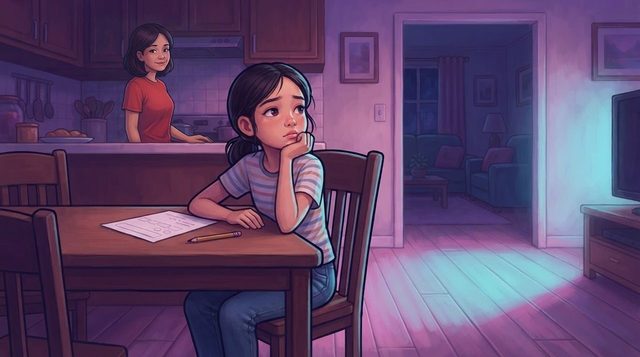
The evening below is invented, an example of the rule on the homework a chatbot finishes fastest: writing. A ten-year-old girl has to write one paragraph on why the boy in her class novel runs away from home. She would like the chatbot to write it. Her dad tells her the chatbot is his, and tonight it can ask her questions but can't write a word of her paragraph.
She writes three messy sentences by hand first. Then her dad opens his account and types: Ask a 10-year-old three questions about why a character might run away. Don't write any of her paragraph. The first question asks what the boy was afraid of. She knows, and says it before her dad finishes reading it aloud. The second asks what happened just before he left, so she flips back to chapter four to check. Her dad closes the laptop, and she rewrites the paragraph with a reason and a detail from the book in it.
On Friday the paragraph comes back with one spelling mistake circled in red. Every sentence around that circle is hers, and she can still tell you what happened in chapter four.
Where can a kid this age get hints-first help without a chatbot?
In Codestronauts, made for kids 8–12, the years before ChatGPT and Claude let a kid in. Its helper offers a hint where a chatbot would offer the answer. Its first mission is Star Catcher, and there the helper is Cody, a fully voiced robot co-pilot who only talks about coding. She points at the line that's wrong and leaves the fixing to the kid, and her help fades as the kid gets stronger.
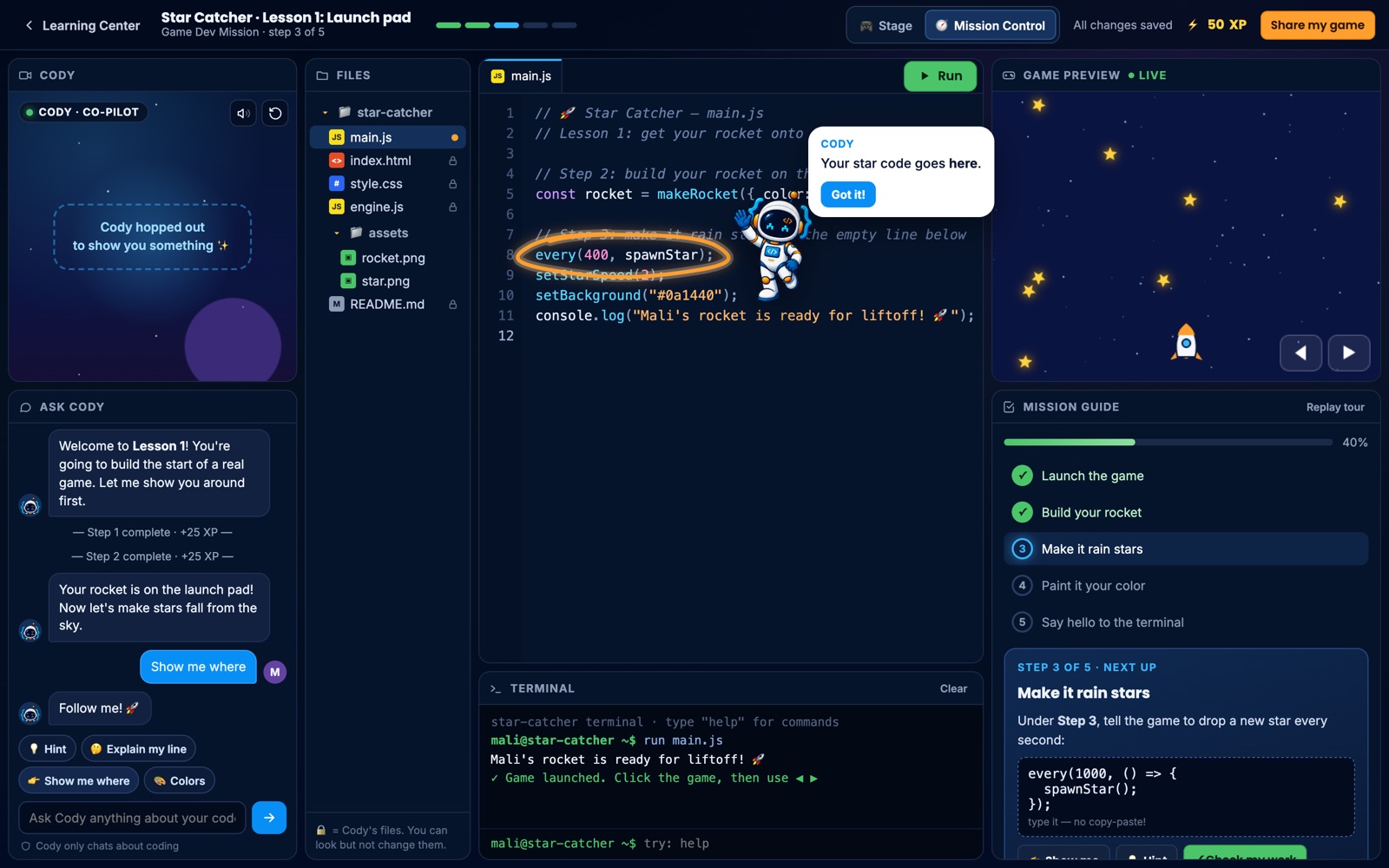
Episode 1 opens with a single press of Run on code already waiting on screen, and that wakes Cody up. From then on the kid types real JavaScript, never drag-and-drop blocks, and the very first line they type builds the ship. A wrong line plays out wrong on the viewscreen before Cody explains why, and each new word gets its explanation right after the kid has watched it work. Every line moves the story forward, and with a cliffhanger closing each episode, the next step is one the kid wants to take. Five episodes and about two hours later, they've built an arcade game with levels, a score and a final boss they designed themselves.
The account is yours. Its Parent Corner opens only with your PIN and lets you see each step your kid takes and each time they sign in, and the course has no ads and no way to chat with strangers. It runs in a web browser with nothing to set up. You pay $29.99 one time for all five episodes, with no subscription behind it.
Take a look at Star Catcher: the mission, its ship and Cody's hints at work.
See how Star Catcher worksQuestions parents also ask
Can my child use the AI tools the school provides?
Follow the school's rules for those at school. At home, sit beside your kid while they use one, ask the teacher what it's meant for, and keep the same order: your kid tries first, the tool explains or hints, and your kid writes the final answer.
Is it OK to use AI to check finished homework?
It's one of the better uses, done the right way. Once your kid has finished, ask the chatbot on your account which problem has a mistake, without the fix. Your kid finds the error and corrects it. Chatbots get things wrong too, so when the chatbot and the textbook disagree, the textbook wins.
When can a child get their own AI account?
It depends on the chatbot. ChatGPT's minimum is 13, and anyone under 18 needs a parent's or guardian's permission to make an account.2 Claude's is 18. Gemini lets a parent turn on access for a child under 13 through Google's Family Link app.4 Whichever one your family uses, at 8 to 12 the help happens with you beside them.
What about spell-check and grammar tools?
Let your kid write the sentence first. A tool that underlines a misspelled word and leaves the fixing to them works as a hint. A tool that rewrites the whole sentence has done the writing, so switch that feature off for homework or skip it.
Will my kid fall behind if they don't use AI now?
We'd bet on the kid who can read closely, work a problem through and write a clear sentence, because that kid can tell when the AI is wrong. Using it with you now, for hints, builds the habit that matters: thinking first and checking what the machine says.
Was this answer helpful?
What was missing?
Sources
- New report reveals how risky and unchecked AI chatbots are the new 'go to' for millions of children, Internet Matters ↩
- Guide to ChatGPT for Parents and Caregivers, Common Sense Media ↩
- Consumer Terms of Service, Anthropic ↩
- Guide your child's Gemini Apps experience, Google (Gemini Apps Help) ↩
- Without Guardrails, Generative AI Can Harm Education, Knowledge at Wharton (The Wharton School, University of Pennsylvania) ↩
- Student Use of AI for Homework Rises as Concerns Grow About Critical Thinking Skills, RAND ↩
- Parents' Ultimate Guide to ChatGPT Study Mode, Common Sense Media ↩
Keep reading
More in AI and the future AIIs it still worth it for kids to learn coding now that AI can write code?Yes. AI now writes code in seconds, and a lot of it is almost right. In Stack Overflow's 2025 survey, the frustration developers cited most, at 66%, was "AI solutions that are almost right, but not quite".
 AICan kids use ChatGPT?No. OpenAI sets ChatGPT's minimum age at 13, and Common Sense Media's advice for anyone younger is that they "should not use it at all". Yet ChatGPT answers anyone who opens it, without a sign-in or an age.
 AIHow do I explain how AI works to my 9-year-old?Give your 9-year-old three plain ideas: a computer does exactly what it's told, AI is a program that learned to guess from millions of examples, and a person still directs it and checks its guesses.
 ConfidenceMy 10-year-old can binge a whole series in a weekend but can't focus on homework for 20 minutes. Why?Because a series is built to keep kids watching, and homework isn't. Every episode ends on an open question and the next one starts by itself.