I think my 11-year-old is letting AI do his homework, and he isn't learning anything.
Short answer
You're probably right, and it's fixable.
In a Wharton-led study of nearly 1,000 high schoolers, students who practiced math with a plain chatbot scored 17% worse than classmates with no AI once it was gone.1
A hint-giving version avoided the drop. So the rule for any helper is hints first, and he takes the last step.
How can I tell whether AI is doing his homework?
Usually by homework that got fast and right at the same time. The page of fraction word problems that used to mean an hour of sighing at the kitchen table is done before dinner, every answer correct, in his own handwriting. You ask how he got number four and he says "I just did it," already halfway back to his phone. Later you find the chatbot still open on the laptop, or in the history on his phone.
That gap between the work and what he can explain is the sign teachers watch for too. An AI detector won't settle it, and a sudden change in his writing style isn't proof on its own. At 11 he's also under the age line: ChatGPT requires users to be at least 13 to make an account,2 so if he's chatting with one by himself, he's on someone else's account or he got past the age question.
Why does it feel like he's learning when he isn't?
Because reading a right answer feels a lot like knowing it, for him and for you. In that Wharton-led study, students with a plain chatbot did 48% better than their classmates on the practice problems, then 17% worse on the exam without it.1 They also came out overly optimistic about how much they'd learned, high achievers included.1 The homework looked like progress the whole time.
Teenagers say as much about themselves. In Common Sense Media's August 2026 survey of US teens, 63% of those who use AI for schoolwork said they get answers from it, and 39% said they feel they're missing out on learning when AI completes their assignments.3 Which leaves the question that matters for your son: the chatbot that hurt and the one that didn't were both chat windows on the same kind of AI,1 so what made the difference?
What does he lose if it keeps going, and can it be undone?
He loses the part of homework that does the teaching. Fifth- and sixth-grade math stacks: fractions turn into ratios and percentages, and those turn into the algebra waiting in middle school. Every answer he copies is a skill he'll be missing the next time it's needed, at a test desk with no chatbot. He can look on track for a whole term and find out at the first test he takes alone.
It can be undone, because the harm came from one habit. The same study gave another group a chatbot built to guide students with hints rather than hand over answers.1 They did 127% better on practice and scored about the same as the no-AI group on the exam.1 Take away the handed-over answer and the drop goes with it.
Why haven't taking the laptop or checking his answers worked?
Because each of those fixes checks whether the answers are right, and what matters is who got there. Bans mostly move the chatbot somewhere you can't see it: in Common Sense Media's survey, 44% of teens who use AI for schoolwork had had a tool blocked on a school network or device, and 59% of those simply switched to a personal device.3 Checking his work can't catch it, because a chatbot's answers are the tidy part. The cheating talk misses him too. He doesn't feel like a cheat, because it felt like understanding while he was doing it.
What works is help built to hold something back. England's Department for Education has written it into its standards for AI learning tools: they shouldn't "provide final answers, full solutions, or complete worked examples by default," they should start "with hints or partial steps," and they should "only show a full solution after a genuine learner attempt".4 That rule fits every helper, you included: a tutor, an older sister, a dad who's good at fractions. The other half of the fix is time when the helper goes quiet, so he finds out what he can do alone before a test tells him.
What can I do about it tonight?
Start with a check, then change where and how the help happens. None of it needs you to know the math.
- Run the closed-laptop check, kindly. Pick one answer from tonight's homework and ask him to walk you through it with the chatbot closed. Then write the same problem with new numbers and let him try it on paper. If he can do it, the AI was a helper. If he can't, it did the work, and now you both know. Tell him first that you're not out to catch him: you want to see what he can do alone, because that's what the test will see.
- Move the help into the open. ChatGPT's terms set the minimum age at 13,2 so his own access ends, and the help moves to your account at the kitchen table, where you read every reply together. He loses a secret tool but keeps the help, so he has far less reason to go hunting for it on another device.
- Switch it to hints before he sees it. In ChatGPT, turn on study mode from the Tools menu, and instead of answering it "breaks down problems into steps, responds with questions".2 Or open every homework chat with a line like
He's 11. Never give the final answer. Give one hint at a time, then wait for him to try. - He takes the last step. The final number, word or sentence is always his, in pencil on his own page. The order of help is his own try, then a small hint, then a bigger one. If he's still stuck after two hints, he stars the question for his teacher and moves on.
- Keep explaining on the table. A simpler explanation of what a ratio is, or a practice problem like the one he missed, counts as help. The answer to number six is a shortcut. Say that line out loud so you both know where it is. And teach him to check what the chatbot says, because it sounds just as sure when it's wrong: ChatGPT "is known to spit out false information known as hallucinations," as the Wharton write-up puts it.1 If a hint says ten percent of 80 is 8, he multiplies it back before he builds on it.
- Talk to his teacher, and set one privacy rule. Ask what the class allows AI for and how his in-class quizzes are going. At home, agree on what never goes into a chatbot: his full name, school, address, photos, passwords and private worries.
What does an evening on the new rule look like?
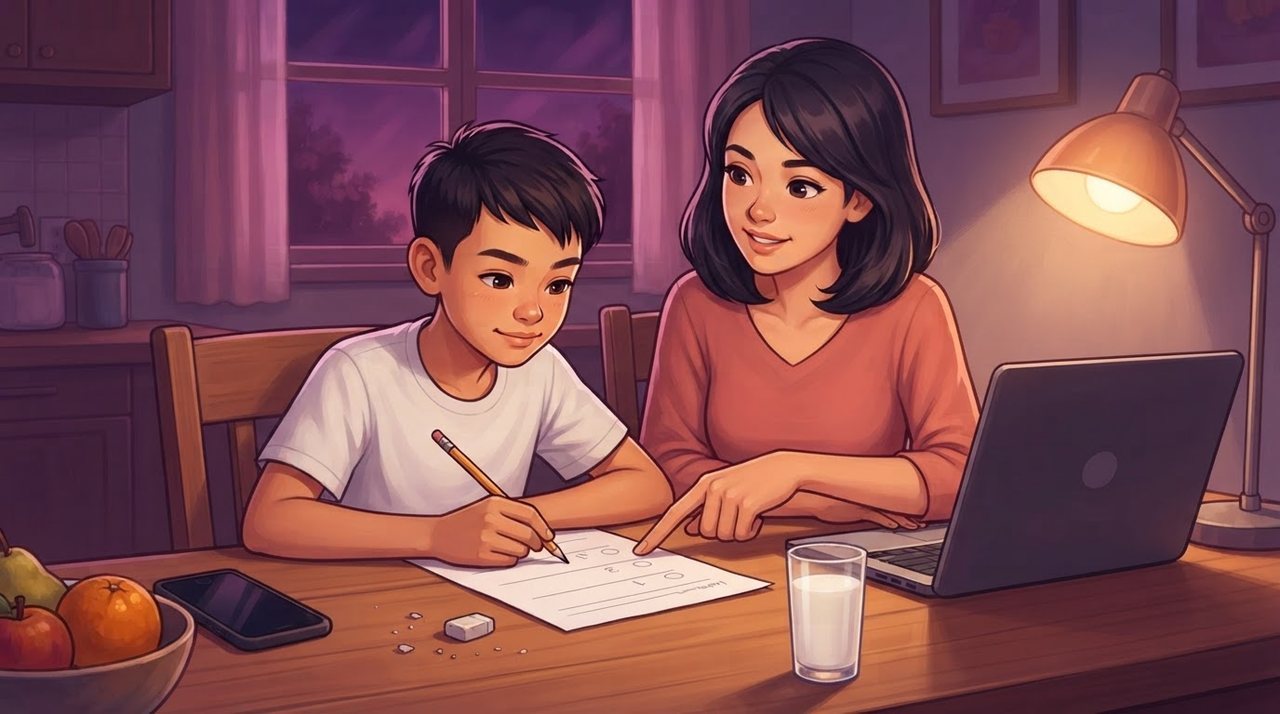
Here's an invented one, to make the rule concrete. An 11-year-old has ten percentage problems and wants to be done before game night. His phone is parked in the fruit bowl, and his mom's laptop sits closed beside her at the kitchen table. He tries problem three, fifteen percent of 80, on paper first, writes a guess he knows is wrong and erases it. Only then does she open the chatbot on her own account, set to hints only, and type the problem in. The reply asks what ten percent of 80 would be. He knows that one, 8. It asks about five percent. He gets 4 after a second and then, before anyone asks, writes 12 on his page. That last step was his, and it's the one that sticks.
Problem seven still beats him after his own try and two hints, so he stars it for his teacher. The whole sheet takes longer than the old way did. By the third night he's getting through most problems before the laptop opens at all, because waiting for a hint is slower than thinking it through himself.
What if his screen time ran on the same rule?
That rule, hints first and the last step his, is how Codestronauts is built. In Star Catcher, our first mission for kids 8–12, he types real JavaScript to wake a nervous robot named Cody and rebuild a starship. When a line is wrong he watches the mistake happen, often as something silly on the viewscreen, and Cody tells him what caused it. She gives hints, not answers, and points to the right line, then leaves the typing to him. Her help fades as he gets better. In Episode 4, Radio Silence, her voice is gone and bringing it back is up to him, so the story itself hands him the stretch where the helper goes quiet.
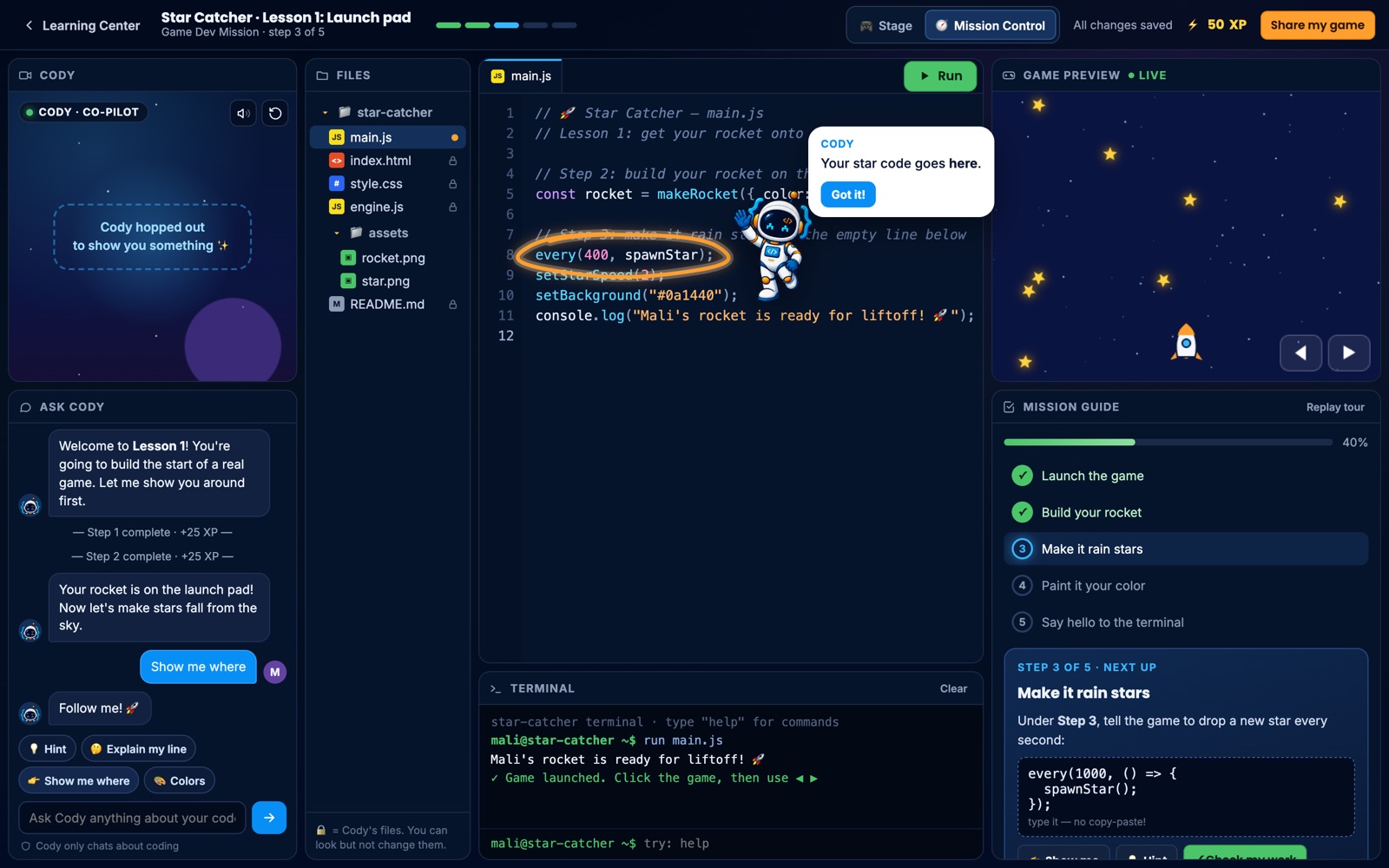
The five episodes, roughly two hours of play, end with an arcade game he built himself. He steers it with the arrow keys, it keeps score, it has levels and sound, and the final boss is one he designed. Nobody can hand him that. The account is yours, its Parent Corner locked with your PIN, and you can see every step he takes. Cody only talks about coding, and there are no ads and no strangers to chat with. He plays it straight from the family computer's web browser, so there's nothing to install. One payment of $29.99 buys the whole mission.
See Star Catcher, where every fix is one he types himself.
See how Star Catcher worksQuestions parents also ask
Is it cheating if my 11-year-old uses AI for homework?
It depends on what his teacher allows and what the AI did. A simpler explanation of a topic or an extra practice problem is help most teachers welcome. Copying or rewording its answers and handing them in as his own is a shortcut many schools treat as cheating. At 11 there's a step before both: ChatGPT is for users 13 and up,2 so any chatbot help comes from your account, with you reading along.
Can an AI detector tell me whether he used ChatGPT?
Not well enough to accuse a child over. Teachers don't rely on detection software alone, and a change in writing style isn't proof either. The closed-laptop check tells you more: if he can walk you through an answer and then solve a fresh one like it, the learning happened.
He says everyone in his class uses ChatGPT. What do I tell him?
That plenty of older kids do, and many of them don't love what it does to their thinking. In Common Sense Media's survey, 70% of teens use AI for schoolwork, and 38% of those users say it leaves them with fewer ideas of their own.3 Then the plain part: it's made for teenagers and grown-ups, so for now it's yours, and he's welcome to it at the table in hint mode.
Should I just sit and do the homework with him instead?
Sit with him, and leave the doing to him. The same rule binds you: ask what he's tried, give the smallest hint that gets him moving, and let him write the last step. If you don't know the method, look it up yourself and turn it into a question for him. An answer from a tired parent at bedtime skips the same practice a chatbot's answer does.
What if he uses AI on a school laptop or at a friend's house?
You can't watch every screen he touches, so make the check travel instead. Do the closed-laptop check at home a few nights a week, and ask his teacher what the class allows. A kid who knows he'll be asked to explain his answers has a reason to do the thinking wherever he is.
Was this answer helpful?
What was missing?
Sources
- Without Guardrails, Generative AI Can Harm Education, Knowledge at Wharton (The Wharton School, University of Pennsylvania) ↩
- Parents' Ultimate Guide to ChatGPT Study Mode, Common Sense Media ↩
- Teens Who Use AI for Schoolwork Are Handing Off Critical Thinking, Common Sense Media Research Finds, Common Sense Media ↩
- Generative AI: product safety standards, UK Department for Education ↩
Keep reading
More in AI and the future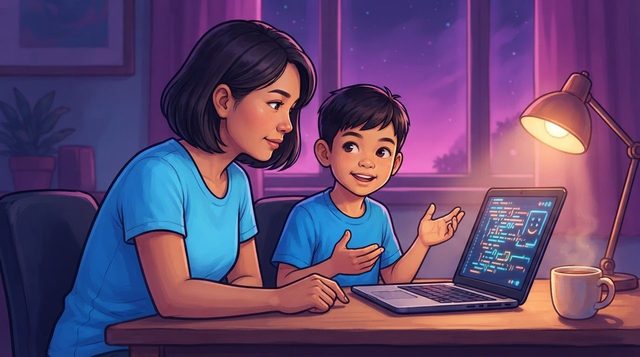 CodingI'm not technical. How can I help my child learn to code?You can help without knowing any code. Let a good course do the teaching and make yourself the audience: ask your child to show you how their program works, and praise the effort.
 AICan kids use ChatGPT?No. OpenAI sets ChatGPT's minimum age at 13, and Common Sense Media's advice for anyone younger is that they "should not use it at all". Yet ChatGPT answers anyone who opens it, without a sign-in or an age.
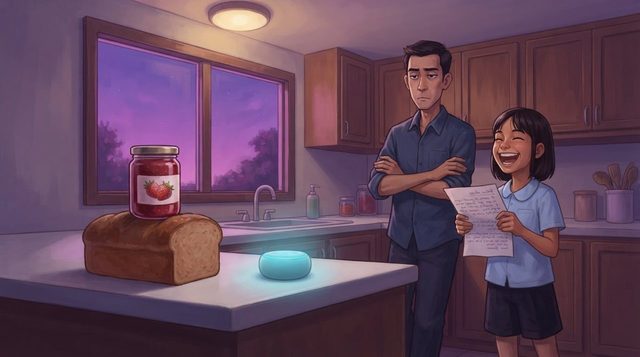 AIHow do I explain how AI works to my 9-year-old?Give your 9-year-old three plain ideas: a computer does exactly what it's told, AI is a program that learned to guess from millions of examples, and a person still directs it and checks its guesses.
 SchoolMy 11-year-old memorises everything for tests but can't explain any of it. How do I help?Ask him to explain, predict and build, because memorising works until a question changes shape.