My 11-year-old memorises everything for tests but can't explain any of it. How do I help?
Short answer
Ask him to explain, predict and build, because memorising works until a question changes shape.
In the OECD's PISA 2012 maths test, students who mainly memorised were much less likely to solve the hardest question than students who connected ideas.1 Turn his flashcards into why-questions, let him teach you, and give him one subject only understanding can pass.

How can I tell he's memorising without understanding?
You see a kid who is ready for the test and lost one question past it. Sunday night, science test tomorrow. He has the water cycle word-perfect: evaporation, condensation, precipitation, each definition in the textbook's order. On Monday he brings home 18 out of 20. Then the bathroom mirror fogs up after his shower, you ask him why, and he recites the definition of condensation again, same words, same order, without ever arriving at the mirror.
Maths goes the same way. He knows that to divide by a fraction you flip it and multiply, and he gets all twenty sums on the worksheet right. Ask him why 6 divided by a half comes out as 12, a bigger number than he started with, and he looks at you as if the question is unfair.
His grades say he's doing fine, and so does his teacher. You're the one who has watched him go quiet at why, and you're left with the thought this page is about: he can memorise anything for a test, but you're not sure he understands any of it.
Does memorising matter if his marks are good?
Not on easy questions, which is exactly why good marks can hide it. The OECD studied how the 15-year-olds who sat the PISA 2012 maths test said they learn. On one of its easiest items, a simple bar chart that 87% of students answered correctly, students who learned by heart did about as well as everyone else.1 On the hardest question in the test, which only 3% of students solved, the ones who mainly memorised were much less likely to get it right than students who connected ideas or worked out what was important to learn.1 The OECD's analyst, Alfonso Echazarra, put it in six words: "Sooner or later, the method matters."1
Learning by heart is also a habit, and habits differ by place. In the same survey, 29% of students in the United States said they learn as much as they can by heart when they study maths, against 12% in Japan and 5% in Viet Nam,1 the very school systems people assume run on rote. Kids pick the method up from how they're taught and tested, so they can pick up another one. The harder part is that the kid doing it usually believes he understands.
Why does he think he understands it, and can that be fixed?
Because a fact you can recall feels exactly like a thing you understand, and grown-ups fall for it too. In Leonid Rozenblit and Frank Keil's studies at Yale, people rated how well they understood everyday things such as a zipper, a flush toilet and a speedometer, then had to write a step-by-step explanation of how each one works.2 Nearly all of them marked themselves down once they faced a real explanation.2 The illusion was far stronger for explanations than for facts or procedures,2 and the authors' reason fits your son well: checking whether you know a fact is trivially simple, while testing yourself on an explanation is hard.2 He knows he knows the definition. Nothing has ever made him find out whether he knows the why.
Left alone, the gap costs him most when school changes gear, from one-step questions to word problems, experiments and essays that ask him to use what he knows somewhere new. That is when a kid with top marks starts to feel he has suddenly got worse.
It is fixable, and the same study shows where the fix starts: the feeling of understanding gave way as soon as people had to explain.2 His memorising isn't wasted either. The OECD notes it gives students concrete facts to reflect on,1 so his memory becomes the raw material and the understanding gets built on top of it.
Why haven't more studying, flashcards or a tutor helped?
Most of them train the part he's already good at. More time with his notes usually means rereading them, and when John Dunlosky's team at Kent State reviewed the evidence on ten common study techniques, rereading and highlighting didn't show much promise.3 Flashcards are better: quizzing yourself was one of the two techniques rated highest.3 But a card with condensation on the front and the definition on the back trains recall, and recall was never his trouble. A tutor drilling past papers does the same thing at a higher price. Explaining it to him yourself feels like progress while he nods along, and that nod is the illusion again, running on your explanation this time.
What works is a task where the answer can't be recalled, only worked out. He has to predict what will happen before he checks, explain it to someone who doesn't know, or make something that fails when his thinking is wrong. Making is the strongest of the three, because the thing he makes gives its verdict without a teacher marking it: a paper plane folded from a half-remembered diagram nosedives in front of him.
Code is the cleanest case of all. A program only does what he meant when the thinking behind it is right, which makes it one of the few subjects where memorising can't stand in for understanding. Copy a line he doesn't understand into the wrong place and the screen shows him exactly what he told the computer to do, which is rarely what he meant.
What can I do tonight so he understands, not just memorises?
Take whatever he's studying this week and ask questions his memory can't answer for him. None of these needs you to know the subject better than he does.
- Change one thing in the question. If he knows 6 ÷ ½ = 12, ask him to guess 6 ÷ ¼ before he works it out. A kid who understands says "bigger again, 24." A kid who memorised reaches for the rule and starts flipping. Then ask him to get the answer a second way, by drawing it or counting halves, and see whether both roads arrive at the same place.
- Move the fact into your house. Why does a cold glass sweat on a hot afternoon? Where do the puddles go after the rain stops? If he can find this week's textbook fact in the kitchen or on the street, he owns it.
- Be the student. Ask him to teach you the topic as if you missed the lesson, and keep asking "why?" until he says "I don't know." That spot is where tonight's studying should start, and finding it is good news.
- Give his flashcards a second back. Keep the cards, because the quizzing works, and add a line to each: an example from real life, or what would happen if it weren't true.
- Ask again in three days. Spreading study out over time was the other top-rated technique in Dunlosky's review,3 and a fact he can still explain in his own words on Thursday is a fact he has learned.
- Give him one thing to make that pushes back. A recipe to halve, a paper plane to send further, a short program to write. Pick anything where the result, rather than you, tells him whether his idea was right.
Keep it curious. You're asking because his answer interests you, and he'll hear the difference between that and a pop quiz.
How does a kid who memorises start to understand?
Here is how it can go, with an invented boy we'll call Krit, eleven, who learns everything the night before and gets it all right. His dad asks him why 6 divided by a half is 12. Krit says the rule. His dad hands him a six-metre ribbon (any string will do), a tape measure and scissors, and asks how many half-metre pieces he can cut. Krit cuts, counts twelve, and stops. "So dividing by a half means how many halves fit." Before anyone asks, he says 6 divided by a quarter must be 24, and he checks it with the rule afterwards, the right way round.
On Thursday his dad asks again, with no ribbon in sight, and Krit explains it in his own words. The next science chapter goes onto flashcards with a second back, and the mirror question gets an answer that mentions the mirror. His marks barely move, because they were already good. Now he works a problem out first and uses the rule to check it.
Where does Codestronauts fit for a kid who memorises?
Codestronauts is a story you code your way through, for kids aged 8 to 12, which makes it a whole course in one of the few subjects memory can't fake. In Star Catcher, its opening mission, your son types real JavaScript, letter by letter rather than dragging blocks, and the very first line he writes builds his ship. From there every line pushes a story forward, as he and Cody, a nervous, voiced robot co-pilot, rebuild the Star Catcher and set out to bring the Great Beacon back to life.
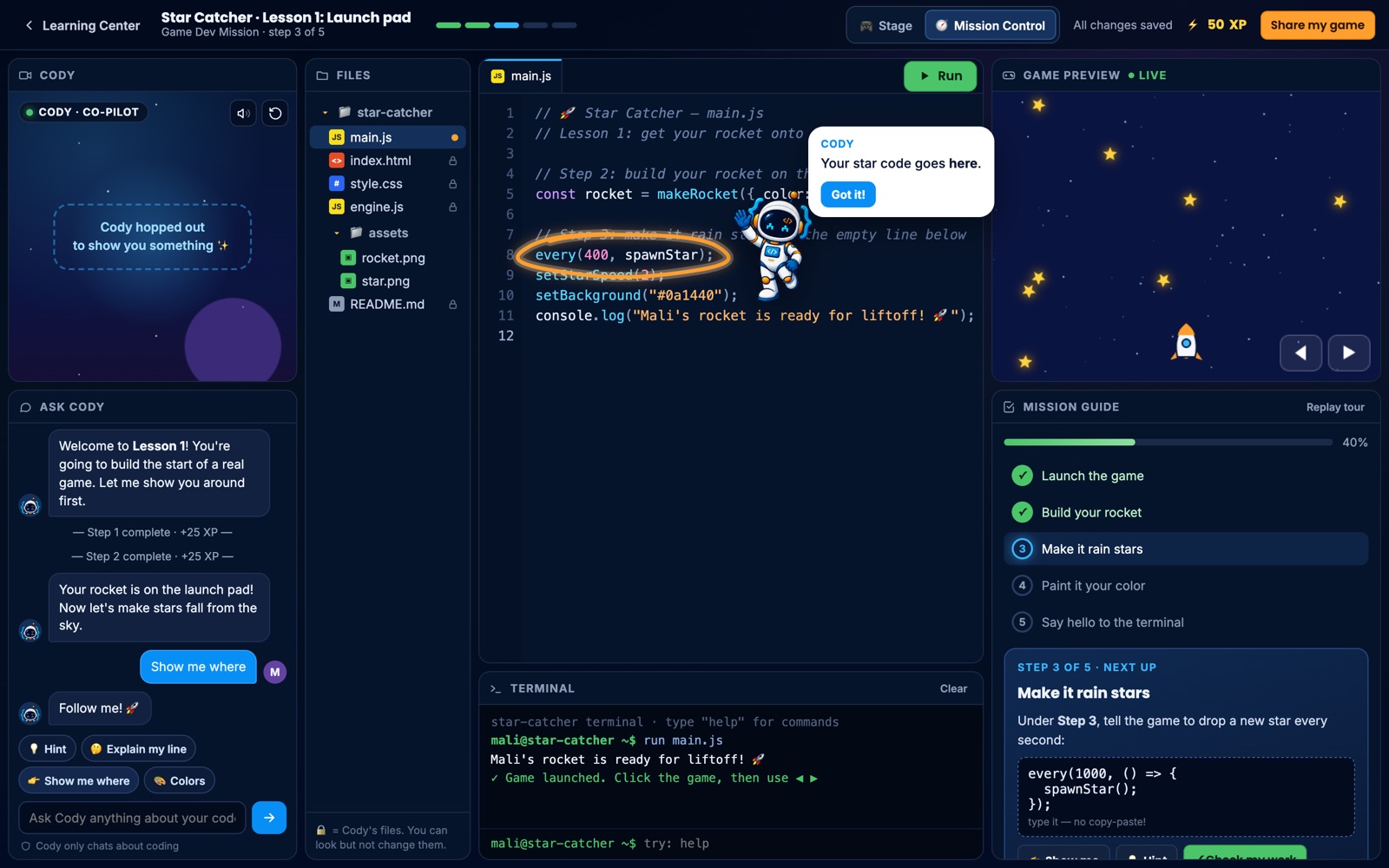
He could memorise that -= sends the ship left, but he only gets it moving right by understanding what x is. Get a line wrong and the ship carries out exactly what he typed, which tends to be funny, before Cody explains what happened. Each new word gets explained just after he has watched it work, so the why arrives with the fact. She starts with hints, and if he's still stuck her final one spells the line out for him to type himself; she helps less as he gets better. Five episodes and roughly two hours later, at whatever pace suits him, he has an arcade game he built himself: he steers it by arrow key, it keeps score across its levels, it has sound effects, and its boss is his own design. The whole of Star Catcher, all five episodes, is one payment of $29.99. Nothing renews. Every step he takes shows in the Parent Corner, behind a PIN only you know.
Give his memory a subject it can't bluff: all five episodes of Star Catcher, ending in an arcade game he builds himself, for one payment.
Get Star Catcher · $29.99Questions parents also ask
Is memorising bad for kids?
No. Times tables, spellings and vocabulary should be automatic, and the OECD notes that memorising gives students concrete facts to reflect on and can ease anxiety by turning maths into simple rules.1 The trouble starts when memorising is the whole method. Keep the recall and add one why-question every time he revises.
How can I tell whether my child understands something or just memorised it?
Ask him to use it somewhere new. Change a number, move the fact into your kitchen, or ask what would happen if it weren't true. Understanding bends to fit the new version, while a memorised answer repeats the old one word for word. A kid who says "I'm not sure, but I think…" and reasons his way there is understanding, even when he lands on the wrong answer.
Should I talk to his teacher about it?
Yes, as a partner. Tell the teacher what you've noticed at home and ask whether homework or tests could include a few why-questions, or a chance for him to explain an answer out loud. If he can't explain things in any subject, or the wording of questions keeps tripping him up, mention that too: vocabulary gaps and learning differences can look like rote learning.
Can learning to code help a kid who only memorises?
It gives him one subject where he can't skip the understanding. A program does what its lines say, so to make it do what he wants he has to know what each line means. When a line doesn't mean what he thought, the screen shows him straight away, with no test day needed to find out. Pair it with the questions above for his school subjects.
Was this answer helpful?
What was missing?
Sources
- Learning by heart may not be best for your mind, OECD Education and Skills Today (Alfonso Echazarra, OECD analyst, 2016), on PISA in Focus No. 61 ↩
- The misunderstood limits of folk science: an illusion of explanatory depth, Leonid Rozenblit and Frank Keil, Yale University, Cognitive Science (2002), PubMed Central ↩
- Which Study Strategies Make the Grade?, Association for Psychological Science (2013), on Dunlosky et al., Psychological Science in the Public Interest ↩
Keep reading
More in School and learning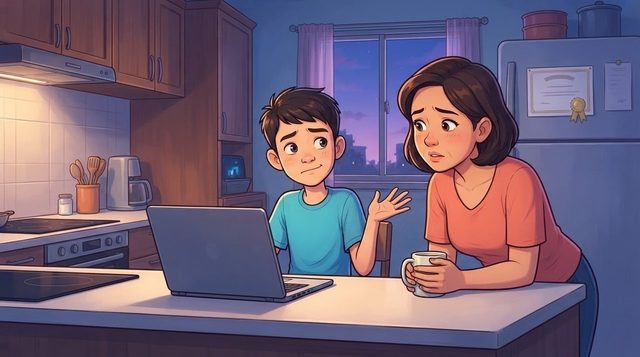 Coding“My son can tell me what he clicked in coding class, but not why. I can't tell if he's learning anything.”Ask him to explain one line he wrote: what it does, and why it's there. If he can, he's learning. If he can only retrace the clicks, he's following steps.
 AII think my 11-year-old is letting AI do his homework, and he isn't learning anything.You're probably right, and it's fixable. In a Wharton-led study of nearly 1,000 high schoolers, students who practiced math with a plain chatbot scored 17% worse than classmates with no AI once it was gone.
 SchoolMy child hates math. What can I do?Start by finding which part he hates: the speed, a gap from an earlier year, or the fear of being wrong. Then give math a job he cares about, through games, cooking, money or code.
 School“We live in Bangkok, and I want my child ready to compete with kids from every country.”Give them a few things that count in any country: English they use for real, a belief that effort pays, and a skill judged the same everywhere, like code.