My child hates math. What can I do?
Short answer
Start by finding which part he hates: the speed, a gap from an earlier year, or the fear of being wrong.
Then give math a job he cares about, through games, cooking, money or code. In a 2018 Stanford study of children aged 7 to 10, attitude toward math added as much to achievement as IQ did.1

Why does homework end in "I hate math" every night?
Usually because the worksheet is where he feels slowest. It's Tuesday, forty division problems, and he's been on the fourth for ten minutes. The eraser has worn a grey patch into the paper. Then the pencil goes down: "I hate math. I'm just bad at it." The second sentence is the one that stays with you, because it sounds like a decision he's made about himself.
Few kids who say it mean the numbers. They mean feeling lost while everyone else gets it, racing a timer, or being stuck on fractions after the class moved on. The same boy may know exactly how many coins he's short of the next upgrade in his game. That's math too, and nobody grades it.
If he hates math, does that mean he's bad at it?
No, and the evidence points somewhere hopeful. In 2018, Stanford researchers gave questionnaires and math tests to 240 children aged 7 to 10.1 Even with IQ and other factors accounted for, a positive attitude toward math still predicted which children did better.1 The lead author, Lang Chen, said the unique contribution of attitude to math achievement was as large as the contribution from IQ.1
The same study found the flip side: children with poor attitudes toward math rarely performed well.1 Chen described attitude and success as feeding each other, a good attitude opening the door to achievement and achievement improving the attitude, and said it can probably run the other way too, as a vicious circle.1 So "I hate math" tells you less about his brain than about which circle he's in. The work is moving him into the other one.
What happens if nothing changes, and when should I talk to the teacher or a doctor?
Left alone, the circle tightens. A kid who has decided he's bad at math stops trying the hard problem, so his practice and his confidence shrink together, right where he needs both. Math stacks, so a wall at long division or fractions turns up again every year after.
This is very fixable between 8 and 12, mostly at home, in how math feels. Check two things on the way.
Ask the teacher whether it's one gap or everything. A kid who was fine until one topic has a gap, and gaps can be filled. If it's every topic, every year, ask whether something more is going on. With dyscalculia, a learning disorder in math, teachers and parents are usually the first to notice the symptoms.2
Know the signs of dyscalculia. Experts estimate it affects between 3% and 7% of people worldwide.2 In school-age children, Cleveland Clinic lists signs such as counting on fingers with small numbers (especially at an age where that seems unnecessary), trouble doing simple calculations from memory and trouble memorizing multiplication tables.2 Its emotional signs include anxiety, even panic, and physical ones like a stomachache.2 If that sounds like your child, tell the teacher what you see, ask the school about an evaluation, and talk to your child's pediatrician about how dyscalculia is diagnosed and treated.2 Dread that strong is worth a pediatrician's visit whatever is behind it.
Why haven't extra practice, rewards and pep talks worked?
Because each one gives him more of what he already dislikes, or asks him to take your word over his own experience. Extra worksheets lengthen the hour where he feels slowest. Flashcard apps with a countdown turn math into a race. A sticker chart buys a good week. Telling him he's great at math doesn't survive a page of red marks.
One kind line backfires most. "I was never good at math either" is meant as comfort, and what he hears is that math is something you either have or don't. In a study published in 2015, a University of Chicago team led by Sian Beilock and Susan Levine followed 438 first- and second-graders and their parents through a school year.3 Children of math-anxious parents learned less math and were more likely to be math-anxious themselves, but only when those parents often helped with homework.3 Beilock warned that when a parent goes around saying "Oh, I don't like math," kids pick up on this messaging and it affects their success.3
What holds is math with a job. A number he cares about does something he can see: a recipe that has to feed six, a score that decides who wins, a ship that has to stop in the right spot. It starts just below his wall, so the first wins come quickly, and the reason to keep going comes from the job itself. Once a number does something, the question shifts from "what's the answer?" to "what happens if I try 20?"
Code shows this clearly. A 2019 meta-analysis by Ronny Scherer and colleagues pooled 105 studies of learning to program and found a moderate overall transfer effect to other skills,4 with mathematical skills among the areas that gained.4
What are the best things to try for a kid who hates math?
Pick the one or two that fit your kid. Each gives math a job, and each suits a different kind of math-hater.
- Go back to the last thing he was sure of, with the teacher or a tutor. For the kid who was fine until one topic and has been lost since. Ask the teacher where the gap starts, then work forward from the last skill he's solid on, a few problems a night. A tutor helps most when they start below the wall instead of at this week's homework; Khan Academy's course challenges can show where the wall is.
- Play games where math decides who wins. For the competitive kid who freezes on paper. Shut the Box, Yahtzee, cribbage and Prime Climb all run on adding, multiplying and thinking a move ahead, and nobody calls them homework. Let him keep score.
- Hand him a real job with numbers in it. For the kid who asks when he'll ever use this. He doubles a recipe when guests come, runs his own allowance, or takes the shopping list and a budget and tries to come in under it. The answer matters because dinner depends on it.
- Find the math inside what he already loves. For the kid with one big passion. A football fan can keep the league table and work out what his team needs from its last three games. A Lego builder can plan a model on graph paper and count the bricks each wall needs.
- Use a puzzle app that teaches through play. For the younger end, and kids who'd rather tap than write. DragonBox Algebra turns solving for x into a card puzzle, and Prodigy wraps practice inside a fantasy role-playing game. They're good for practice and early wins, less so for "what's it for?"
- Star Catcher, from Codestronauts (ours). For the 8-to-12-year-old who loves games and stories and wants something that feels grown-up. It's a space adventure in real, typed JavaScript, where the numbers in the code have jobs on screen: where the ship sits, how many starbits are counted, what the score says. We built it; more below.
- Make a game in Scratch. For the 8- or 9-year-old who wants to build something tonight. Scratch uses snap-together blocks, and every game in it runs on numbers: a sprite's x and y position, a score, a timer. Change 10 to 20 in a move block and the cat goes twice as far.
What can I do this week, before buying anything?
Start with how math sounds and feels at home.
- Ask what the worst part is, away from homework. In the car, ask whether it's the speed, not getting it, the teacher or the kids who finish first. If it's only that class, the pace or the teacher may be the problem more than math is. His answer tells you which option to try first.
- Retire your own math put-downs. No more "I was never a math person" or groaning over the bill. When a problem stumps you, say "Let's work it out" and do.
- Sit beside him and leave him the pencil. Ask how he'd start, even if he's wrong. The Chicago researchers pointed to math books, board and computer games, and apps that "allow parents to interact with their children around math in positive ways."3
- Shrink tonight's goal. Ten problems done carefully beat forty done in tears; ask the teacher about a shorter set for a few weeks.
- Give one number a job before Sunday. Try one option from the list once. A game of Yahtzee counts.
- Write the teacher three lines. What he hates, what you see at home, and whether it's a gap or more.
How could things change for one kid who's sure he's bad at math?
Beam doesn't exist, but his Friday quiz does. He's nine, and the times tables have convinced him he's "bad at numbers." On a drive to his grandmother's, his dad asks what the worst part is. Eventually it comes out: the Friday quiz with the timer, when everyone else flips their paper first.
His dad writes the teacher three lines, and she agrees: Beam knows more of his facts than he thinks, and freezes against the clock. The flashcards go in a drawer. After dinner, father and son play Yahtzee, and Beam keeps the score sheet, which means adding every round and checking his dad's totals with deep suspicion. On Saturdays he builds a catch-the-apples game in Scratch, decides each apple is worth five points, and before each run he works out how many he needs to beat his best.
Three weeks in, the Friday quiz still isn't his favorite, but his teacher mentions he finished it. And when his dad asks, half joking, whether he's still bad at numbers, Beam thinks about it and says he's only bad at the timed kind.
Where Star Catcher fits for a kid who hates math
Star Catcher is the first mission of Codestronauts, a coding course told as a story for kids 8–12, and it gives numbers the kind of job this page keeps coming back to. In the first episode, your kid presses Run and wakes Cody, a slightly nervous robot co-pilot. Their first typed line builds the ship. From there it's real JavaScript, never blocks, and the values in it decide what happens on screen. In Thruster Trouble, rocket.x -= 10 takes ten from the ship's x and slides it left, and Cody asks what moving right needs. Five self-paced episodes take about two hours altogether, from an empty hangar to relighting the Great Beacon. At the end, the arcade game on screen is one your kid wrote. It has arrow-key controls, levels, sound and a score, and its final boss is one they design. It's the kind of programming practice that the 2019 meta-analysis linked with gains in mathematical skills.4
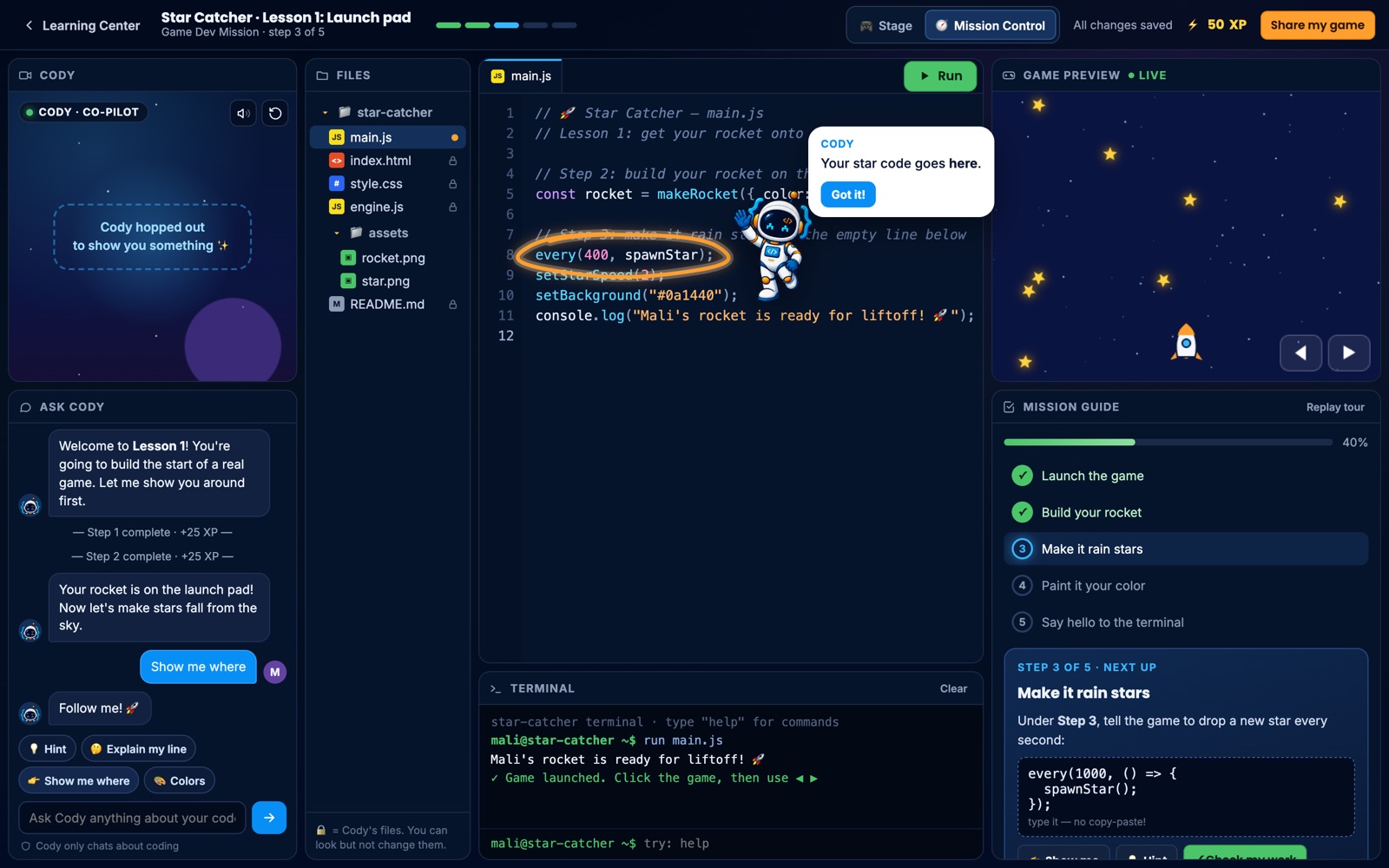
For a kid who freezes at being wrong, how mistakes land matters. A mistake in the code happens right there in the game, sometimes comically, and Cody then walks him through it. She points to the line to check, offers a hint instead of the answer, and steps back as he improves. Every line pushes the story on, and every episode stops at a cliffhanger, so kids come back to find out what happens next. There's no download, since it opens in the browser; the account is yours, in a Parent Corner a PIN keeps shut, where you approve every purchase. Kids see no ads and can't chat with strangers. $29.99 buys the whole mission once, nothing renews, and brothers and sisters share it.
See the mission where the numbers your kid types fly a starship.
See how Star Catcher worksQuestions parents also ask
How can I tell math anxiety from plain dislike?
Watch what happens before the math starts. Dislike is complaining and stalling, then getting on with it. Anxiety shows up early and in the body: a stomachache on quiz mornings, tears before he's read the problem, a blank mind on a test when he knew it the night before. If it looks like anxiety, tell the teacher, drop timed drills at home for a while and start with problems he can win. If it lasts or gets worse, bring it up with his pediatrician.
My kid is good at math but says he hates it. Why?
Often because it's too easy or too repetitive. A kid who gets it the first time, then does thirty more of the same, learns that math means boredom. Ask the teacher for harder problems instead of more of them, and give him puzzles without an obvious method: logic puzzles, strategy games, or a game of his own where he has to work out the scoring. Kids like this often warm to math once it pushes back a little.
How do I help with math homework if I was bad at math myself?
Help with how you sit, more than with the answers. Let him explain his thinking, ask what the problem is asking, and look things up together when you're both stuck. In the Chicago study, children of math-anxious parents learned less only when those parents often helped with homework,3 so when homework turns tense, a short note to the teacher beats a long night at the table.
Is it too late to change how a 12-year-old feels about math?
No. Twelve is a natural point for a fresh start, because algebra and ratios feel different from the arithmetic that went wrong. A 12-year-old also responds to math with a grown-up job: a budget, a game's scoring, a program that has to work. Start with one real win, build from there, and leave the old labels behind.
Was this answer helpful?
What was missing?
Sources
- Positive attitude toward math predicts math achievement in kids, Stanford Medicine (2018) ↩
- Dyscalculia: What It Is, Causes, Symptoms & Treatment, Cleveland Clinic ↩
- Parents' math anxiety can undermine children's math achievement, University of Chicago News (2015) ↩
- The Cognitive Benefits of Learning Computer Programming: A Meta-Analysis of Transfer Effects (Scherer, Siddiq and Sánchez Viveros, Journal of Educational Psychology, 2019), ERIC (U.S. Department of Education) ↩
Keep reading
More in School and learning SchoolMy 11-year-old memorises everything for tests but can't explain any of it. How do I help?Ask him to explain, predict and build, because memorising works until a question changes shape.
 ConfidenceMy child keeps saying he's stupid. What can I do?Skip the argument and hand him proof. Answer calmly, find out what he's stuck on, then set up small, real wins he can point to later.
 SchoolMy 9-year-old can swipe through an iPad but can barely type on a laptop. When should kids learn to type?Start now. "Most research supports starting students on formal keyboarding around grade 4," says occupational therapist Theresa Tovey, and fourth-graders are 9 or 10.
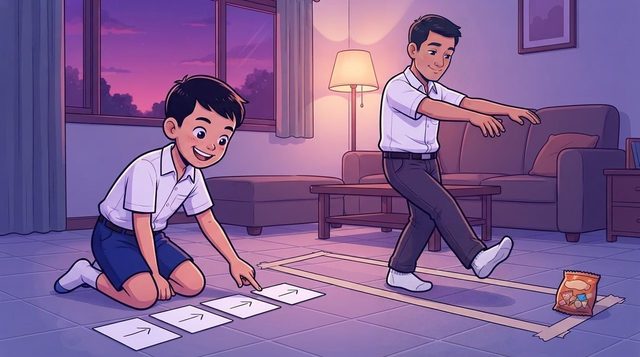 SchoolMy son has coding lessons in Grade 3 at his Thai school. What is he actually learning?Mostly how to solve problems in clear steps, with some programming.