School is too easy for my child. What should I do?
Short answer
Ask the school to skip what your child already knows and fill that time with harder work, and give them real difficulty at home.
A 1990–91 study found 40 to 50 percent of regular material could be dropped for high-ability students, and cuts of up to half made no difference to test results.1
Struggle is easiest learned early.

How can I tell school is too easy for my child?
It looks like good news, which is why it's easy to miss. The spelling list is memorized by Monday and Friday's test comes back perfect. Homework is done before the groceries are put away. At the parent-teacher conference the teacher says your child is doing great and there's nothing to work on, and you drive home pleased and a little uneasy.
The unease is about what you haven't seen. You can't remember the last time your child was properly stuck: reading something twice, trying it another way, asking for help with a real question. They've never studied for a test because they've never needed to. If you've landed on this page, the worry probably sounds something like this: school has always come easily to them, and you're scared they'll never learn what working hard feels like. That worry is well placed, and you've caught it early enough to act.
One caution before you call the school: straight A's on their own don't show that a child is gifted, or that they're unchallenged. Grades also reflect effort and how easy the assignments are. More telling: how often your child already knows a unit before it's taught, and whether anything at school makes them stop and think.
Why isn't the teacher already giving my child harder work?
Because in most classrooms the teacher's spare minutes go to the kids who are behind, and a child who's doing fine reads as a child who's fine. When teachers were surveyed for the Fordham Institute's 2008 report on high achievers in US schools, 81 percent named struggling students as the ones most likely to get one-on-one attention, and only 5 percent named advanced students.2 Forty percent of those teachers said programs for high-achieving students were too often watered down and lacking in rigor.2
Call it triage. But it means doing well is exactly what keeps your child off the list for anything harder. And the gap can be large. In the University of Connecticut study from the short answer, teachers found they could drop 40 to 50 percent of the regular material for their high-ability students, in at least one subject, because those students had already mastered it.1 Someone has to ask, and that someone is usually you.
What does it cost a child to never struggle?
Mostly the cost comes later, when the work finally gets hard and the habits for hard work aren't there yet. The Fordham Institute's 2011 study of America's top-scoring students, which followed individual children over several years, found that many high achievers struggled to maintain their elite performance.3
Our own read, as engineers and parents, is that a child who has never needed to prepare meets the first hard unit (long division, an essay that comes back covered in notes, a science test nobody can wing) without any practiced moves for being stuck. Rereading the question, trying a second way, breaking it into pieces, asking a precise question instead of announcing "I don't get it." Those moves come from use, and a kid who sails through school hasn't had the reps.
This is fixable, and 8 to 12 is a good window for it. A wrong answer at nine costs a few minutes and some grumbling. The same lesson at fifteen can cost a grade that counts, or the identity of the kid who never has to try. Let them practice being stuck now, while it's cheap.
Why don't extra worksheets or racing ahead fix it?
Because most of them add more work without adding more difficulty. Here's where the usual moves fall short:
- The extra worksheet. A second sheet of the same thing is still easy, and it punishes being quick, so bright kids learn to slow down.
- The class helper. Kind, and good for patience, but explaining what you know is a different job from meeting what you don't.
- Racing ahead in the same textbook. Next year's workbook adds speed, but the problems still come with a worked example above them, so it rarely feels hard for long.
- Praise for the grades. Celebrating an effortless A tells a child the A is the point, and the effort optional.
What works has three features. There's no ceiling, so a harder version is always waiting. Failure shows itself straight away and costs nothing: the tower falls, the program doesn't run, and nobody is grading. And the child gets to raise the bar themselves. After years of clearing bars set for the whole class, a challenge they can make harder on their own terms (a heavier book on the tower, a faster enemy in the game) is the first that keeps pace with them. Making things fits all three, and code fits better than most, because it never runs out of harder problems. Once a character moves, it can jump; once it jumps, it can dodge; once it dodges, something can chase it.
What should I ask the school for?
Ask for a plan, and bring evidence instead of a label. A folder of work lands better than the word "gifted."
- Samples. A couple of weeks of work finished early and right, plus anything beyond grade level they do at home, and where they do get stuck.
- A pretest. If your child can show they've mastered a unit before it starts, they skip the practice they don't need. That's called curriculum compacting, and the University of Connecticut study is the evidence to bring: when teachers cut as much as half the regular material for gifted students, their test results matched those of similar students who did all of it.1
- What fills the freed time. The same study found the replacement work often wasn't the advanced content these students needed.1 Ask for harder problems, an open-ended project or work from the grade above, and never more of the same.
- Acceleration, if they're far ahead. Moving up a grade in their strongest subject, or a whole grade if they're ahead everywhere. In a review of a century of research, reported by Northwestern University in 2017, accelerated students performed significantly better than non-accelerated peers their own age, and comparable to older students who hadn't been accelerated.4 Co-author Paula Olszewski-Kubilius added that acceleration is "still rarely used, and most schools do not systematically look for students who need it."4 You may have to raise it yourself, with your child's view in the room.
- Testing, if it's broad. When a child is ahead in every subject, year after year, ask how the district identifies students for gifted services. Each district sets its own rules.
- A date to look again. Agree on what you'd expect to see in a month, and meet again then.
How do I give my child real difficulty at home?
Give them one place every week where they're a beginner and failing costs nothing. Most of these can start tonight:
- Pick something they're bad at. Juggling, a Rubik's cube, chess puzzles rated above their level, a song worked out by ear.
- Wait before you rescue. When they get stuck, count to sixty in your head before you say anything. Then ask what they've tried so far, and leave the answer to them.
- Stop letting them win. Play chess, cards or a strategy game for real. Losing to a parent is the cheapest failure there is.
- Hand them a build that can fail on its own. A paper airplane that has to reach the end of the hallway, a tower of dry spaghetti and tape that has to hold a book off the table, a short program that has to do one thing. The build gives the verdict, so you don't have to.
- Change the dinner question. Ask "What was hard today?" and answer it yourself, so being stuck sounds normal at your table.
- Keep the stakes small. Skip the prizes and the sticker charts, and leave the relatives out of it. Difficulty does its best work where nothing rides on it.
What happens when a bright kid finally gets stuck?
Often they stall, put it off or get upset, sometimes all three, and the first time is usually the loudest. That's normal. A child who has always known the answer has had no practice at not knowing it, so being stuck can feel like being found out. In that moment, stay close and stay calm. Skip both the rescue and the pep talk. Say what you see ("this one's fighting back"), ask what they've tried so far, and if they need to walk away for a bit, let them, then come back to it together later that day.
A made-up third grader shows the shape of it. Call him Nat. He reads two grades ahead, finishes math sheets before the last one has been handed out, and has never once said he doesn't get something.
His parents take a folder to school: three weeks of math, done early and right. The teacher agrees to pretest him before the next unit. He passes most of it, and in place of the drill sheets he gets a packet of logic puzzles from the grade above. The first two sit half-done in his bag for a week, which is exactly the stall described above.
At home his dad stops letting him win at chess and gives him a box of spaghetti, a roll of tape and a job: a tower that holds the dictionary off the table. The first tower folds the moment the book touches it. So does the second. On the third night Nat notices that the triangles hold and the squares don't, and the dictionary stays up. Within a minute he wants to try the heavier atlas.
His grades that term look exactly like the term before. The change is quieter. When two of the logic puzzles come back wrong, he takes them to his teacher and asks her to show him where he went off track, something he has never needed to do.
Where does Codestronauts fit for a child who finds school easy?
Code is one of the few things a quick kid can't coast through, because the computer doesn't care how smart anyone is: the line works or it doesn't. Codestronauts, a coding course for ages 8 to 12 told as a story, is built around that. Star Catcher, its opening mission, begins with your child waking Cody, a robot co-pilot with a nervous streak. Together they rebuild a starship called the Star Catcher and get the Great Beacon burning again, with every typed line pushing the story on and all five episodes breaking off at a cliffhanger. The code is real JavaScript, typed by hand rather than snapped together from blocks, and the first line your child writes builds the ship.
When the code is wrong, your child watches it go wrong on screen, often comically, before Cody walks them through what happened. She points at the right line and offers a hint instead of the answer, and as your child improves she steps back. For a child used to knowing the answer first, a hint that leaves the last step to them is new territory. That's the cheap, visible failure this page has been arguing for, inside a story your child wants to see the end of.

The five episodes run about two hours, at whatever pace your child sets, and end in a finished arcade game of your child's making: arrow keys to steer, levels, sound effects, a score counter and a final boss built to your child's own design. It plays on a laptop, desktop or phone with no download. Grown-ups hold the account and approve every purchase, and the whole mission is $29.99, paid once, with nothing that renews.
See the mission where a quick learner finally meets code that pushes back, and builds a whole game by the end.
See how Star Catcher worksQuestions parents also ask
Should my child skip a grade if school is too easy?
It can be the right call for a child who is ahead in every subject and keen to move. Moving up in one subject, like math, is a gentler first step that leaves friendships alone. Decide with the school, and ask your child: some want the new challenge, others only want to stop repeating what they know.
Does my child need to be tested as gifted to get harder work?
Not always. A pretest, compacting and harder assignments can all happen in a regular classroom, on the strength of work samples. Formal testing matters when you're after a gifted program or a grade skip, and each district sets its own rules, so ask the school what it uses and when.
What if the school says no?
Ask what the teacher can do inside the class instead: a pretest before each unit, harder problems in place of the drill, a reading list from the grade above. Put it in writing and set a date to talk again. And build the difficulty at home either way. Getting comfortable with being stuck doesn't need the school's permission.
My child is happy and gets straight A's. Should I leave it alone?
Keep the A's and the happiness, and add one place where they're a beginner. Nothing needs taking away. The aim is that by the time school does get hard, being stuck already feels familiar, and something they know how to work through.
Will coding be hard enough for a child who finds school easy?
Yes, because code has no ceiling. In Star Catcher a kid goes from the one line that builds a ship to a whole arcade game with a boss the kid designs, arrow-key steering, a score, levels and sound, and every step is a real problem the computer checks the moment they press Run. Typed code also makes every bracket count, a kind of care quick kids are rarely asked for.
Was this answer helpful?
What was missing?
Sources
- Why Not Let High Ability Students Start School in January? The Curriculum Compacting Study, The National Research Center on the Gifted and Talented, University of Connecticut (Reis et al., 1993) ↩
- Neglecting High Achievers (on the Fordham Institute report High-Achieving Students in the Era of NCLB), ASCD, Educational Leadership, October 2008 ↩
- Do High Flyers Maintain Their Altitude? Performance Trends of Top Students (2011), Thomas B. Fordham Institute, with the Northwest Evaluation Association ↩
- Gifted students benefit from ability grouping, ScienceDaily, from Northwestern University, January 13, 2017 ↩
Keep reading
More in School and learning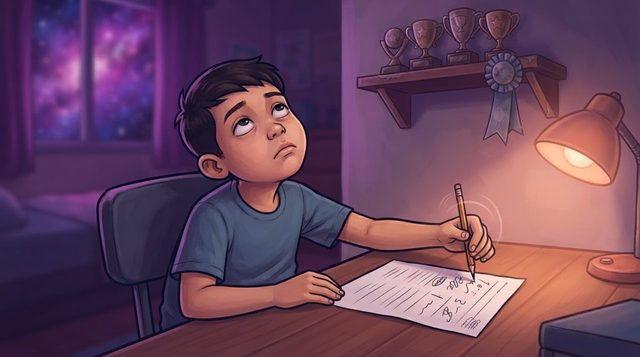 PotentialMy child is gifted but lazy. What can I do?Praise how your child works instead of how smart they are, and hand them challenges where mistakes are cheap. The “gifted” label is often the reason effort feels risky.
 MotivationMy 9-year-old is always bored. What should I do?A 9-year-old who is always bored usually has too little in the day that fits their level or matters to them. It's worth catching now.
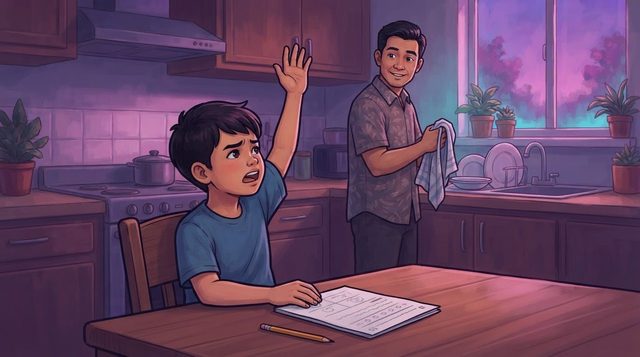 ConfidenceMy son wants me to do everything for him. How do I get him to figure things out on his own?Stop answering the first call. When he asks, have him read the problem aloud, ask what he's tried and give one clue instead of the fix, so being stuck turns into something he works through.
 SchoolMy 11-year-old memorises everything for tests but can't explain any of it. How do I help?Ask him to explain, predict and build, because memorising works until a question changes shape.