My son wants me to do everything for him. How do I get him to figure things out on his own?
Short answer
Stop answering the first call. When he asks, have him read the problem aloud, ask what he's tried and give one clue instead of the fix, so being stuck turns into something he works through.
You're far from alone: in a 2025 EdWeek Research Center survey, 82 percent of teachers said students have become less independent over the years.1
Why does he call for help before he's even read the question?
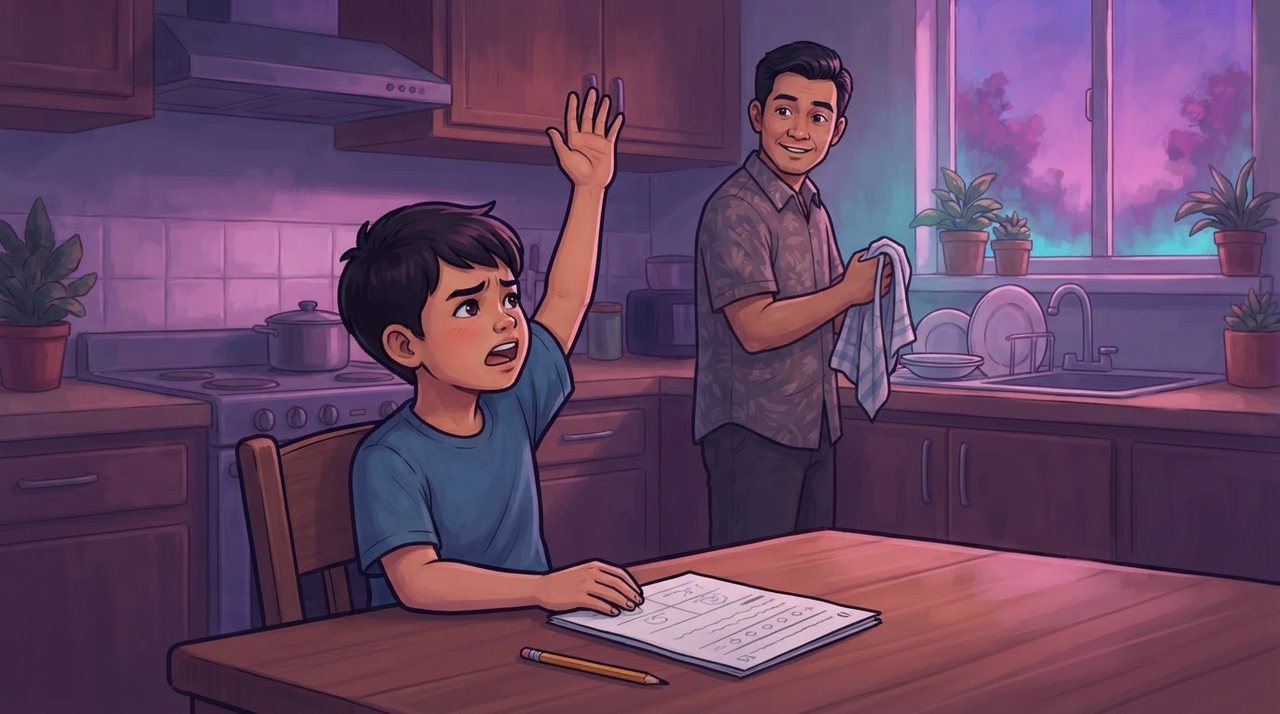
Because, so far, asking has always been faster than trying. The worksheet comes out, and before his eyes reach the first question you hear it from the kitchen: "I can't do it." You walk over and read the question aloud, and he answers it in about two seconds. Later the same evening he wants you to find the charger lying next to his bag, open a box he hasn't tugged at and fix a game setting he's never gone looking for.
None of it is beyond him, which is the maddening part. He waits, and someone comes. Parents describe it in nearly the same words: he wants me to do everything for him, or he just sits there until somebody does it. Psychologists call the pattern learned helplessness. A child expects to fail before he starts, so the job goes to the nearest grown-up before he's tried it himself. The other signs tell it apart from a bad night: the bare minimum when he does try, dropping a task at the first snag, and "I'm bad at this" said about himself, week after week and in more than one subject.
Is this normal, or did I teach him to wait?
A bit of both, and the second part is good news, because a habit learned at home can be changed at home. Teachers see it too. A nationally representative EdWeek Research Center survey of 1,268 teachers, principals and district leaders, run in February 2025, found that 82 percent of teachers said students have become less independent over the years.1 In an open-ended answer on the survey, one middle school science teacher wrote, "Parents want their student to have things done for them."1
Research on younger children has looked at what heavy steering does: in a study published in 2018 by the American Psychological Association, researchers followed 422 children and assessed them at ages 2, 5 and 10.2 Overcontrolling parenting at age 2, which meant constantly telling a child what to play with and how to play with a toy, was associated with poorer emotional and behavioral regulation at age 5. Children who regulated themselves better at 5 were more likely to be productive in school at 10.2 The lead author, Nicole Perry, put it plainly: children with helicopter parents "may be less able to deal with the challenging demands of growing up."2
Every rescue is an act of love, and every one also spends a chance to practice. So the useful question is what kind of help builds the habit of trying first.
What does it cost him if I keep stepping in?
Mostly, it costs him a method. A kid who is rescued every time learns one move for being stuck, which is to call for someone, and that move stops working the day he's one of a whole class waiting on one teacher. The questions get longer in the upper grades and the projects stretch over weeks. A child who has never sat with a hard problem for five minutes meets all of that with the only tool he has, and from the outside it looks like laziness.
Still, this is fixable. Helplessness is learned, so it can be unlearned, and every evening of homework hands him a fresh chance to practice the other habit. What he needs is practice at being stuck, in doses small enough to win.
Why doesn't "figure it out yourself" work?
Because he doesn't have a first move yet. You've probably tried some version of all three of these. Doing it for him gets everyone to bed on time and teaches him once more that asking works. Refusing outright, with a "you're smart, figure it out," leaves him staring at the page, because nobody has shown him what figuring it out looks like, and the evening ends in tears with nothing learned. Sitting beside him through the whole sheet feels like the middle path. In practice you become the voice that reads every question aloud, and he waits for you at his elbow instead of across the room.
What works sits between doing it and walking away. A kid learns to get unstuck from a loop he can run himself: read the clue, try one change, check what happened, go again. He needs problems that answer back fast and plainly, with help that points at the spot and leaves the filling in to him. It works best when the problem itself does the answering, so no grown-up has to rule on whether he got it right, and his next try doesn't depend on anyone's mood.
Debugging code is that loop at its cleanest. The program does something wrong, the screen shows exactly what, and the kid changes a line and runs it again, over and over in one sitting, at almost no cost. Good research backs the carry-over, too: a 2018 meta-analysis of 105 experimental and quasi-experimental studies found "a positive, significant, and moderate transfer effect of learning computer programming to contexts outside of programming."3
What do I say the next time he calls for help?
Say something that hands the problem back with a way in. These steps work for homework, chores and anything else, starting tonight.
- Have him read it to you. "Read me the question" often settles an "I can't do it" on the spot, because so many of them arrive before the first line was read.
- Ask what he's tried. If the answer is nothing, ask for one try before you help, even a wrong one. Finish the sentence you're typing before you walk over, so he gets a moment to start alone. A wrong try gives you both something to look at.
- Give a clue, never the fix. Point at the word he skipped, the step where it went wrong, the place lost things usually turn up. Then put the pencil back in his hand.
- Put a stuck card on his desk. A good one says: read it again; find the part you do know; try one thing; check what happened; then ask, and say what you tried. A house rule of three tries before calling a grown-up gives the card some teeth.
- Talk about stuck as temporary. "This one's tricky" leaves room for the next try in a way "I'm bad at fractions" doesn't. When the router or a form beats you, say your own steps out loud: what you tried and what you'll try next.
- Ask how he did it. When he gets himself unstuck, have him walk you through it. Telling it turns a lucky break into a method he owns.
- Start where he's strong. Practice try-first on things he likes and is good at, a Lego build or a game setting, before you ask it of fractions. Early wins should be small enough to finish in one sitting.
- Hand back one daily job a week. Shoes, the school bag, breakfast, setting up his own game. Accept good enough, and don't redo it while he watches.
- Keep asking for help welcome. The new rule is asking with what you tried: "I did this and this, and it still does that." It's a better question, and it's the kind engineers ask each other all day.
Some kids who wait to be rescued are dealing with more than a habit. If he avoids even the things he enjoys, if the asking comes with worry, stomachaches or trouble sleeping, or if he stalls every time reading or writing is involved, look further. The AAP's HealthyChildren site lists avoiding activities, school or social interactions, trouble sleeping, and ongoing complaints like headaches or stomachaches, among the signs of anxiety, and says to talk with your pediatrician if you're worried.4 Ask his teacher what they see as well, since a stall that shows up in one subject every time can point to a learning difference worth an evaluation.
What changes once he starts getting himself unstuck?
The calls come less often, and later. Our example is a boy of ten, invented for this page, whose opening line at homework time has been "I don't get it" since second grade. His dad starts small. Every call gets the same two replies: read it to me, and what have you tried? The first week is loud. Twice the answer to the second question is "nothing," and his dad waits him out, smiling, until there's one try on the page.
By the third week the stuck card is curling at the corners. He has also started a coding project, a little ship he's teaching to fly, and it goes wrong in front of him all the time, so he runs the loop many times a night. The ship drifts the wrong way, he reads the line, changes one symbol and runs it again. One Thursday he calls "Dad?" from his room. Before his dad is out of the chair, a second call follows: "Never mind. Got it."
How Codestronauts gives him the stuck-and-fix loop
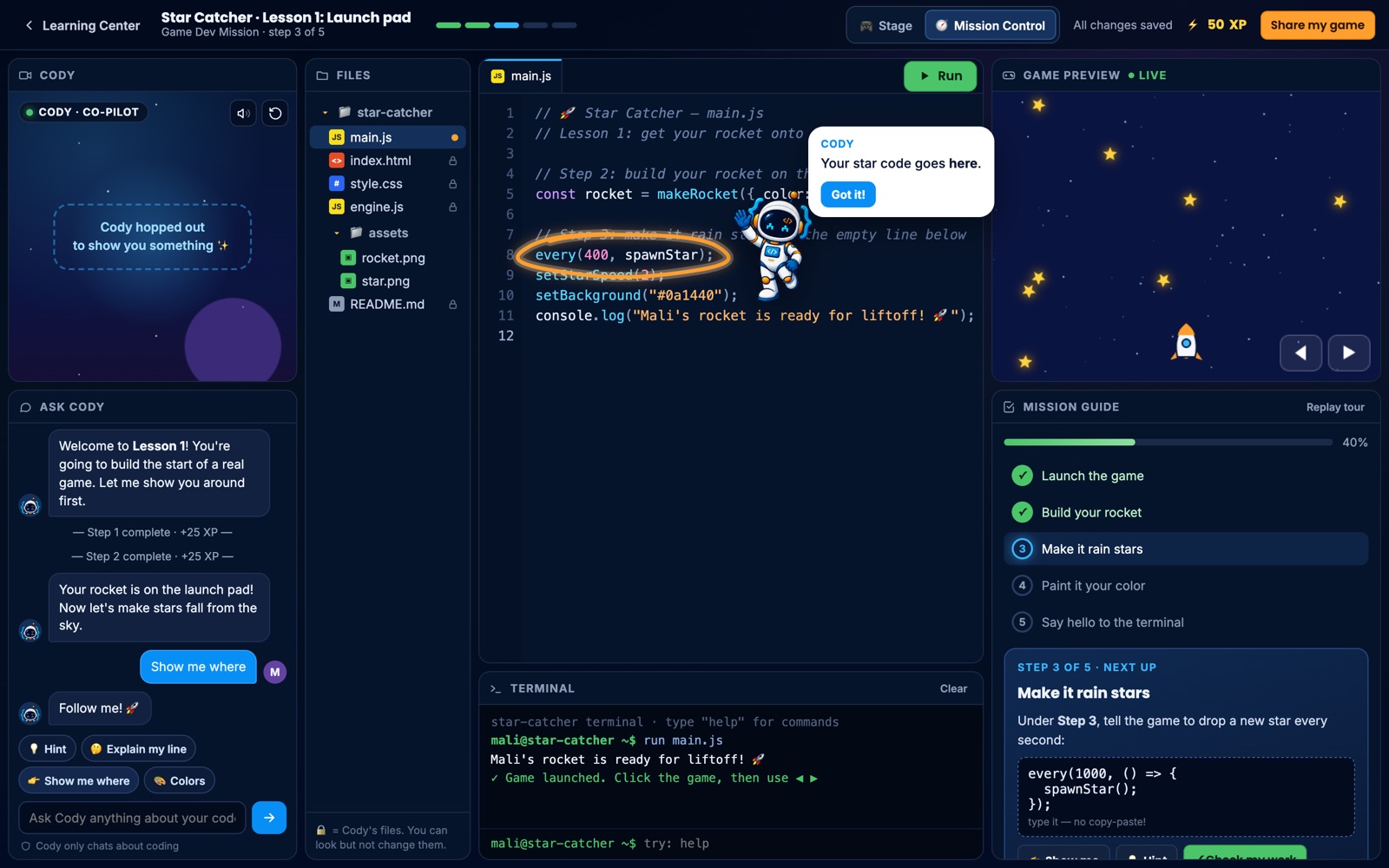
Codestronauts teaches kids 8 to 12 to code inside a space story, and Star Catcher, the mission every kid starts with, runs on exactly that loop. Your son presses Run and wakes Cody, a robot co-pilot with a nervous streak. Together they rebuild a starship and set out to relight the Great Beacon, and each line he types pushes the story forward. Everything he writes is real JavaScript, typed by hand, beginning with makeRocket();, the line that builds the ship.
Even the teaching runs try-first. Each new piece of code does its thing on screen before Cody explains it, so he has seen it work before anyone tells him how. When his code is wrong, he sees that too: the mistake shows up in the game, often in a way that's funny to watch, and Cody tells him what went wrong. Then she does what this page has been asking you to do: she points at the line where the trouble is and gives a hint instead of the answer, and her help fades as he gets better. You can sit nearby and ask what he's tried, while she does the pointing. In Radio Silence, the fourth episode, Cody has lost her voice and only he can bring it back, so this time he's the one doing the rescuing. Five self-paced episodes, roughly two hours altogether, build up to an arcade game he coded himself, steered by arrow key, with a climbing score, sound, several levels and a boss he dreamed up. There's nothing to install: it opens in a browser. One payment of $29.99 buys the whole mission, siblings share it, and your PIN-locked Parent Corner shows every step he takes.
See Star Catcher, where a robot who gives hints, not answers, is waiting for your son.
See how Star Catcher worksQuestions parents also ask
Is learned helplessness the same as being lazy?
No. A kid in the helplessness habit expects to fail before he starts, so trying feels pointless and asking feels safe. You can usually tell by what a small clue does. Point at the first step and a helpless kid often gets moving straight away, because the clue handed him a starting point he didn't believe he had.
How long should I let him struggle before I step in?
Our rule: one real try and a few minutes of real effort, then a clue. Step in sooner when frustration turns into tears or anger, since by then the feeling is the problem he's working on, and a calm clue does more than a talk. If he's stuck the same way every night, the work may be too hard, and his teacher should know.
What if he melts down when I won't just tell him?
Expect a rough week or two, because a deal that used to work is ending. Stay warm and a little boring: name the feeling, offer the clue again and wait, with the pencil still in his hand. If the meltdowns are big and frequent, or come over things he can clearly do, mention them to his pediatrician.
Should I tell his teacher he asks for help before trying?
Yes, and ask what they see. Some kids wait to be rescued at home and work alone at school, others the other way round, and the difference tells you a lot. Ask for homework he can do on his own, so it stays practice and never becomes a test of whether you'll step in. If one subject is always where he stalls, ask whether an evaluation makes sense.
Can coding really teach a kid to get himself unstuck?
It's one of the best places to practice. A program shows the result of every change at once, so a kid can read the clue, try a fix and run it again many times in one sitting, with no grown-up ruling on whether he was right. A 2018 meta-analysis of 105 studies found that learning to program carries over, moderately, to contexts outside programming.3 Pick a course whose help comes as hints.
Was this answer helpful?
What was missing?
Sources
- Are Today's Students Less Independent? Depends on Who You Ask, Education Week (EdWeek Research Center survey, February 2025) ↩
- Helicopter Parenting May Negatively Affect Children's Emotional Well-Being, Behavior, American Psychological Association press release (via Newswise), on Perry et al., Developmental Psychology (2018) ↩
- Study: The Cognitive Benefits of Learning Computer Programming, University of Oslo, Faculty of Educational Sciences, on Scherer, Siddiq & Sánchez Viveros, Journal of Educational Psychology (2018) ↩
- Anxiety in Teens is Rising: What's Going On?, American Academy of Pediatrics, HealthyChildren.org (Claire McCarthy, MD, FAAP) ↩
Keep reading
More in Confidence and focus ConfidenceMy child keeps saying he's stupid. What can I do?Skip the argument and hand him proof. Answer calmly, find out what he's stuck on, then set up small, real wins he can point to later.
 CodingI'm not technical. How can I help my child learn to code?You can help without knowing any code. Let a good course do the teaching and make yourself the audience: ask your child to show you how their program works, and praise the effort.
 CodingMy 10-year-old daughter loves building things but says coding is for boys.Act now, while the idea is new. In Microsoft's survey of 11,500 European girls and young women, most girls' interest in STEM took hold around age 11½ and began to fade by 15.
 SchoolSchool is too easy for my child. What should I do?Ask the school to skip what your child already knows and fill that time with harder work, and give them real difficulty at home.