My son can't focus on anything. How can I help him?
Short answer
Treat focus as a skill he's still building, and start with sleep: kids 6 to 12 need 9 to 12 hours a day, and regularly falling short is linked to attention, behavior and learning problems.1
Then train it in short timed stretches he can win, one instruction at a time, on projects whose goal is his.

What does "can't focus on anything" usually look like?
Saturday shows it best. He begs to open the new Lego set, empties two bags onto the rug and drifts off before the first page of instructions is done. Sent upstairs to tidy his room, he's found lying on the floor flicking a bottle cap at the wall, the room exactly as it was. Halfway through a board game with his sister he's up and gone before his turn comes round. Then the console goes on, and he plays the same game for an hour without shifting in his seat; you call his name from the doorway and he doesn't hear it.
When parents say "he can't focus on anything for more than a few minutes unless it's a game or a video," they're describing two kinds of attention. A game or a feed hands him the next thing every few seconds: a new clip, a new reward, a new sound. A Lego build, a tidy room or a board game asks him to come up with the next step himself and hold on to it while something more exciting flickers at the edge of his mind. That second kind is the one he's short on. School, sport and everything he'll want to build later all run on it.
Is focus something he has, or something he learns?
He learns it, and at 8 to 12 he's in the middle of learning it. Harvard's Center on the Developing Child counts the ability to "focus thinking, filter distractions, and switch gears" among the executive function skills, and says it plainly: "Children aren't born with these skills—they are born with the potential to develop them".2 Those abilities keep growing and maturing through the teen years and into early adulthood.2
So a boy who drifts off a worksheet is partway through building the skill. The useful questions become what kind of practice builds it, and how to tell whether something else is getting in the way.
Does it matter if he can't concentrate yet?
It matters, because the cost piles up quietly. Homework that should take twenty minutes spreads across the evening and becomes a nightly argument. Teachers start writing "easily distracted" in their comments. Worst of all, kids begin to explain it to themselves with lines like "I'm just bad at school," and that belief is harder to shift than the focus itself.
Part of it may have a plain cause. Pediatricians at the AAP point out that a child with not enough, or poor quality sleep may have difficulty paying attention or "zoning out" in school,3 so a bedtime that has crept later can pass for a focus problem.
Every part of this can be turned around. A skill that keeps maturing into early adulthood2 is a skill that answers to practice, and a boy of 8 to 12 has years of that growth ahead of him. Starting now works with his brain's own schedule.
Why haven't reminders, rewards and screen limits worked?
Each one aims at the wrong part. "Concentrate!" asks for the very skill he's still building, so it lands as criticism, and stress makes focus harder still. A sticker chart for sitting at the desk pays for time in the chair, and a kid can spend forty minutes in that chair thinking about his game. Screen limits clear away the distraction, which helps, though an empty evening trains nothing by itself: the attention a game was holding doesn't flow into the worksheet on its own.
What trains focus has three parts. First, a goal he cares about, so he wants to hold on. Second, a task that waits for him. A feed moves on every few seconds whether he's paying attention or not, while a half-built model or a recipe halfway done sits there until he takes the next step. Third, steps that have to be right and in order, so each small win of attention shows. Building from instructions, baking, chess, a big Lego set and coding all qualify.
Coding is the strictest of them. A program won't run on half a thought: one missing bracket and nothing moves, so he has to slow down, read what he wrote and find the step he skipped. And he does slow down, because the thing he's building is his. In a randomized trial in Italy, first graders who had a month of coding lessons improved significantly more in planning and inhibition than first graders in matched classes still waiting their turn.4 With second graders, the gains from eight coding lessons matched or beat what seven months of ordinary school activities had brought.4 Inhibition is the brake that keeps a kid on the line in front of him instead of the thought flickering past.
Which habits help him focus, starting this week?
Measure first, then train in short stretches he can win. Any one of these helps, and together they make a week of practice.
- Find his number. For three days, time how long he stays on a task he didn't choose before he drifts. That's his starting point, whatever it is.
- Set the timer just past it. Understood suggests considering a 10-minute timer and increasing the time little by little as your child gets better at focusing.5 If his number is six minutes, start at seven. The break comes when it rings.
- Do the first step together. Starting is the hardest part. Open the book to the page, write the date, read the first question aloud, then step back.
- Give one instruction at a time. "Get your bag, find the sheet, start question one" is three things to hold. Say the first, wait, then say the next.
- Agree on a quiet signal. Come up with a signal for when your child's mind starts to wander,5 like a hand on the shoulder or a code word, so you can call him back without a lecture.
- Clear the table. The phone goes in another room, the TV goes off and one task sits on the desk.
- Move between stretches. A run round the garden or ten jumping jacks between chunks resets him.
- Protect bedtime. Count back from wake-up time and hold it on school nights.
- Give him one stretch a day on something he's making. A model, a recipe he picked, a comic, a game of his own. Focus practiced on his own goal is the easiest focus he'll ever practice.
- Name it when you see it. "You stayed with that for twelve minutes" tells him focus is something he does, and something he can grow.
- Check the size of the task. A boy who drifts the moment he sits down may be facing work too hard to start or too easy to care about. Watch which, or ask his teacher, then cut it into smaller steps or give him a harder version.
When should I talk to his doctor about focus?
The AAP's guidelines for confirming ADHD give you the yardstick. Symptoms occur in 2 or more settings, such as home, school, and social situations, and cause some impairment;6 they have continued for more than 6 months;6 and they began before age 12.6 Measure what you see against those three. A boy who drifts at the Lego table but holds steady through a football match and an afternoon at a friend's has a skill to grow. A boy whose coach, teacher and grandparents all describe the same struggle, month after month, deserves an appointment.
Booking one commits you to nothing. There is no single test for ADHD:6 the pediatrician listens to you, reads what his teacher reports and will do a physical and neurologic examination6 to rule out other causes. Write down two or three recent moments when focus cost him something he wanted, and take them along. Whatever the visit finds, the practice above still helps.
What might a month of practice look like?
Here's an example, made up but typical. Krit is ten. His parents time him on reading for three evenings and get four minutes, then five, then four. They set the timer at five, read the first paragraph with him and move his bedtime half an hour earlier. The first week is bumpy. By the end of it he beats five most nights and asks for the timer himself, because beating it is a small win.
In week two the timer goes to seven, and Krit picks a weekend project: a marble run made of cardboard tubes and tape. It fails a dozen times. He spends most of a Saturday morning on it, testing one tube at a time, and his dad says only "you've been at that a long while." By week four reading sits at ten minutes, and the marble run has a loop. Nothing about Krit changed overnight. He practiced a skill, in stretches he could win, on a goal that was his.
Can screen time train focus instead of using it up?
That's what we built Codestronauts to do. Its opening mission, Star Catcher, made for ages 8–12, drops him into a story where Cody, a jittery robot co-pilot, needs his help to rebuild a starship, so the goal belongs to him from the start. The screen waits on him the way that marble run did. The ship moves only when his JavaScript is right. A mistake in his code happens right there in the game, often comically, before Cody walks him through what went wrong. Each new word of code gets explained right after he sees it work, so he's never asked to hold a rule he hasn't used. Her hints come first and thin out as he gets better, so the thinking stays his.
The five episodes run 15 to 40 minutes each, roughly two hours across the mission, which suits a boy stretching his timer: one sitting, one goal, and a clear place to stop. Every episode stops at a cliffhanger, and the next sitting opens on a question he already wants answered. He comes out the far end holding a working arcade game, built line by line by him: arrow keys to steer, a score that counts up, levels with sound, and a final boss he drew up himself. Any laptop or desktop browser runs it, and there's nothing to download. The account is yours, kept behind the Parent Corner and its PIN, and strangers and advertisers have no way in. He can start tonight: Wake Up, Cody, the opening episode, costs nothing and asks for no card, and a single $29.99 payment opens the other four.
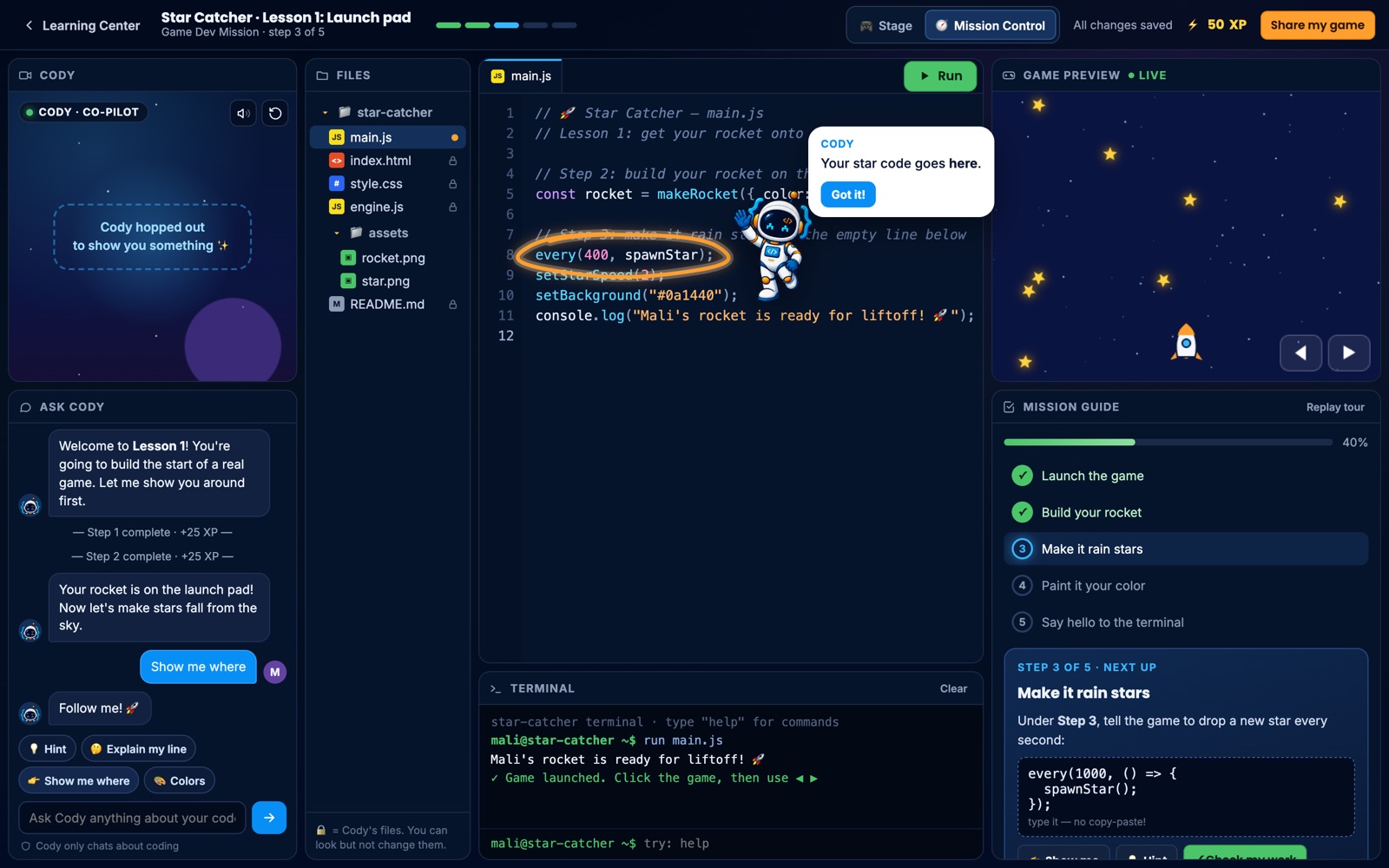
See how Star Catcher's story waits for your son's next line of code.
See how Star Catcher worksQuestions parents also ask
Are video games and YouTube ruining his attention span?
They train a different kind of attention: following a stream someone else controls. The bigger cost is usually what they crowd out, like sleep, reading and the boredom that sends a kid off to make something. Keep screens out of his bedroom at night and off during homework, and steer some of his screen time toward things he builds. An hour spent making something trains the focus an hour of watching never asks for.
How long should a child his age be able to focus?
Focus depends on the task, the hour, his sleep and his interest, so a single figure for every kid between 8 and 12 says little about yours. His own baseline on a task he didn't choose matters more. Measure it for three days, set the timer just past it and lengthen it a little each week. Steady growth from his own number is the sign you're looking for.
Should I sit with him while he works?
For the start, yes. Sit down for the first step, then move to the next room and stay within call. Hovering for the whole stretch turns his focus into yours, and he needs the practice of holding it alone. As the timer grows, cut your part back to a check-in when it rings.
Do fidget toys and breathing exercises help?
For some kids, yes. Fidgets are sensory tools that can help some kids focus better,5 and Understood notes that studies have shown that mindfulness can help kids improve their behavior and their ability to focus on lessons and on schoolwork.5 Try a squeeze ball during reading, or three slow breaths before he starts, and keep whatever actually helps him.
Was this answer helpful?
What was missing?
Sources
- Recommended Amount of Sleep for Pediatric Populations: A Consensus Statement of the American Academy of Sleep Medicine, Journal of Clinical Sleep Medicine (PubMed Central) ↩
- InBrief: Executive Function, Center on the Developing Child at Harvard University ↩
- Healthy Sleep Habits: How Many Hours Does Your Child Need?, American Academy of Pediatrics (HealthyChildren.org) ↩
- Coding in Primary Grades Boosts Children's Executive Functions (Arfé, Vardanega, Montuori and Lavanga, 2019), Frontiers in Psychology ↩
- 6 ways to help your child focus, Understood ↩
- Diagnosing ADHD in Children: Guidelines & Information for Parents, American Academy of Pediatrics (HealthyChildren.org) ↩
Keep reading
More in Confidence and focus ConfidenceMy 10-year-old can binge a whole series in a weekend but can't focus on homework for 20 minutes. Why?Because a series is built to keep kids watching, and homework isn't. Every episode ends on an open question and the next one starts by itself.
 ScreensIs YouTube bad for my child?Not by itself. For kids 8–12 the bigger problem is who's choosing: by default YouTube picks the next video, and its product chief said in 2018 that recommendations drive over 70% of viewing time.
 ConfidenceMy child keeps saying he's stupid. What can I do?Skip the argument and hand him proof. Answer calmly, find out what he's stuck on, then set up small, real wins he can point to later.
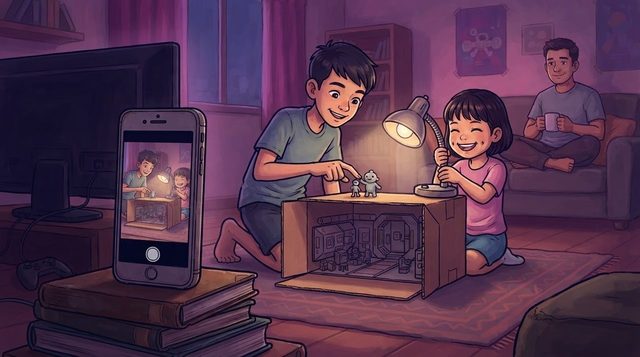 ScreensHow do I get my kid to create instead of just consume?Start from what they already consume and hand them its making twin: a stop-motion app for the YouTube kid, a game maker for the gamer, a comic for the reader.