My child keeps saying he's stupid. What can I do?
Short answer
Skip the argument and hand him proof. Answer calmly, find out what he's stuck on, then set up small, real wins he can point to later. Gushing doesn't help: in an experiment with children aged 8 to 12, the kids low in confidence chose the easier task after over-the-top praise.1

Is it normal for a kid to keep calling himself stupid?
Now and then, yes. When it keeps coming back, it's a pattern worth acting on. Bob Cunningham of Understood calls it very painful to hear, and not uncommon.2
It tends to go something like this. It's the fourth word problem of the night's homework, and he has erased the same answer until the paper has gone soft. Then the pencil skids across the table: “I'm so stupid.” Last week it was the spelling test, the week before that a drill at soccer practice. At bedtime it comes out quieter: “Everyone in my class is smarter than me.” You tell him that isn't true, that he's smart, and he gives you the look kids save for things parents are supposed to say. It breaks your heart a little, and nothing you say seems to reach him.
Where does a kid get the idea that he's stupid?
From evidence, which is also the way back out. In 1977 the psychologist Albert Bandura argued that the biggest single source of belief in yourself is what he called mastery experiences, and after a lifetime of study he hadn't changed his mind.3 Angela Duckworth of Character Lab sums up the idea: if you attempt hard things again and again and eventually succeed, you come to believe in your capabilities.3 It runs the other way too. Fail over and over, and you come to believe you can't succeed even when you try.3
Seen that way, “I'm stupid” is a conclusion he drew from what he has seen: the red marks, the answer that wouldn't come, the kid at the next desk who finished first. Your “you're smart” is one sentence against a pile of his own data, so it loses. The useful question is what evidence would change his mind, and how to get him some.
Should I worry, and when does he need a professional?
Worry mostly about the habit it builds. A kid who's sure he's stupid protects himself by not trying: he skips the hard problem, sits out the drill, calls the club boring. Every skipped try is one less chance to get better, so the gap he fears grows, and the belief looks proved. That loop is the real cost.
It's also very fixable. Duckworth describes her daughter Amanda in tears through an accelerated seventh-grade math class, and her husband sitting beside her working the easiest problems first, then the next easiest. By senior year Amanda was wondering aloud whether to major in math.3
Bring in a professional when it looks like more than a confidence problem:
- Low mood most days. The American Academy of Pediatrics counts talk of feeling sad, worthless or guilty among the signs of depression, along with losing joy in things he loved, trouble sleeping and pulling away from friends; if signs like these last more than two weeks, talk to his pediatrician.4 The AAP estimates that 2 to 3 percent of children aged 3 to 11 have depression, and it calls depression in a young child very concerning, so if you see these signs, book the visit.4
- Always the same subject. If it's always reading, spelling or math and he really is struggling, ask the school about an evaluation for a learning difference such as dyslexia. A kid who works harder than everyone around him and still falls behind has every reason to feel stupid until someone finds out why.
- Any talk of not wanting to be alive, or of hurting himself. Call his doctor that day. If you think he's in danger right now, call emergency services. In the US, you can call or text 988, the 988 Suicide & Crisis Lifeline, and reach a counselor any time of the day or night.5
Why don't reassurance and pep talks change his mind?
They ask him to take your word over his own experience, and the gushing kind can make things worse. Researchers from Utrecht University and Ohio State had 240 children copy a van Gogh painting, then sent each one a note from a “professional painter” with simple praise, inflated praise (an extra word like “incredibly”) or none.6 Offered a choice of what to draw next, kids with low self-esteem picked the easier pictures after inflated praise, while confident kids went for the harder ones.6 The low-confidence kids were more apt to take on the tougher drawing after simple, positive feedback.1 The lead author, Eddie Brummelman, put it this way: “If you tell a child with low self-esteem that they did incredibly well, they may think they always need to do incredibly well.”6
The other usual moves miss too. Arguing (“You are not stupid!”) gives him a position to defend. Mentioning that you were bad at math once, or that his cousin struggled too, pulls the talk away from how he feels, and Cunningham says that usually doesn't help.2 Making everything easy fails more slowly: people who get only easy successes, Bandura warned, “come to expect quick results and are easily discouraged by failure.”3
What works is proof he makes himself: something hard enough that winning counts, cut into steps small enough to win, with results he can see and keep. Bandura's recipe, in Duckworth's words, is “a series of challenges, each incrementally more difficult than the next, but none so far a stretch that success is impossible.”3 It works even better when someone actually needs what he makes.
What actually rebuilds a kid's belief in himself?
Five kinds of activity hand a kid that sort of proof. Pick by the kid: one he'll really do beats the best one on paper, and two at a time is plenty.
- Rebuild the exact skill he calls himself stupid at. If it's math, go back to the last place he was solid and climb from there, easiest problems first, the way Amanda's dad did. Ten minutes a night with you or a tutor. The proof is a page of problems he couldn't do last month.
- A skill with levels he can see. Martial arts belts, swimming badges, chess puzzle ratings, music grades. Someone else marks each step, so he can't wave it away as luck or you being nice.
- A real job someone depends on. Cooking one family dinner a week, keeping the fish alive, fixing his own flat tire. The proof is that everyone ate it, or the bike rolls.
- Teaching someone younger. Let him show a cousin how to tie a knot or beat a level. Being the expert for an afternoon feels nothing like being the slowest in class.
- Making something that works. Building, wiring, writing code. Code gives the cleanest proof there is: he types a line, presses Run, and it either works or shows him exactly what went wrong. When it works, nobody did it for him, and he can show anyone. One way in is Codestronauts, a story where kids 8 to 12 type real JavaScript to wake a robot and rebuild a starship (more on it below).
What should I say the next time he says it?
Keep it short in the moment and save the real work for later.
- Answer in one calm line. “That one's hard. Hard isn't the same as stupid.” Then help with the next small step instead of debating the label. A big emotional reaction, Cunningham notes, likely won't make the situation better.2
- Find the pattern. For a week, jot down when it comes out: one subject, one time of day, after one friend. Later, when things are calm, ask “When do you feel that way the most?” The pattern tells you which option above to start with.
- Praise what he did, plainly. “You found that mistake yourself.” “You tried a third way.” Skip “incredible” and “genius”: simple, specific feedback is what sent the low-confidence kids in the van Gogh experiment back for the harder drawing.1
- Shrink the next task. Start with a problem he can already do, then add one step. Bandura's advice is that breaking a complex skill into smaller ones teaches better than everything at once.3
- Start a proof list. A sheet on the fridge where you write each thing he couldn't do and now can, with the date. When the voice comes back, point at the list.
- Watch your own words. If you call yourself an idiot when you lose your keys, he's learning the script from you.
How might the first month go?
Here's a made-up case to show the shape of it. Ton is nine, and spelling tests have convinced him he's “the dumb one.” His mom stops arguing with him and answers with one calm line. A week of notes shows the comments come on spelling nights and nowhere else, so she asks his teacher, who agrees he's behind on spelling patterns and moves him into a small group. At home they do six words a night instead of the whole list, and every word he masters goes on the fridge sheet.
On weekends he starts a coding course. The first time a line he typed makes a ship move, he calls his little sister over to watch, and makes her watch twice. A month in, the fridge sheet runs off the bottom of the page. He still says “I'm so dumb” on some nights. Then one evening, stuck on a word, he says something new: “Wait, I know this pattern.” And he gets it.
How Codestronauts hands a kid proof he can't argue with
Codestronauts teaches kids 8 to 12 to code through story. Star Catcher, the first mission, is a run of exactly those small, real wins. Episode 1 starts with pressing Run, which wakes Cody, a nervous robot who needs him. The first line he types builds the ship. After that, every line of real JavaScript he writes moves the story forward: he rebuilds the Star Catcher, teaches it to fly and helps relight the Great Beacon, over five episodes that each end on a cliffhanger.
For a kid who has decided he's stupid, the details matter. Wrong code plays out on screen, often in a funny way, and then Cody explains why, so a mistake becomes something to fix rather than a verdict. Cody nudges with hints and points at the line worth a second look, but the fix is always his, and her help fades as he gets better. What he walks away with is a working arcade game of his own, boss included (he designs that one), with a score to beat and levels to climb: proof he can hand to anyone. There's nothing to install, it takes about two hours in all at his own pace, and $29.99 buys all five episodes once, with nothing to renew.
He also gets a job nobody else can do. Cody counts on him from the first episode, and in the fourth, Radio Silence, she goes quiet, and he's the one who brings her voice back. Being needed by someone, even a robot, makes the proof land harder. The PIN-locked Parent Corner shows you each step he's finished, and every one is a fair new line for the fridge sheet.
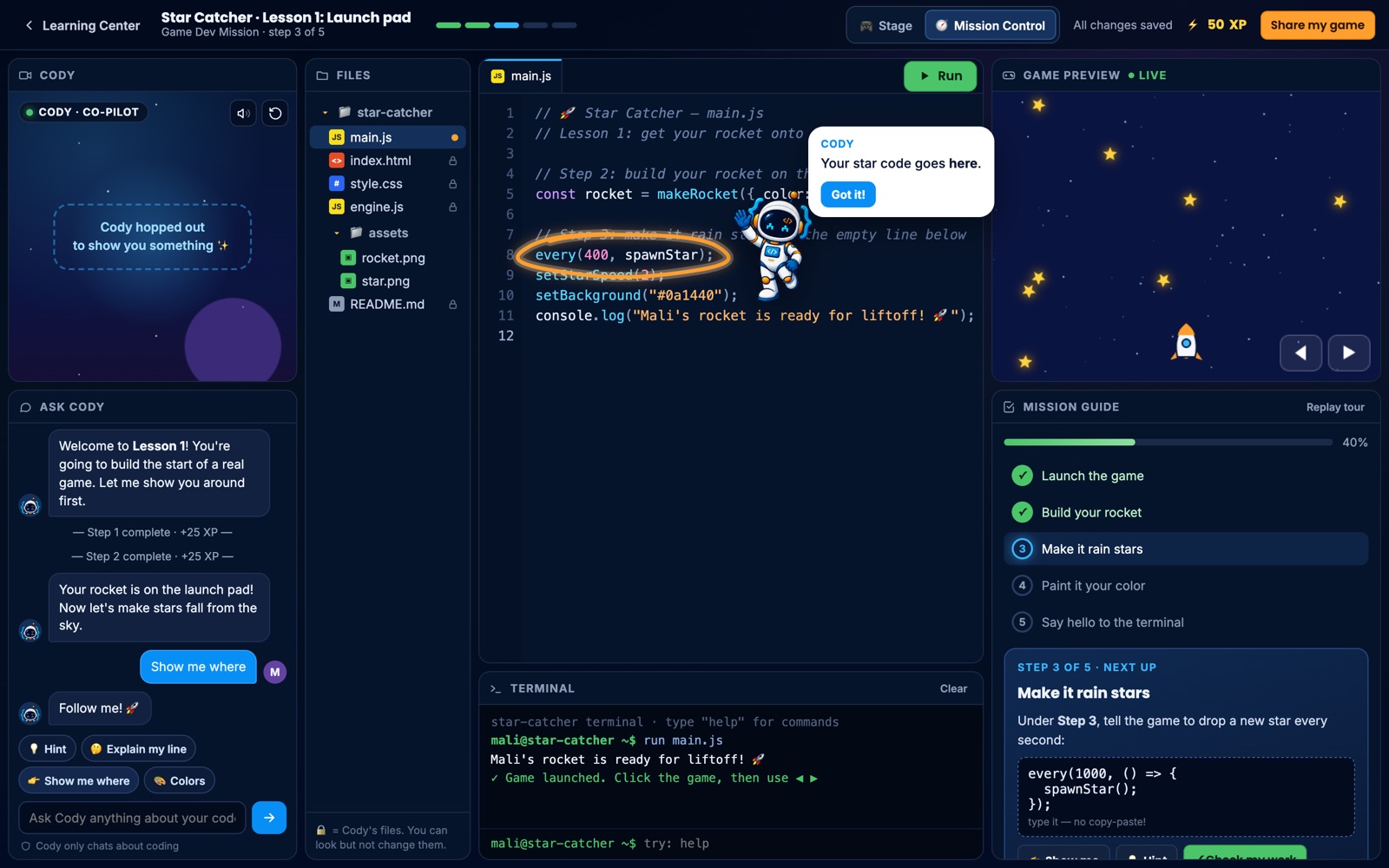
Have a look at Star Catcher, the mission where a nervous robot is waiting for his help.
See how Star Catcher worksQuestions parents also ask
Should I tell him he's smart when he says he's stupid?
Tell him something true and specific instead. “Smart” is a verdict he can argue with; “You worked out the last two on your own” is a fact he can't. Keep it plain, without “incredible” or “genius”: gushing tends to backfire with kids who are low on confidence, and a specific fact gives him something to hold on to.
Could he be saying it to get attention or get out of the work?
Sometimes, and that's fine to notice. Kids say it to vent, to be comforted or to escape a hard task. Your answer is the same either way: one calm line, then back to the next small step. He gets comfort without the label becoming a big scene. If it keeps coming back, it's telling you something real, so look for the pattern.
What if he really is behind at school?
Then be honest: behind and stupid are different things, and behind can be fixed. Ask the teacher exactly where he's slipping, check whether a learning difference could be part of it, and rebuild from the last thing he does well. A clear plan is more believable to him than being told everything's fine.
Is coding too hard for a kid who already thinks he's stupid?
A good first course starts smaller than he expects. In Star Catcher the very first step is pressing Run, and Cody explains each new word right after he sees it work. Wrong code shows him what happened instead of marking him wrong. That's what makes code good for confidence: the computer does exactly what he typed, so when it works, he knows he did it.
Was this answer helpful?
What was missing?
Sources
- High Praise Could Backfire on Kids with Low Self-Esteem, The Ohio State University, College of Arts and Sciences (2014) ↩
- What should I do when my child says “I’m stupid”?, Bob Cunningham, EdM, Understood ↩
- Cultivating Confidence, Angela Duckworth, Character Lab (2020) ↩
- Depression in Children and Teens, HealthyChildren.org, American Academy of Pediatrics ↩
- 988 Lifeline, 988 Suicide & Crisis Lifeline ↩
- When Being Called “Incredibly Good” Is Bad for Children, Association for Psychological Science, on Brummelman et al., Psychological Science (2014) ↩
Keep reading
More in Confidence and focus MotivationMy child quits everything. How do I help them stick with something?Your child is in good company. The average kid quits a sport by age 11, most often because it stopped being fun.
 PotentialMy child is gifted but lazy. What can I do?Praise how your child works instead of how smart they are, and hand them challenges where mistakes are cheap. The “gifted” label is often the reason effort feels risky.
 ConfidenceMy son wants me to do everything for him. How do I get him to figure things out on his own?Stop answering the first call. When he asks, have him read the problem aloud, ask what he's tried and give one clue instead of the fix, so being stuck turns into something he works through.
 SchoolMy child hates math. What can I do?Start by finding which part he hates: the speed, a gap from an earlier year, or the fear of being wrong. Then give math a job he cares about, through games, cooking, money or code.