My child quits everything. How do I help them stick with something?
Short answer
Your child is in good company. The average kid quits a sport by age 11, most often because it stopped being fun.1 A good story pulls kids back three ways, with a role to play, someone counting on them and an ending to reach. Pick activities built like that, with a finish line agreed up front.
Why does my child quit everything they start?
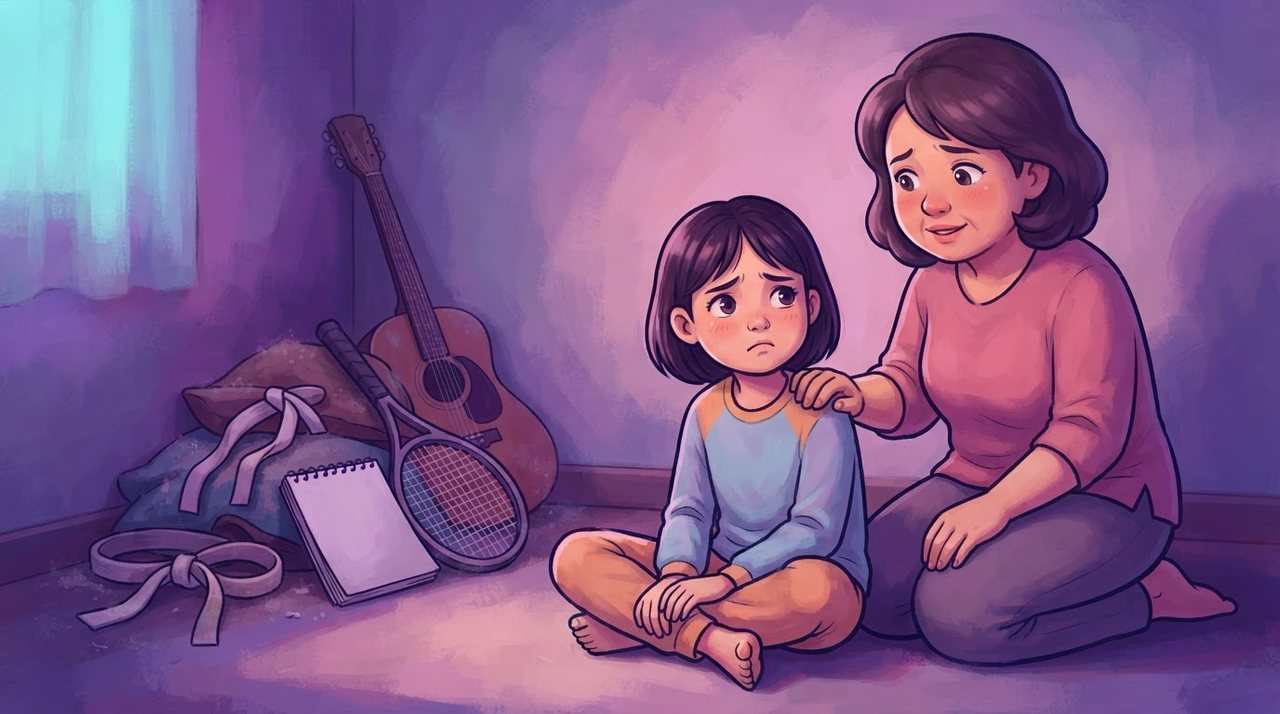
Because the start is the best part of almost anything, and the slog comes right behind it. Swim is fun until the splashing turns into laps. Piano is fun until the second book. Robotics camp is fun until the robot won't turn left. Each time, your child comes home sure that this one is boring or the coach is mean. Each time, you let it go, because nobody wants to drag a crying kid to the pool.
Then it adds up. The ukulele lives under the bed with the fees you won't see again. You hear yourself telling other parents, my kid quits everything. When the next sign-up form comes home, you catch yourself wondering why this one would go any differently.
Is it normal for kids to quit this much?
Yes. A 2019 national survey of sports parents by the Aspen Institute and Utah State University found that the average child spends less than three years in a sport and quits by age 11, most often because it isn't fun anymore.1
The reason matters more than the age. When a kid leaves because the fun ran out, the verdict is on the activity. A child who has quit five things has told you five times what kind of activity doesn't hold them. So the question worth asking is what would make your child look forward to the next session.
Should I worry that my child never sticks with anything?
A little, and then you can stop, because this is fixable. The real cost of leaving at the first slog is everything on the far side of it: the week the piece finally sounds like music, the day the robot turns left. Those moments are where a kid learns that being stuck is a stage you pass through. Leave early every time and you never reach them.
The pattern can change, often the moment the right thing comes along. Angela Duckworth, the psychologist who wrote Grit, describes her daughter Lucy starting ballet, gymnastics, track, handicrafts and piano with enthusiasm and dropping every one. Then Lucy landed on viola. Three years later, her interest was still growing.2 A string of quits can be a search that hasn't found its answer yet.
Why don't rules, rewards and pep talks make it stick?
They all push from the outside, so the push lasts only as long as you keep pushing. Forcing a kid to finish turns Tuesday nights into a standoff. Paying for practice works until the payments stop. Then the activity feels like a job they've been let off. Pep talks about grit bounce off a 9-year-old. Signing up for the next shiny thing restarts the same cycle with new gear.
What holds kids is a pull from inside the activity. Three things supply it, and a good story can carry all three. The first is a role to play. In a 2017 study titled “The Batman Effect,” 4- and 6-year-olds asked to stick with a dull, repetitive task, with a tempting video game on offer as a break, worked longest when they pretended to be a hero such as Batman.3 The second is someone who needs them, which learning scientists call the protégé effect. In a Stanford experiment, eighth graders who believed they were teaching their own computer character spent more time on learning activities than classmates learning for themselves. They learned more too, with the biggest gains among students who usually struggled.4 The third is an ending they want to reach. It pulls hardest when they're building it, because a half-finished game or song brings a kid back the next day. Look for all three before you pay for the next thing.
What should I try first with a kid who quits everything?
Most of these steps shape the next thing your child tries. They work with any activity. None of them costs a cent.
- Talk about quitting on a calm evening, never on the drive home from a bad practice. Ask what they liked at the start and the exact moment it stopped being fun. Write both down, because "the drills got boring" and "the coach yells at me" need different fixes.
- In the moment they want to quit, hand them a role. Ask what a hero of theirs would do in this exact spot, whether that's a striker, a speedrunner or a starship captain, or let them coach themselves by name: "What's Maya's next move?" In the Batman Effect study, young children worked longest as a hero and second-longest when they thought about themselves in the third person.3 Then slow it all down. Shrink the next step, take a few slow breaths, set a timer for one more five-minute try, and treat asking for help as part of trying.
- Agree on the finish line before the first day: a season, a term, a recital, the end of the story. Under the Hard Thing Rule that Duckworth's family lives by, everyone picks their own hard thing and may quit only at a natural stopping point, never on a bad day.2
- Let your child choose between two or three options you're happy with, since a kid who picked it has a stake in it.
- Pick by pull. Before you pay, ask whether it gives them a role to play, someone counting on them and an ending they'll want to reach. The best endings are things they make and can show you.
- Make progress visible. Break a big goal into pieces they can finish in one sitting. Mark each one done where they can see it.
- Praise the fixing. "You figured out why it broke" teaches more than "you're so smart." "You can't play it yet" keeps the door open.
- Check whose goal it is. If you'd be more upset than your child about quitting, the goal may be yours. Kids feel that pressure.
How will I know my child has found the thing that sticks?
You'll know when they ask for it before you bring it up. Suppose the ukulele under the bed belongs to a fourth grader who has quit swim, piano and a robotics club in two years. His parents try one more thing. This time they choose by pull: he gets to be the captain of a small ship, a character is stranded until his code works, and the finish line is a game he'll build himself.
On the first night he gets something wrong and the screen does something ridiculous. He laughs, finds the line and fixes it. On the third night he asks to keep going before anyone mentions it. Nobody had to bribe him or set a timer. A character was counting on him.
How Codestronauts uses story to keep kids coming back
We built Codestronauts for the kid with the ukulele under the bed. In Star Catcher, our opening mission, a child between 8 and 12 learns to code inside a story that pulls all three ways. Your child's first press of Run wakes Cody, a robot co-pilot made mostly of nerves and jokes, and she makes them her captain on the spot. From then on, each line of code your child types pushes the story ahead. They rebuild the Star Catcher, teach it to fly and light the Great Beacon again, one cliffhanger at a time. In Radio Silence, episode four, Cody's voice is gone. Getting it back is up to your child.
It's all real JavaScript, typed by hand. The first line, makeRocket();, builds a ship out of words. Mistakes play out on the viewscreen, sometimes as a pile of rockets where one should be. Cody explains what went wrong and hints at the fix without handing it over. Her help fades as your child gets better. The finish line is in view from day one: five episodes that add up to about two hours, each short enough for one sitting, at your child's own pace. Waiting at the end is a working arcade game they coded, steered with the arrow keys, with sound, levels, a running score and a final boss they designed. The whole mission costs $29.99, paid once and shared by siblings. Your PIN-locked Parent Corner shows you every step.
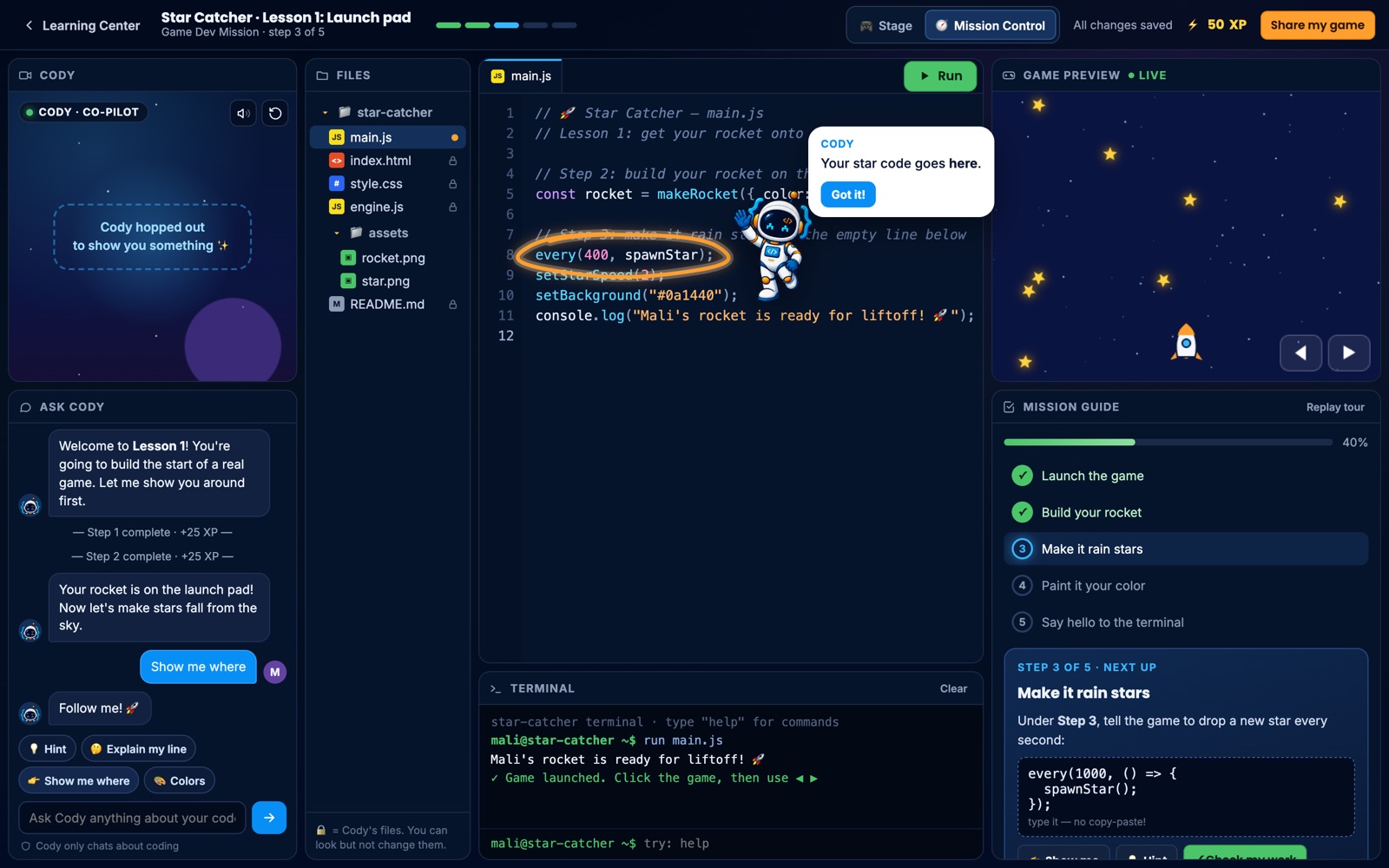
See the ship your child would captain and the game they would finish building.
See how Star Catcher worksQuestions parents also ask
Should I let my child quit an activity they hate?
Usually yes, once you know why. A harsh coach, a bully on the team or months of real dread are reasons to stop now. Plain boredom in week three tends to pass, so for that one, hold to the finish line you agreed on. When they do stop, ask what they'd want from the next thing, so each choice is better than the last.
How long should a child stick with something before quitting?
Until the natural end you agreed on at the start, such as the end of the season, the term or the recital. For something new, keep the first commitment short enough that the end is in sight, a few weeks or a single term, then decide together whether to sign up again. Kids handle a commitment far better when they know exactly when it's over.
Is it bad to bribe my child to keep going?
A small treat can get a kid through a rough week, but it makes poor glue. Once the reward is the reason, the activity starts to feel like a chore, and kids tend to drop it when the rewards stop. Save rewards for finishing a stretch you agreed on. Put your effort into what makes the activity worth coming back to.
Could quitting everything point to something deeper?
Sometimes. If your child is also drifting from friends and old favorites, sleeping or eating differently, or seems worried or low most days, talk to your pediatrician. Anxiety, trouble focusing and feeling behind can all show up as quitting. If none of that fits, treat it as a search for the right pull and keep looking.
He's quit piano, swim and robotics. Why would coding be any different?
Coding gets dropped like anything else when it's a string of puzzles with nothing riding on them. It holds kids when their code makes something happen that they care about: a character who depends on them, a story their code pushes forward, and a game they can show off at the end. That's the bar we built Star Catcher to clear.
Was this answer helpful?
What was missing?
Sources
- Survey: Kids quit most sports by age 11, The Aspen Institute's Project Play ↩
- Grit: The Power of Passion and Perseverance (an excerpt, pages 241–242), Character Lab (Angela Duckworth) ↩
- The “Batman Effect”: Improving Perseverance in Young Children (Child Development, 2017), University of Minnesota (White, Prager, Schaefer, Kross, Duckworth and Carlson) ↩
- Teachable Agents and the Protégé Effect: Increasing the Effort Towards Learning (Journal of Science Education and Technology, 2009), Stanford Graduate School of Education (Chase, Chin, Oppezzo and Schwartz) ↩
Keep reading
More in Motivation and sticking with it PotentialMy child is gifted but lazy. What can I do?Praise how your child works instead of how smart they are, and hand them challenges where mistakes are cheap. The “gifted” label is often the reason effort feels risky.
 MotivationMy 9-year-old says every learning app is boring.He's probably right, and his verdict is worth listening to.
 ConfidenceMy son wants me to do everything for him. How do I get him to figure things out on his own?Stop answering the first call. When he asks, have him read the problem aloud, ask what he's tried and give one clue instead of the fix, so being stuck turns into something he works through.
 ConfidenceMy child keeps saying he's stupid. What can I do?Skip the argument and hand him proof. Answer calmly, find out what he's stuck on, then set up small, real wins he can point to later.