My 9-year-old is always bored. What should I do?
Short answer
A 9-year-old who is always bored usually has too little in the day that fits their level or matters to them.
It's worth catching now.
Gallup's student surveys find 74% of fifth graders highly engaged at school, and only about a third of high schoolers.1
Give them one real problem to own, then step back.
Is it normal for a 9-year-old to be bored all the time?
Bored now and then is normal at any age. Bored nearly every day is a pattern, and at 9 it has a familiar shape.
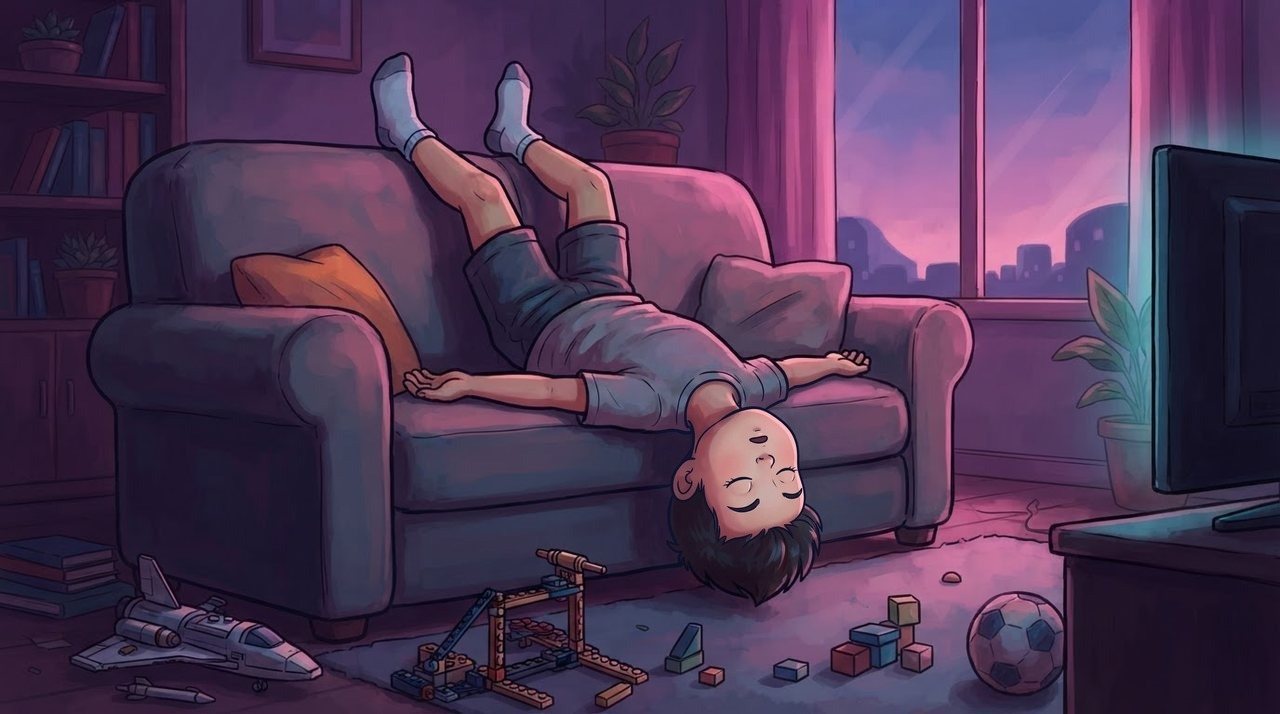
The bus drops them off, and before the backpack hits the floor you hear it: "I'm bored." You offer the Lego, the bike, the library book they begged for last week, and each one gets a shrug or a flat "that's boring." Homework gets the bare minimum. The tablet holds them for an hour, then that's boring too. You can spend a whole Saturday at the water park and still hear "there's nothing to do" before dinner.
What stings is remembering the younger version. At 4 or 5 this kid asked why about everything: why the moon follows the car, why you can't tickle yourself. Somewhere around second or third grade the questions thinned out, and "I'm bored" moved into the space they left.
Where did all their questions go?
A good share of them went into the school day, which mostly rewards finishing over wondering. When the developmental psychologist Susan Engel observed elementary classrooms, kindergartners showed two to five episodes of curiosity in a two-hour stretch. By fifth grade it was zero to two, and many children got through a whole school day without asking a single question.2 She traced it to time pressure. Teachers with a lot of material to cover come to treat questions as getting off task.
Erin Westgate's work on boredom at the University of Virginia, later published in Psychological Review, accounts for the rest. In her model, boredom has two causes: what a task demands doesn't match what the mind has to give, or the task connects to nothing the person values.3 Work that's too easy and work that's too hard both qualify. A 9-year-old who spent the day on assignments they didn't choose can come home short on both. "Bored" is the word they have for it.
That gives you two things to look for: work that fits this particular kid, and a reason they would care to finish it.
Does it matter if my 9-year-old is bored now?
It matters, because engaged kids do better on the things parents care about most. In Gallup's student surveys, engaged students are 2.5 times as likely to say they get excellent grades, and 4.5 times as likely to feel hopeful about the future, as their actively disengaged classmates.1 Bryan Goodwin's research column in ASCD's Educational Leadership cites a meta-analysis finding that effort and curiosity together count as much for success in school as intelligence does.2 Curiosity is worth protecting, and 9 is early enough to protect it.
It's also very fixable, and the same body of work shows why. Dozens of studies since the 1970s have found that children's surroundings strongly shape how open they are to exploring.2 In one study of 40 preschoolers, the children explored more with a friendly, supportive adult in the room than with an aloof, critical one.2 When Engel's team put a box with 18 drawers of odd objects into classrooms, the biggest factor in how much kids tinkered with it was how much the teacher smiled and talked encouragingly.2 Between school pickup and bedtime, you are that adult.
Why don't screens, jars, chores or classes fix it?
Each of them fills the hour and asks nothing back, when what an always-bored 9-year-old is missing is a challenge and a reason to take it on. Each one also teaches that boredom is a problem someone else solves. It's easy to end up as a full-time activity director without ever applying for the job.
Here is how the usual fixes tend to play out at this age:
- A screen ends the complaint in seconds, then sets a pace of novelty that a book or a bike can't match, so the next quiet hour feels even flatter.
- A jar of activity ideas is your list on slips of paper. At 9 kids want a say, and a slip they didn't write rarely holds them for long.
- Chores as the price of saying "I'm bored" teach them to stop telling you.
- Signing them up for another class adds one more adult's plan to the week. The art class or the chess club runs well while it's new, then joins the pile of things they used to do on Tuesdays.
- Waiting it out works for a kid with ideas and materials nearby. For a kid who is bored every day, it usually means another evening of drifting.
What works has three ingredients. The problem is the right size: hard enough to need them, small enough to crack this week. Someone needs the result, whether that's a little brother waiting for his game or a character who stays stuck until they help. And at the end they have made something they can show you. A story helps, because curiosity feeds on gaps, and Goodwin's column counts the cliff-hanger at the end of a chapter among the things that set it off.2 A school day rarely has room for a problem that takes as long as it takes. An evening at home does.
What should I try first with my 9-year-old?
Start with one evening, and trade filling the time for handing over a problem. These steps work with or without any course or app:
- Ask which kind of bored it is. Give them five words to point at: too easy, too hard, lonely, tired, pointless. Lonely and tired need you, or a snack and an early night; the other three are what the rest of this list is for.
- Hold back the rescue. Say "sounds like you need a project," then go back to what you were doing, phone away, for ten minutes. Let them see a grown-up doing something slow.
- Hand over a real problem with a deadline. The card for Grandma has to do something when she opens it, by Sunday. The marble run has to take a full minute. The cousins arrive Saturday and need a treasure hunt.
- Give the project an audience. A younger sibling, a grandparent on a video call or the class at show-and-tell turns "something to do" into something someone is waiting for.
- Leave raw materials where they will trip over them: cardboard, tape, string, a broken flashlight to take apart, an old phone for stop-motion, a library book on how things work.
- Answer some "why" questions with "let's find out," and keep one evening a week for finding out together, outside when you can.
- Ask the teacher one question: is the work too easy or too hard for them right now? Either can come home as "I'm bored," and a teacher can adjust both.
What could this look like for one 9-year-old?
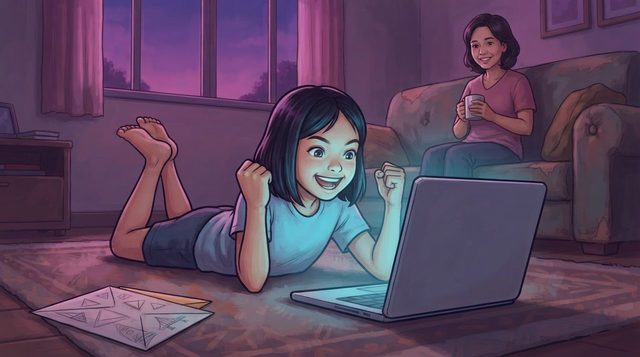
Here's how it can play out, in an example we made up. A 9-year-old girl spends her afternoons drifting from the couch to the tablet and back. On Monday her mom stops suggesting things. She mentions that the cousins are coming on Saturday and nobody has planned the treasure hunt, puts a stack of index cards on the table and goes back to cooking.
For twenty minutes nothing happens. Then the questions start. How many clues? Can one be in the freezer? Can the little cousins read yet? By Wednesday she has eight riddles and has learned, by testing them on her dad, that clue three is far too easy. On Saturday she watches four kids stall at clue five and grins through the whole thing. On Sunday she asks if she can make a harder one for next time.
Her week had the same hours in it as the week before. This time it also had a problem her size, people waiting on the result and something at the end that was hers.
When the free time lives on a screen, make the screen the project
For plenty of 9-year-olds the bored hours end up on a screen, so let the project live on one too. That's the idea behind Star Catcher, the first mission from Codestronauts, where kids 8–12 learn to code by playing through a space story. Your kid's first job is to wake Cody, a nervous little robot who needs their help. From then on, each line of code they type pushes the adventure along: the starship gets rebuilt and learns to fly, and every one of the five episodes stops on a cliffhanger. The code is real JavaScript that kids type by hand, with no blocks to drag, so a kid who finds most things too easy has something real to work at. A wrong line plays out in front of them, often to funny effect, and then Cody walks them through the bug. Cody offers hints and leaves the answers to your kid, and she helps less and less as they get better.
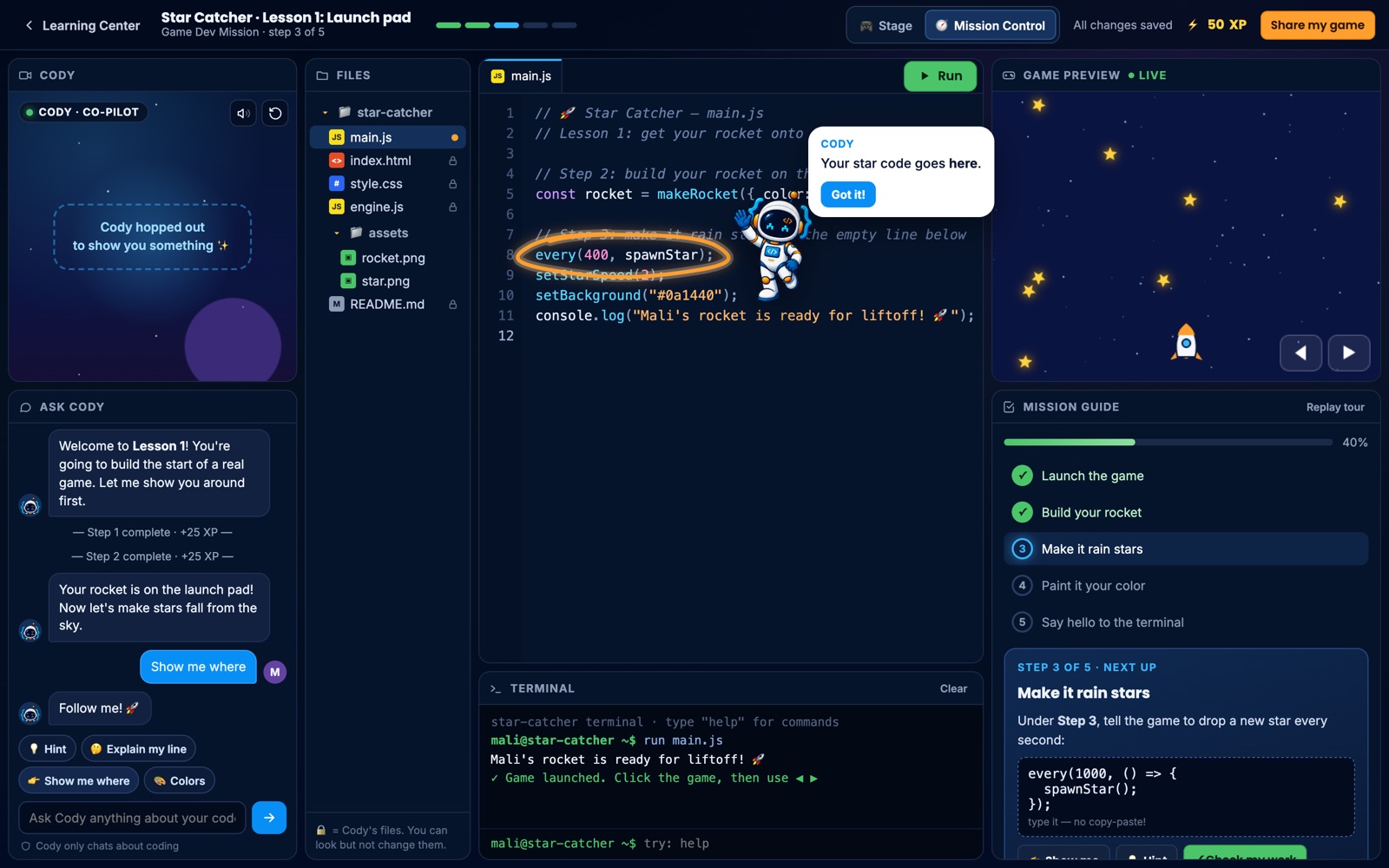
By the end they own an arcade game they made, down to the boss they invented, with arrow-key steering, levels, sound and a score to beat. The skill underneath carries over to other things. A 2019 meta-analysis of 105 studies found the biggest gains from learning to code in creative thinking, math, metacognition, reasoning and spatial skills.4 The five episodes add up to roughly two hours, taken at whatever pace suits them, in the browser. The whole mission costs $29.99, paid once, and you keep the keys in the Parent Corner, which only your PIN opens.
See the mission your 9-year-old would play, and the arcade game they would finish with.
See how Star Catcher worksQuestions parents also ask
Should I let my 9-year-old be bored sometimes?
Yes. Empty time is where kids practice choosing what to do, and plenty of good ideas start there. Westgate compares boredom to pain: unpleasant, but useful feedback about whether we want to, and can, focus on what we're doing.3 The trouble starts when that feedback has nowhere to go. Keep some unplanned time in the week, and keep materials and half-finished projects within reach so the boredom has something to push against.
Could constant boredom be a sign of something else?
Sometimes. Talk to your pediatrician if the boredom comes with sadness or irritability, a loss of interest in things they used to love, changes in sleep or appetite, or trouble focusing everywhere, games included. Kids with ADHD or anxiety often feel boredom more sharply. If it mostly shows up at school, ask whether the work is too easy or too hard. A bright kid coasting through easy work gets bored, and so does a kid who is lost and calls the class boring.
Is my 9-year-old bored because of screens?
Screens are part of it. A feed or a fast game serves up something new every few seconds, so a book or a puzzle feels slow next to it. Bans tend to start fights at this age. Changing what the screen is for works better: a stop-motion film, a comic or a game they make asks for effort and gives back something they built.
Is 9 a good age to start coding?
Yes. Most 9-year-olds read well enough to type real code, and they are old enough to want something grown-ups use. Codestronauts is made for kids 8–12. Episode 1 opens with your kid pressing Run, and Cody names each new word just after they see it work, so a 9-year-old who has never coded can begin there.
Was this answer helpful?
What was missing?
Sources
- School Engagement Is More Than Just Talk (Tim Hodges, 2018), Gallup ↩
- Curiosity Is Fleeting, but Teachable (Bryan Goodwin, Educational Leadership, Sept 2014), ASCD ↩
- Why Boredom is Interesting (Erin Westgate, doctoral dissertation, 2018), University of Virginia ↩
- Some Evidence on the Cognitive Benefits of Learning to Code (Scherer, Siddiq and Sánchez-Scherer, 2021), Frontiers in Psychology ↩
Keep reading
All answers SchoolMy 9-year-old can swipe through an iPad but can barely type on a laptop. When should kids learn to type?Start now. "Most research supports starting students on formal keyboarding around grade 4," says occupational therapist Theresa Tovey, and fourth-graders are 9 or 10.
 AIHow do I explain how AI works to my 9-year-old?Give your 9-year-old three plain ideas: a computer does exactly what it's told, AI is a program that learned to guess from millions of examples, and a person still directs it and checks its guesses.
 PotentialMy 9-year-old daughter wants to be a doctor. Should she learn to code?Yes. Medicine runs on software now, and she'll spend her working life inside it. In one study, family doctors spent nearly 6 hours of an 11.4-hour workday in the electronic health record.
 ScreensAre there educational games my kid will actually want to play?Yes, when the learning is the gameplay. Kids drop quizzes dressed up as games and stick with games where the skill is how you win.