My child is gifted but lazy. What can I do?
Short answer
Praise how your child works instead of how smart they are, and hand them challenges where mistakes are cheap.
The “gifted” label is often the reason effort feels risky.
In Carol Dweck's experiments, 90 percent of fifth graders praised for effort chose harder puzzles, while most praised for being smart chose the easy ones.1
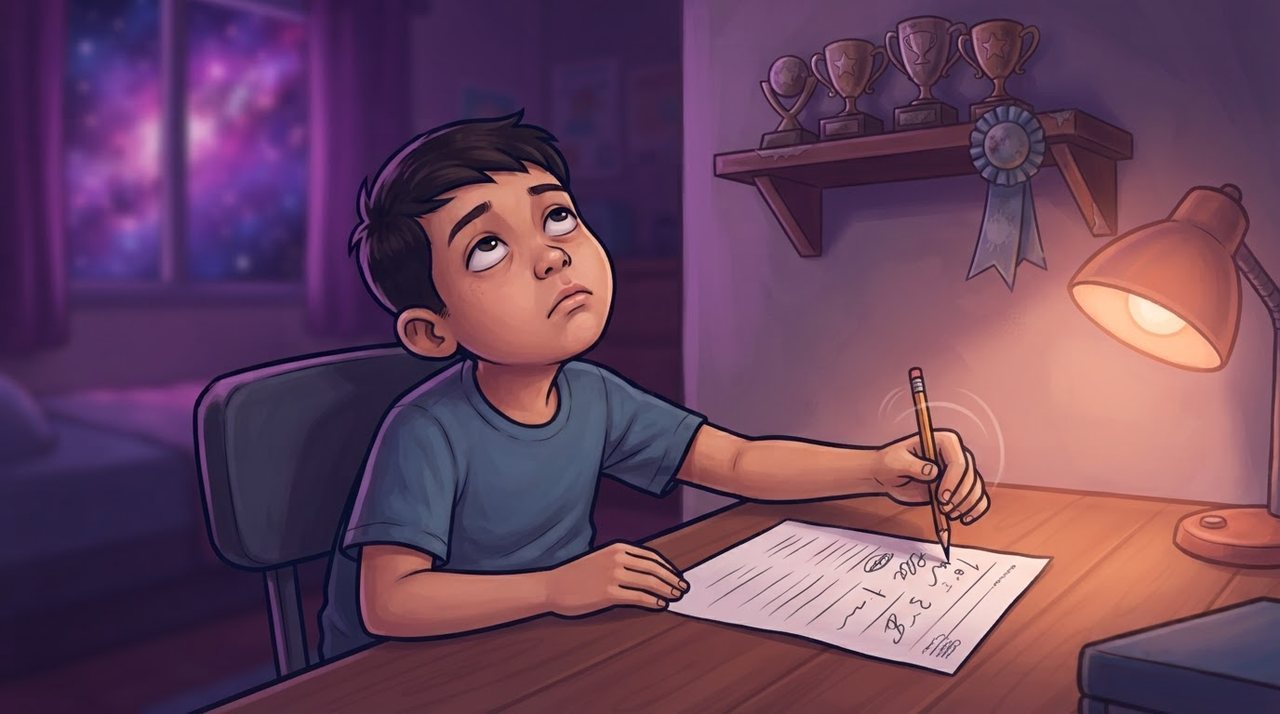
Is my child lazy, or is something else going on?
Usually something else, and the clue is where their effort goes. The math sheet that should take ten minutes is still blank at eight o'clock. The history project gets three sentences, written in the car on the way to school. At every conference the teacher says your child is one of the brightest in the class and could do so much more if they tried. Anything with a grade attached gets the bare minimum.
Then you walk past their room and find them on the fortieth attempt at the same boss fight, jaw set, refusing to quit. That child has plenty of effort. They spend it where it feels safe and pays off fast, and somewhere along the way school stopped being that place.
Why would a gifted child avoid trying?
For a child who has been told they're smart, effort can feel like a threat. Psychologist Carol Dweck showed this with New York fifth graders, who each solved a round of easy puzzles and then heard one sentence of praise, either for being smart or for working hard.1 Offered a harder round next, 90 percent of the children praised for effort took it, while most of those praised for intelligence picked the easy one.1
Dweck's explanation fits the gifted-but-lazy pattern closely. Children who believe being smart means finding things easy come to treat challenges, mistakes and even the need to try as threats to their ego.2 If you never really try, a B says nothing about your brain, so coasting keeps the label safe. Games feel different. The level doesn't judge anyone, a lost life costs ten seconds, and nobody is grading how clever you are. The effort shows up wherever failing is cheap.
What happens if they keep coasting?
The bill tends to come due when school stops being easy. Around the move to middle school the work gets harder for everyone, and a child who has never practiced struggling meets it all at once. Dweck describes these children losing confidence and motivation when the work is no longer easy for them.2 Grades that used to come for free start to slip, and the child concludes they were never that smart after all.
This is fixable. The habit was learned. In Dweck's experiment, a single sentence of praise was enough to change which puzzles a ten-year-old would attempt.1 Everyday words and the right kind of challenge can move it back the other way. Between eight and twelve is a good time to do it, while a hard week still costs nothing that matters.
Why does pushing a gifted kid harder usually backfire?
Because each push works on effort without changing what effort means to the child. A sticker chart buys a good week, until the novelty wears off. Taking away the tablet turns homework into a contest of wills, and bright kids are very good at contests of wills. The pep talk is the sneakiest trap, because “You're so smart, you could do this in your sleep” repeats the exact message that made trying feel risky. Harder work is part of the answer, but on its own it gives a child who is guarding the label harder things to avoid.
Pressure about the future backfires as well. Ellen Braaten, a psychologist at Massachusetts General Hospital, traces a lot of parental micromanaging to worry about what will become of the child.3 Wanting them to reach their potential is, as she puts it, “an awful lot of pressure to put on a child,” and “kids who are put under too much pressure will start to refuse to do things.”3 When the pushback is fierce, ask yourself whether it's aimed at the work or at you.
What works looks a lot like the game they already grind. Look for problems hard enough that nobody expects them solved on the first try, feedback aimed at the work instead of at the child, and progress they can see. Above all, look for a reason to try that has nothing to do with proving they're smart. When a character in a story needs their help, the question in their head moves from “Am I smart enough?” to “Can I fix this?”, and that one is safe to work on. A project with no answer key, such as building a game or a machine, gives a gifted kid that in a way a worksheet can't.
What can I do this week to bring the effort back?
Start with your own words, then change what your child practices on.
- Praise the process out loud, starting with the game. Ask how they finally beat that level, let them walk you through all forty tries, and call it what it was, hard work, so they hear that the effort is already theirs. Then trade “You're so smart” for what they did, as in “You tried three ways before that one worked.”
- Find the exact sticking point. Braaten puts it plainly: “It's important to identify the specific roadblock that's hanging them up.”3 Small, concrete questions get further than “Why won't you just do it?” Try “Do you have what you need?” or “What is this sheet asking you to do?”
- Map what's left. Braaten counts knowing how close you are to done as part of persistence, and suggests “helping them figure out where they are at in the process and what they still need to finish.”3 A short list of what remains turns an endless evening into a few small jobs.
- Hand them one thing hard enough to fail at first, like a tricky puzzle or a bit of code, and struggle alongside them. Saying “this is hard, that's why it's fun” when you mean it does more than any lecture.
- Ask the teacher whether the work matches what your child already knows. From the outside, boredom and laziness look the same.
- Keep “gifted” out of their identity at home. Braaten names making giftedness a big part of who the child is as one of the biggest mistakes she sees parents of gifted kids make.3
- Aim your expectations at what they love. Braaten finds that parents' expectations for gifted kids tend to run too high and toward the wrong things, and she tells them, “Make sure you're aligning your child's abilities and what brings them meaning and joy.”3 A child who is quick at math and lit up by building may go further through the building.
- Listen more as they get older. “The older kids are, the more you need to listen, and the less you should give advice,” Braaten says.3 Ask how they plan to tackle the project, and let them run their plan before you offer yours.
- Rule out the other causes. If your child can't start even the things they enjoy, or the slide was sudden, talk to your pediatrician about attention, anxiety or a learning difference, which a bright child can hide behind good scores for years.
What does it look like when it starts to turn around?
Consider, as an example, a fifth grader who tested into the gifted program at seven and has coasted ever since. Homework is a nightly standoff, and her reading log is fiction in both senses. Her parents stop calling her smart and start asking about the platformer she's been stuck on all week. She explains, in great detail, six different ways she has tried the jump.
That weekend they give her a small coding project: make a character walk across the screen. It breaks three times. The first two times she declares the whole thing stupid. The third time she reads the error message, finds the typo herself and calls everyone in to watch it run. Her grades won't move this week. Still, she has felt effort pay off on something she cares about, and her parents saw it and named it. That feeling is what she carries back to the math sheet.
How does Codestronauts help a gifted kid who coasts?
Codestronauts built its first mission, Star Catcher, around the things games get right. Made for 8-to-12-year-olds, it's a space adventure in which Cody, a nervous robot, needs your child. They wake her, rebuild a starship and fight to relight the Great Beacon, and every line they write moves the story on. In the fourth episode, Radio Silence, Cody loses her voice and only your child can bring it back. Everything they type is real JavaScript, starting with the line that builds the ship, so a fast learner never gets stuck dragging blocks. Each new piece works on screen before Cody explains it, which suits a quick kid who would rather see than be told. When it's wrong, they watch it misfire in the game, often comically, and Cody walks them through why. She hints instead of handing over answers and steps back as your child improves, so the work keeps asking for real effort. For a kid who has learned to hide from effort, trying becomes the point of the game, and a mistake is just the next clue.

Over five episodes and roughly two hours, taken at their own pace and each ending on a cliffhanger, that effort becomes an arcade game your child built, with a boss they designed, levels, a score, sound and arrow-key controls. The asking comes from Cody, so you can stop being the one who pushes. The Parent Corner, behind your PIN, still shows you every step. It runs in the browser with nothing to install, and one payment of $29.99 covers the whole mission for every sibling.
Take a look at the mission your child would play, from waking Cody to designing the boss.
See how Star Catcher worksQuestions parents also ask
Is my gifted child lazy or just bored?
Often bored, at least in part. A Johns Hopkins analysis, summarized by the Fordham Institute, put the share of American elementary and middle school students already working above grade level in reading at roughly 20 to 40 percent.4 For a child that far ahead, the worksheet covers something they learned last year, and the bare minimum is a sensible response. Ask the school whether the work can be pitched higher, and find real challenge outside school as well.
Should I stop telling my child they're smart?
You don't have to ban the word. Make it rare, and make praise for process common: the strategy they picked, the way they kept going, the fix after the mistake. Those are things your child controls and can repeat. When you do say smart, attach it to something they did, as in “That was a smart way to test it.”
Could it be ADHD or anxiety instead of laziness?
Sometimes, and it's worth checking. Braaten points to anxiety about a task, and to trouble with executive functioning (the skills that plan and start work), as roadblocks that can pass for laziness.3 Raise it with your pediatrician or the school psychologist if your child struggles to begin even things they enjoy, if the change was sudden, or if they work hard and still fall behind. Gifted children can have ADHD or a learning difference too.
Is coding a good fit for a gifted child who won't try?
It suits this problem well. Code answers in seconds, and its complaints are about the program, never the programmer. Errors are an everyday part of the job for every coder, so a mistake reads as normal. And there's always something harder to build, which means a quick kid never runs out of challenge. For a bright 8-to-12-year-old, pick real typed code over drag-and-drop blocks; in Star Catcher, the first line a kid types builds their ship.
Was this answer helpful?
What was missing?
Sources
- How Not to Talk to Your Kids, Po Bronson, New York Magazine, 2007 ↩
- The Secret to Raising Smart Kids, Carol S. Dweck, Scientific American ↩
- Why Your Gifted Kid Seems Lazy And Unmotivated, Fatherly, interviewing Ellen Braaten, Ph.D., Massachusetts General Hospital ↩
- Addressing the learning needs of students performing above grade level, Thomas B. Fordham Institute, on a Johns Hopkins Institute for Education Policy report (2016) ↩
Keep reading
All answers MotivationMy 9-year-old is always bored. What should I do?A 9-year-old who is always bored usually has too little in the day that fits their level or matters to them. It's worth catching now.
 MotivationMy child quits everything. How do I help them stick with something?Your child is in good company. The average kid quits a sport by age 11, most often because it stopped being fun.
 SchoolSchool is too easy for my child. What should I do?Ask the school to skip what your child already knows and fill that time with harder work, and give them real difficulty at home.
 ConfidenceMy child keeps saying he's stupid. What can I do?Skip the argument and hand him proof. Answer calmly, find out what he's stuck on, then set up small, real wins he can point to later.