My 10-year-old can binge a whole series in a weekend but can't focus on homework for 20 minutes. Why?
Short answer
Because a series is built to keep kids watching, and homework isn't.
Every episode ends on an open question and the next one starts by itself. When University of Chicago researchers had Netflix users turn autoplay off, sessions ran about 18 minutes shorter.1 A show supplies the pull. Homework asks your kid to bring their own.
Can they really focus, or do they just like the show more?
Usually they can, and a good story does a lot of the focusing for them. Hours of watching don't rule out an attention problem, though, and the first question at the bottom of this page says when to ask a doctor.
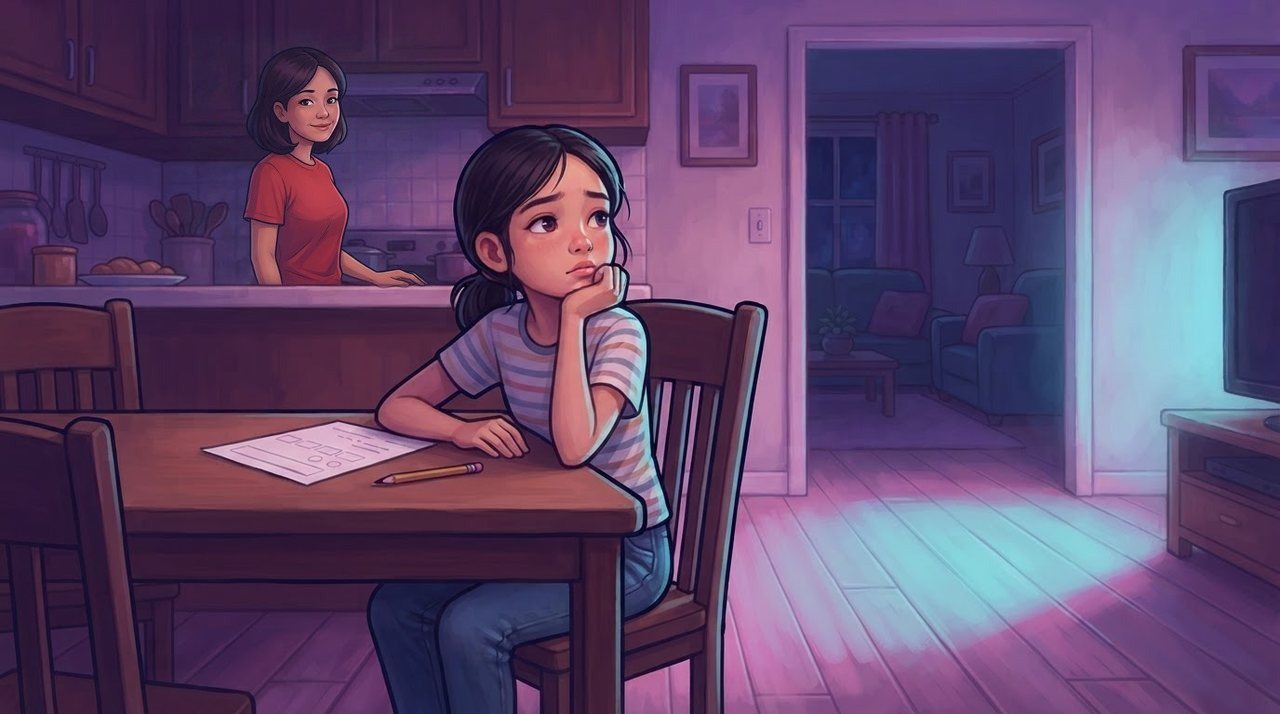
It's Sunday night. Your 10-year-old started a new series after dinner on Friday, finished the season by Saturday bedtime and can retell every twist. Now a page of fraction problems sits on the kitchen table. Twenty minutes in, they've sharpened two pencils, gone for water, asked what's for dinner and written their name. It's the same kid, two days apart.
Daniel Willingham, a professor of cognitive psychology at the University of Virginia, describes the same split: “Even small children who have difficulty focusing in class will sit with rapt attention in the presence of a good storyteller”.2 Psychologists call stories “psychologically privileged,” he writes, meaning our minds treat them differently from other material.2 Stories stick, too: in one study he describes, people remembered about 50 percent more from stories than from plain explanatory passages.2 The weekend binge is a brain doing what brains do with a well-built story.
Doesn't a whole weekend of watching prove they could concentrate if they wanted to?
It proves a show can hold them. Holding their own attention on a worksheet is a different job.
“Continuous activity doesn't mean sustained attention,” says Ron Steingard, a child and adolescent psychiatrist quoted by the Child Mind Institute. On a fast-moving screen, he says, “short bursts of attention are all that's involved”.3 Natalie Weder, a child and adolescent psychiatrist at the Child Mind Institute, adds that in a cartoon like SpongeBob “there's never a second when there's nothing happening on the screen”.3
A series stacks story on top of that pace. Willingham's definition of a story starts with a goal and something in the way: “In every story, a central character has a goal and obstacles that prevent the goal from being met”.2 Each episode ends with the obstacle still standing, and the platform makes stopping hard. Brennan Schaffner, who led the Chicago autoplay study, says Netflix's 5-second countdown “is hardly enough time for viewers to consider, or even just re-visit, their original intentions”.1
Homework arrives with none of that. The problems belong to nobody your kid cares about, finishing number four changes nothing they can see, and the last question leads nowhere. So the weekend and the worksheet test different things. One shows how well a story can steer them. The other asks a 10-year-old, at the end of a school day, to do all the steering. The useful question for a parent is what happens when the work comes with some of a story's pull.
Does it matter if every homework night turns into a standoff?
It matters, because the habit compounds. It's also very fixable.
Homework gets longer and less guided from here, through fifth grade and into middle school. When every assignment needs a parent to supply the push, evenings harden into a routine: you nag, they stall, and the show waits as the prize for getting through it. The bigger cost sits underneath. Steering attention onto something that matters but doesn't grab you is a skill a 10-year-old is still building, and a kid who only switches on when a screen or a parent flips the switch gets very little practice at it.
The way out shows up in the binge. The attention is there, and it answers to a well-built story. Willingham's advice to teachers is to borrow a story's parts where a whole story won't fit, since “it may still be useful to inject elements from the story format into lessons”.2 A parent can do the same at the kitchen table.
Why hasn't “no screens until homework is done” fixed it?
Because that rule sets the order of the evening and leaves homework with no pull of its own. Keep the rule. It just can't do this job alone.
Under it, homework becomes the toll before the show, and plenty of kids rush it to get back to the cliffhanger they've carried around all day. Sitting beside them works while you're there, because you become the pull, and it fades the moment you leave to start dinner. A sticker chart can't outbid a season finale. The talk about middle school sets a payoff years away against a next episode that starts on its own. Taking the show away for a week moves the fight to a new spot, and the worksheet is exactly as flat as before.
What works is giving the work the parts a story has:
- A problem worth solving, up front. A question with stakes before the first step.
- Steps that change something they can see. Each finished piece moves something forward.
- Someone who needs it done. A character, a younger sibling, a parent who has conveniently forgotten fractions.
- An ending that leaves the next step waiting. A cliffhanger, pointed at the next piece of work.
The pull of “one more episode” is a trick of story structure. It works just as well when the next scene depends on a skill your kid is building.
What can we change before tonight's homework?
Start with the screen, then give homework some story of its own.
- Turn off autoplay on every profile they watch. Netflix keeps the switch in each profile's playback settings, and YouTube has an Autoplay toggle on the video page. In the Chicago study of 76 Netflix users, that single extra click before the next episode cut viewing sessions by about 18 minutes.1
- Open homework with the problem. Before they start, ask which question looks meanest and what they'd bet the answer is. Willingham suggests teachers spend 10 or 15 minutes building interest in a problem whose solution is the material to be learned.2 At home, a ten-second bet does the same job.
- Build the work around what they love. Rewrite two of tonight's word problems so the show's characters are in them, and when a reading or writing assignment lets them choose, let them pick the topic. The Child Mind Institute suggests exactly this for reading practice: choose topics of interest.4
- Cut the work into short episodes. Ten minutes of work, a short break away from screens, then ten more. Tick off each finished episode where they can see it.
- End each stretch on a cliffhanger. Before a break, read the next problem out loud and stop there. It waits for them, half-solved in their head.
- Give the work a someone. Ask them to teach you one problem as if you've forgotten how it goes. A kid explaining it to a slightly helpless grown-up has a reason to get it right.
- Ask them what helps. At a calm moment, well away from homework, ask when focusing felt easy and why. Kids often know.
- Keep a one-week note. Jot down when focus comes easily and when it doesn't: the subject, the time, what came before. It shows you what to change, and it's worth bringing to a teacher or a doctor.
- Give one evening a week to making. Pick something where every step changes what happens next, like building a small game or coding a short animated story. Steering through the hard parts gets easier when the next scene is waiting on them.
What might the first week look like?
Here is a made-up week for a 10-year-old who finishes a whole animated series over a long weekend, then melts down on Monday over twelve fraction word problems. Her parents switch autoplay off that night, so every new episode now takes a decision. On Tuesday, homework opens with a bet: which of the twelve looks hardest, and what's the answer? She bets on number nine, works in two ten-minute stretches with a snack in between, and ends the first stretch by reading number nine out loud. Now she wants to know if she won. After she checks, she explains it to her dad, who swears he never understood it at her age.
Some nights still drag. But twenty minutes of homework stops being a standoff, and on Saturday morning she spends an hour building a small game where every line she types changes what the ship on screen does. She calls her parents over to watch it fly.
Is there learning that pulls like the next episode?
That pull is what we built Codestronauts around. Star Catcher, our first mission, designed for ages 8–12, opens on a call for help, an empty hangar and a nervous robot named Cody asleep inside it. Pressing Run wakes her. From there every line they type pushes the adventure on, and each episode breaks off on a cliffhanger, so the urge for one more lands on the next piece of code. In Thruster Trouble, the second episode, the ship waits on the viewscreen while Cody circles the one line with a piece missing, and the kid's fix is what sends it flying. Cody is fully voiced, and she needs them. She offers hints rather than answers, and says less as they get better. A mistake plays itself out in front of them, sometimes comically, before she walks them through what happened.
Your kid types real JavaScript from start to finish, never drag-and-drop blocks, across five self-paced episodes of 15 to 40 minutes, roughly two hours altogether. What they walk away with is an arcade game of their own making: they steer with the arrow keys, rack up points, climb through levels with sound effects and face a final boss whose design is theirs. Any laptop or desktop browser runs it, with nothing to download. The account belongs to you, locked behind your Parent Corner PIN. Ads and strangers stay out of it, brothers and sisters can share it, and one $29.99 payment covers the whole mission.
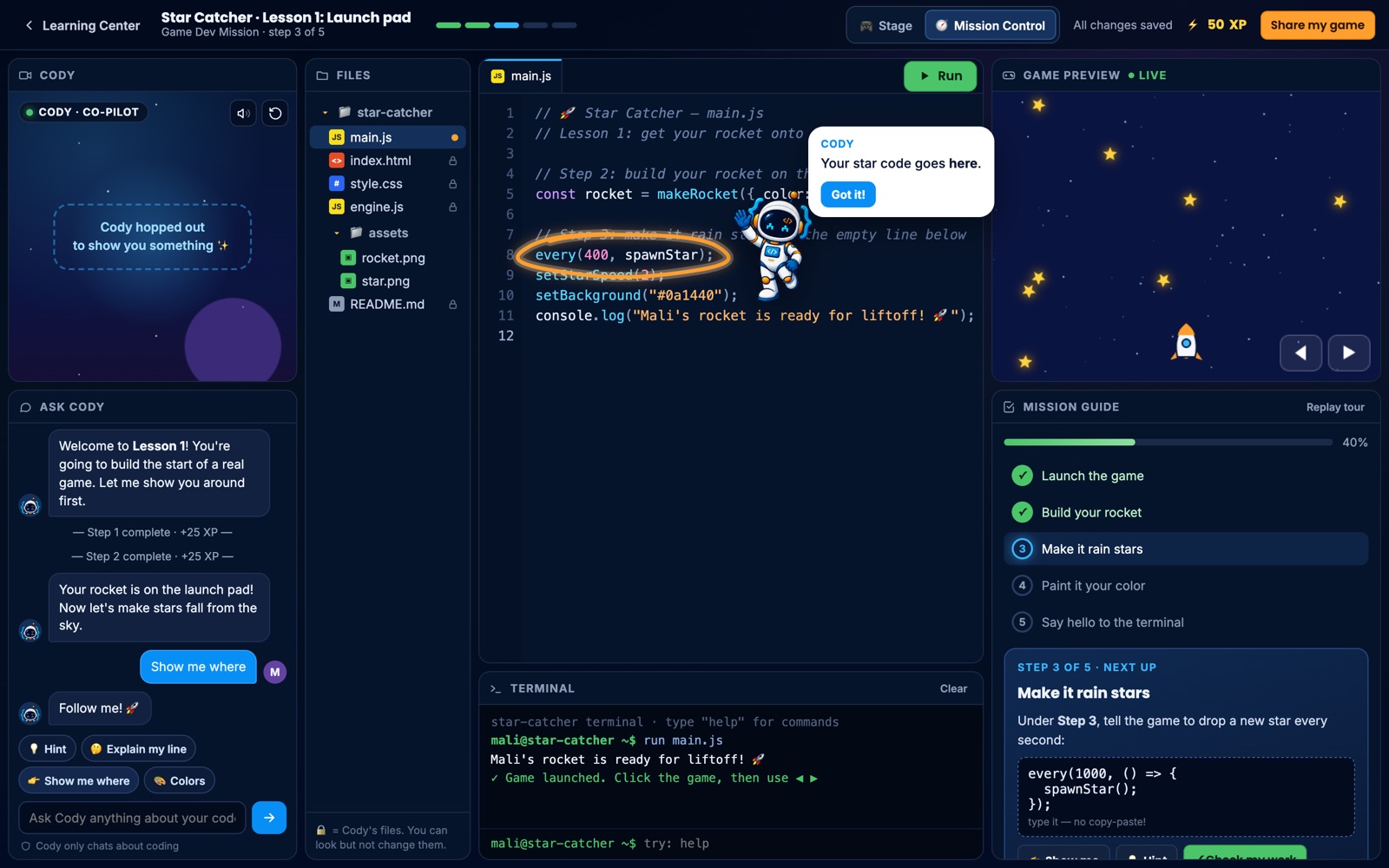
See how Star Catcher's story moves forward with every line your kid types.
See how Star Catcher worksQuestions parents also ask
Could trouble focusing on homework be ADHD?
It can be, even in a kid who watches for hours. The Child Mind Institute notes that kids with ADHD often hyperfocus on things that really interest them and struggle with things that don't.4 Ask your pediatrician if focus trouble also shows up at school and with friends, lasts for months and gets in the way of schoolwork or friendships. Stress, sleep problems and anxiety can look similar, NIMH notes,5 so a good evaluation checks all of it. Bring your one-week note.
Is binge-watching bad for a 10-year-old?
A season over a rainy weekend now and then is fine. Watch what it pushes out: sleep, homework, outdoor play and friends. Autoplay is the part to switch off, since it lets anyone lose track of time and watch more than they meant to, as the University of Chicago team warns.1 Agree on a stopping point before the show starts, at the end of an episode, and let the cliffhanger be what brings them back the next day.
Why can they remember every episode but not last week's spelling words?
Stories are built to be remembered. Willingham writes that most researchers credit the causal connections, each event causing the next, for making stories easy to remember.2 A spelling list has no causes at all. Have your kid write a silly five-sentence story that uses every word, with each sentence causing the next. The list turns into a plot.
Should screens wait until homework is done?
Yes. As a house rule it keeps the evening's order clear and ends the bargaining. Pair it with autoplay off and a stopping point agreed before the show starts. Then give homework some pull of its own with the steps above, so the show stops being the only thing worth sitting down for.
Was this answer helpful?
What was missing?
Sources
- UChicago scientists study the hidden cost of Netflix’s autoplay, University of Chicago News ↩
- Ask the Cognitive Scientist: The Privileged Status of Story (Daniel T. Willingham), American Educator, American Federation of Teachers ↩
- Do Video Games Cause ADHD?, Child Mind Institute ↩
- Hyperfocus: The Flip Side of ADHD?, Child Mind Institute ↩
- Attention-Deficit/Hyperactivity Disorder in Children and Teens: What You Need to Know, National Institute of Mental Health ↩
Keep reading
More in Confidence and focus ScreensHow much screen time is OK for a 10-year-old?A sensible start is one to two hours of fun screen time a day, homework aside, as Nemours KidsHealth suggests.
 MotivationMy child quits everything. How do I help them stick with something?Your child is in good company. The average kid quits a sport by age 11, most often because it stopped being fun.
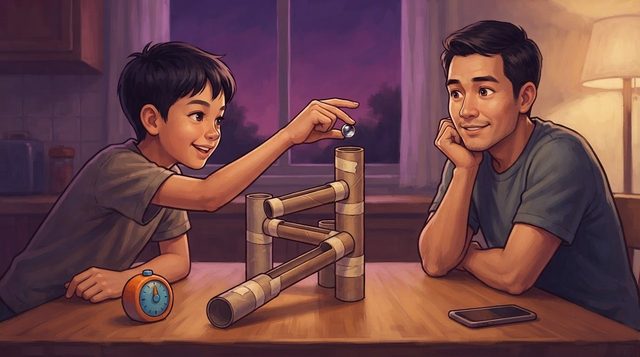 ConfidenceMy son can't focus on anything. How can I help him?Treat focus as a skill he's still building, and start with sleep: kids 6 to 12 need 9 to 12 hours a day, and regularly falling short is linked to attention, behavior and learning problems.
 Screens“My 10-year-old wants TikTok because all her friends have it.”Not yet, and say it kindly. TikTok's rule is 13 for an account, though she isn't imagining the crowd: in a 2021 University of Michigan poll, 49% of US parents of kids 10 to 12 said their child had used social media apps.