“My 10-year-old wants TikTok because all her friends have it.”
Short answer
Not yet, and say it kindly.
TikTok's rule is 13 for an account,1 though she isn't imagining the crowd: in a 2021 University of Michigan poll, 49% of US parents of kids 10 to 12 said their child had used social media apps.2
Give her a date, a way into the jokes and a screen she directs.
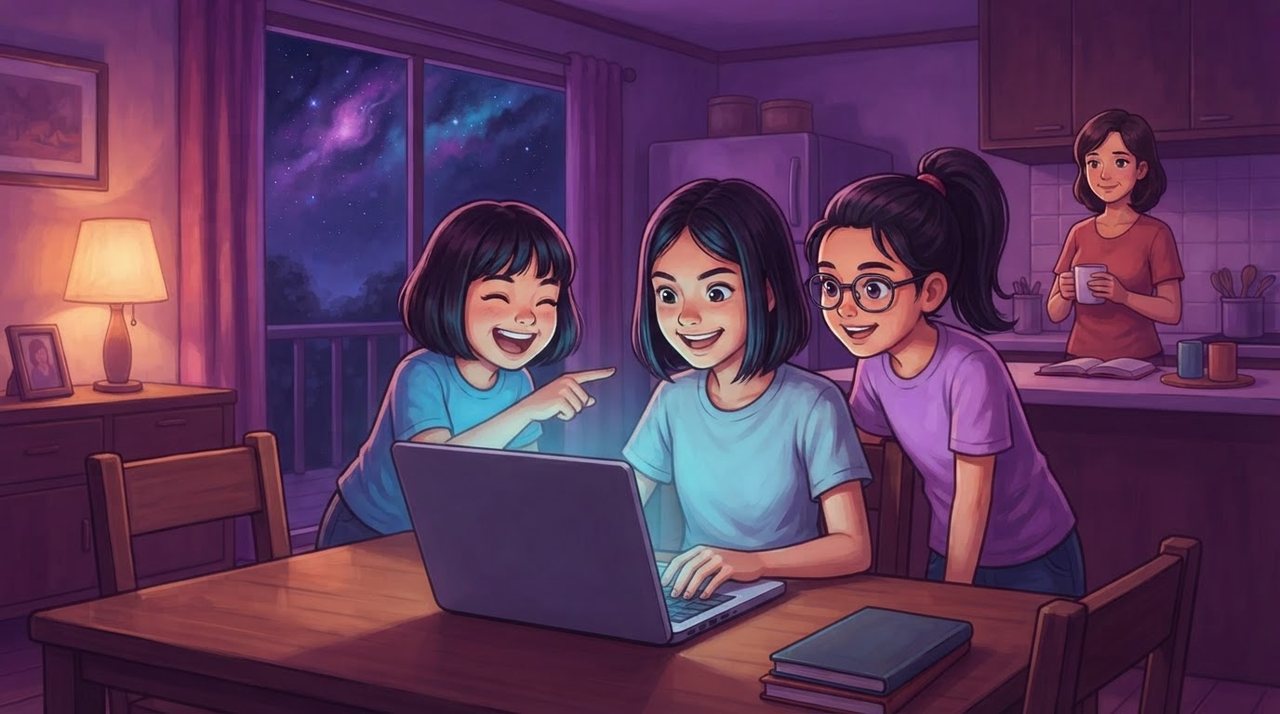
Do all her friends really have TikTok?
Some of them probably do, and the ones who don't are asking at home too. From where she sits at lunch, it looks like all of them.
The ask comes in the car, or at bedtime, with names attached: "Everyone has it. Even Mint's mum said yes." At school the girls replay a sound from last night's videos and fall about laughing, and she laughs a second late because she missed it. There's a dance going round the class that she half knows.
Listen past the app and she's asking for three things. She wants to belong, to be one of the girls who gets it. She wants in on the jokes, the sounds and catchphrases that now move through a class faster than folded notes ever did. And she wants to make something, because the dances and lip-syncs are things kids her age rehearse, film and redo until they're right. Those are good things to want at ten. TikTok is simply where her friends found them first.
Her sense of the crowd isn't far off, either. In the University of Michigan's C.S. Mott Children's Hospital poll, run in June 2021, 49% of US parents of children aged 10 to 12 said their child had used social media apps in the past six months.2 The poll's authors noted that could include versions of teen apps made for younger kids, TikTok's "younger user" section among them.2
What does TikTok actually allow at 10?
Very little. TikTok's own Guardian's Guide says you need to be at least 13 to create an account, and that the minimum can be different where local laws say so;1 its US terms put it at 14 in Florida.3
In the United States, a child who signs up with an under-13 birthday goes automatically into a separate version.4 She can watch a feed of videos checked as age-appropriate, and she can't comment, message, share her own videos or keep a profile.4 TikTok describes that version for the United States only, and its guidelines say it removes accounts when it believes the user is under the minimum age.4 The only gate is the birthday she types in: Common Sense Media's guide notes that kids can easily bypass the age rule by entering a false birth date.5
What she'd really be joining is the For You feed. TikTok's guide says the feed is built from everything she does in the app, whether she likes a post, comments, or watches a video to the end, and uses all of it to choose what she sees.1 She opens the app and the feed picks the first video, then every one after it. Common Sense describes it as an endless stream tailored to the user's interests, highly engaging but often hard to step away from,5 and adds that it learns exactly what a teen likes and gradually widens what they see beyond their usual interests.5
So under "Can I have TikTok?" sits a bigger question about her afternoons: who decides what comes next. On the For You feed, the app does.
What does waiting cost her, and what would a yes cost?
Waiting costs her something real for a while. Saying yes at ten costs more. Both can be handled.
She'll miss some jokes, learn a dance a week after everyone else, and have an afternoon or two of feeling like the baby of the group. Falling behind the other kids on a joke stings at ten, so take it seriously.
A yes now, on a made-up birthday, puts a ten-year-old in the teen app, and TikTok treats her by the age she typed. Claim 16 and direct messages open up, because TikTok only switches them off for accounts under 16.1 The things Common Sense warns parents of teens about come with it: viral challenges and trends that can pressure teens into risky behaviour,5 and shopping pushed hard through TikTok Shop, influencers and in-app purchases.5 Underneath sits the habit. Three years of a feed choosing every next video, right in the years when she's learning to run her own free time.
Every part of this can be fixed. The belonging, the jokes and the making she's after don't live inside one app, and she can have most of them within a week. The feed can wait until 13, when TikTok's teen settings and your own controls are ready for it.
Why doesn't a flat no, the kids' version or a borrowed birthday settle it?
All three argue about TikTok, while the belonging, the jokes and the making she asked for go unanswered.
A flat no tells her that her friends don't count. The ask comes back louder, or goes underground at sleepovers, on a friend's phone.
The US kids' version, where it exists, is still a feed picking her next video, and it takes away the parts she wanted: she can't post her dance, comment on her friend's video or keep a profile anyone can follow.4 For a ten-year-old who wanted in on her friends' videos, that's a hard sell.
An account on a grown-up's birthday, watched closely, breaks TikTok's own rule. Its US terms say it will ban an account it finds belongs to an under-13 outside the kids' version.3
What works is meeting each need another way and handing her the controls of something. A clear "not yet" with a date, so the no has an end. A way into the jokes and dances that runs through you and her friends instead of a feed. And some screen time that sits still until she tells it what to do: choreographing and filming a routine, drawing a comic, building something in Minecraft's creative mode, writing code. Code is the sharpest version. A feed spends the whole afternoon guessing what she'll watch next, and a program waits for her instructions and carries out exactly those.
Common Sense Media's guide gives teens on TikTok the same direction: parents should encourage them to be creators rather than just consumers.5 A ten-year-old can start on that half now, without the app.
How do I say "not yet" without making her the odd one out?
Agree with her first, give the rule an end date, then fill the gap with the parts she actually wants.
- Start with the feeling. "You're right, lots of your friends have it, and missing the joke is rubbish." Then the rule. A kid fights a rule far harder when she thinks you skipped the first part.
- Use TikTok's own number, and a date. "TikTok says 13,1 so we'll set it up together on your thirteenth birthday." Tell her what that yes looks like. Teen accounts are private by default and start with a 60-minute daily screen time limit.1 Direct messages stay off until 16, and so does having her videos shown in strangers' For You feeds.1 She can watch LIVE but can't host one,1 and spending money in TikTok Shop waits for 18.5 Link your accounts with Family Pairing and set a daily limit of your own; when she reaches it, she asks you for a one-time passcode to keep going.1 A no with an end date feels like a wait, and a ten-year-old can live with a wait.
- Call two or three other parents. "All her friends" can turn out to be two girls and somebody's big sister, and families who agree to wait together make "not yet" ordinary in that class.
- Keep her in on the jokes yourself. When a sound or a dance is going round, ask her to teach it to you, or look up that one video together on your phone and watch it side by side. She gets the reference, and the choice of video was yours, with no algorithm lining up the rest of her evening.
- Give the dances somewhere to go. Let her and a friend choreograph and film on a family phone, and keep the videos in the family: shown at dinner, sent to grandparents. She gets the rehearsing, the retakes and an audience who adores her, and nobody she doesn't know is watching.
- Lock the app store. TikTok carries a 13+ rating in Apple's App Store and is listed for Teens on Google Play, and its own guide points parents to those stores' parental controls.1 Set them to block apps above her age: Screen Time on Apple devices or Google Family Link on Android.
- Hand her one screen where she gives the orders. Pick a project with a finish line she cares about: a stop-motion short, a comic, a small game. Ask her the question that makes the difference visible: on that screen, who decided what happened next?
What could the next few months look like?
Fah's household is fictional, but its dinner-table argument is this page's. Fah is ten, and she has asked for TikTok three times this month, each time with a longer list of friends. Her mum doesn't argue with the list. She tells Fah it's fair to hate missing the jokes, marks Fah's thirteenth birthday on the family calendar as the day they'll set TikTok up together, and offers a deal for the meantime: Fah teaches her every dance that goes round the class.
The first week, Fah performs one in the kitchen with a wooden spoon for a microphone while her mum films it on her own phone. By the third weekend Fah and her friend Ying are inventing a routine of their own on Saturday mornings. Fah writes it in a notebook as numbered steps in counts of eight, crossing out moves that don't work and reshooting the ending until it lands. Grandma answers every video with a row of hearts.
Her mum notices the notebook reads like a program: steps in order, done exactly as written, fixed when they go wrong. She starts looking for a coding project for the school holidays. By the end of term two more girls from the lunch table have learned the routine, and they learned it from Fah's notebook, with no app deciding what they'd see.
Star Catcher: a story that waits for her code
Codestronauts teaches code to kids aged 8–12 inside a space story, and Star Catcher, the mission that opens it, runs the opposite way to a feed: the story goes forward on the lines she types. In Wake Up, Cody, the first episode, one press of Run on code that's already written wakes Cody, a jittery robot, in an empty hangar. The first line she writes herself builds the ship. From there she types real JavaScript herself rather than snapping blocks together, and every line carries the adventure forward: she rebuilds the Star Catcher, and the two of them go after the Great Beacon to relight it. Every one of the five episodes breaks off on a cliffhanger.
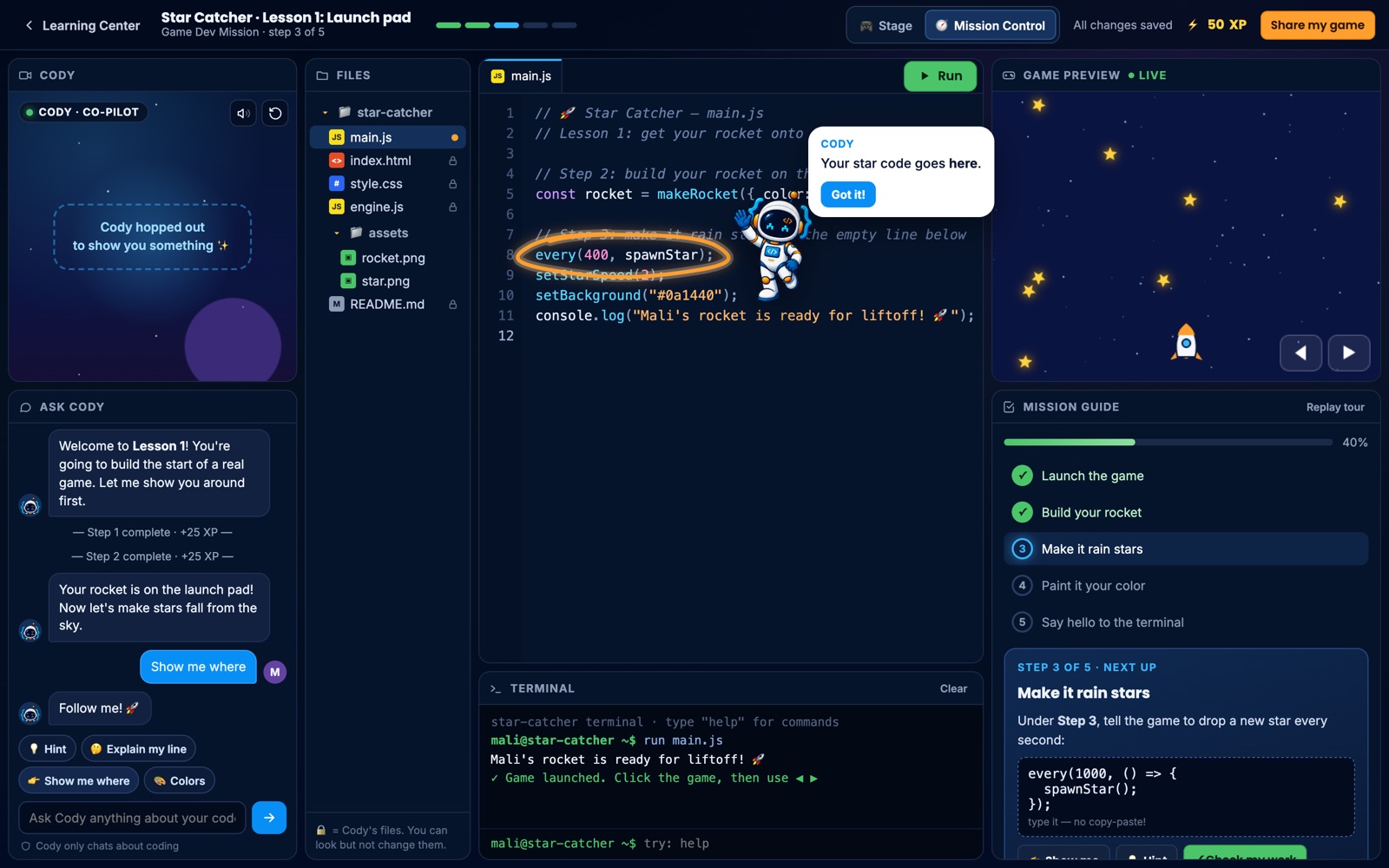
Cody is fully voiced and only talks about coding. She gives hints rather than answers, shows which line to look at again, and steps back as the kid gets better. If a line has a bug, your daughter watches the mistake happen on screen, often comically, and then Cody explains why. In about two hours, at her own pace, she ends up with an arcade game she made: she flies it with the arrow keys, it keeps her score, its levels have sound, and the boss waiting at the end is one she dreamed up. The account is yours, in a Parent Corner locked with your PIN, where you approve purchases and can see every step and sign-in. Kids go by first names, the course carries no ads, and nobody can chat with strangers. Everything happens in the browser, with nothing to download. Star Catcher is $29.99 once for the whole mission, siblings can share it, and nothing renews.
Take a look at the mission, the ship she would rebuild and the price.
See how Star Catcher worksQuestions parents also ask
What age is TikTok for?
13, by TikTok's own rule, or different where local laws say so;1 its US terms set 14 in Florida.3 In the United States, under-13s who sign up go into a separate version where they can watch but can't comment, message or post.4 TikTok says it removes accounts when it believes the user is under the minimum age.4 The only check at sign-up is the birthday a child types.5
Can I set her up with my birthday and keep a close eye on it?
We wouldn't. It puts a ten-year-old in the teen app without the limits meant for her real age, and TikTok's US terms say it will ban an account it finds belongs to an under-13 outside the kids' version.3 Wait for 13, then set it up with her real birthday and Family Pairing, which links your account to hers so you can manage content, privacy and well-being settings.1
What if she's already watching TikTok at a friend's house?
Expect it, and keep it calm. Ask her to show you what she saw and what she liked about it. Common Sense Media's advice to parents of teens is to ask about their favorite creators or trends, rather than starting with worries or warnings,5 and it suits a ten-year-old just as well. If something upset her, she can tell you and still go to sleepovers.
How should we set up TikTok when she turns 13?
Together, with her real birthday, linked through Family Pairing.1 Teen accounts start private with a 60-minute daily limit,1 and direct messages stay off until 16.1 Turn on Restricted Mode, which filters out mature content like explicit language or violence.5 Talk about filters early: Common Sense notes beauty filters can distort how teens see themselves,5 and TikTok restricts some appearance effects for under-18s.1 Scroll her feed with her weekly for the first few months.
Was this answer helpful?
What was missing?
Sources
- Guardian's Guide, TikTok ↩
- Sharing too soon? Children and social media apps (National Poll on Children's Health, October 2021), C.S. Mott Children's Hospital, University of Michigan ↩
- Terms of Service (US), TikTok ↩
- Youth Safety and Well-Being (Community Guidelines), TikTok ↩
- Parents' Ultimate Guide to TikTok, Common Sense Media ↩
Keep reading
More in Screens and gaming ScreensIs YouTube bad for my child?Not by itself. For kids 8–12 the bigger problem is who's choosing: by default YouTube picks the next video, and its product chief said in 2018 that recommendations drive over 70% of viewing time.
 ScreensMy 10-year-old only wants to play video games. Should I worry?Usually not. Loving games at 10 is normal, and most kids who game never develop a problem.
 ScreensHow much screen time is OK for a 10-year-old?A sensible start is one to two hours of fun screen time a day, homework aside, as Nemours KidsHealth suggests.
 ScreensMy son used to build Lego for hours. Now he only wants screens.He's still a builder. Screens won because games and videos of other people playing feel easier than making something, and toys don't have autoplay. So give the builder a screen job: worlds to construct, games to code.