My son used to build Lego for hours. Now he only wants screens.
Short answer
He's still a builder. Screens won because games and videos of other people playing feel easier than making something, and toys don't have autoplay.1 So give the builder a screen job: worlds to construct, games to code.
Across 105 studies, students who learned to program got better at creative thinking, math and spatial skills.2
How does the Lego bin go quiet?
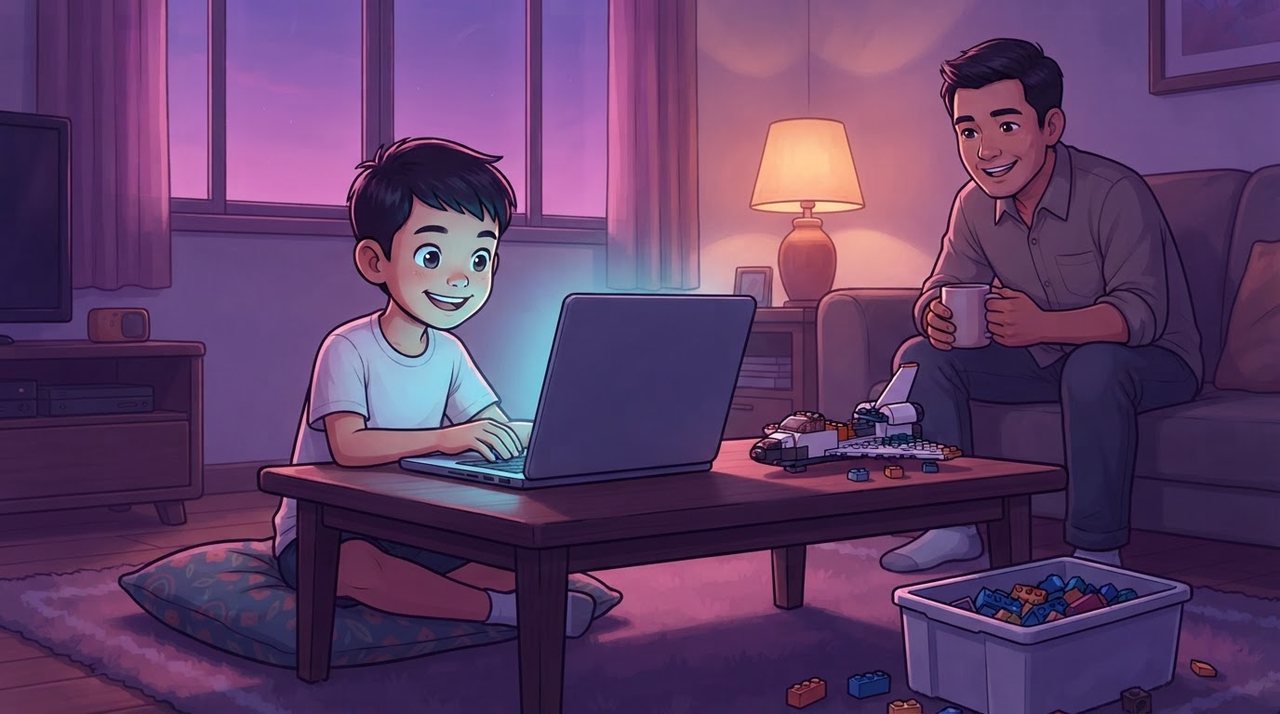
Usually without anyone deciding it. The bin is still under his bed. On the shelf sits the spaceship he spent a whole rainy weekend on a couple of years ago, one wing hanging by a single brick, and nobody has fixed it. Ask him to build something and you get "later", or that Lego is for little kids.
Meanwhile he's on the sofa with a phone, and a lot of the time he isn't even playing. He's watching someone else play: a stranger building a castle in Minecraft block by block for forty minutes, a speed-build of a set he'd have begged for at seven, a boy his age running an obstacle course in Roblox. Take the screen away and he drifts around the house asking when he can have it back.
Look at what's on that screen, though. Very often it's building. He just isn't the one doing it.
Did the screens switch off the builder in him?
No. They handed him an easier option, and most of what he does on them is watching. The American Academy of Pediatrics puts it plainly in an answer written about a preschooler that fits a nine-year-old just as well: playing digital games or watching videos of other people playing "feels easier and immediately satisfying, while trying a new game or being creative takes some work".1 Open-ended play is harder to start and to keep going, it adds, because toys don't have autoplay.1
So he traded building for watching, and the screen took the blame. A phone or a laptop can build things too. Nobody has given his a building job yet, and his choice of videos gives him away: a boy who sits through forty minutes of someone else's castle still cares how things fit together.
What does he miss when the building stops?
Real practice in a skill that matters, and he can get it back. Building with bricks goes with the ability to picture shapes in space and turn them over in your head, and may help build it. Psychologists Jamie Jirout and Nora Newcombe studied 847 children aged 4 to 7 in a nationally representative US sample,3 and the ones who played with puzzles, blocks and board games more than six times a week scored higher on a block-design test of spatial reasoning than kids who played with them less often or never.3 The APS release on the study notes that these skills are especially important for success in science, technology, engineering and math.3
There's a quieter loss as well. A long Lego build is a plan, a run of small failures and a finish: the tower leans, so he widens the base; the wing snaps off, so he braces it. The AAP counts hands-on play as important for learning and for building an attention span.1 On a video, the person on screen does all of the fixing.
This is fixable, and he doesn't have to be seven again to fix it. The same kind of thinking can be trained on the screen he already loves. A meta-analysis by Ronny Scherer and colleagues, pooling 105 studies,2 found that learning to program carried over to creative thinking, mathematical skills and metacognition, followed by spatial skills and reasoning.2
Why haven't a bigger set or a screen ban brought him back?
Each one asks him to go back to the old kind of play, and at nine or ten he has moved on from it.
The big new set gets built in an afternoon, page by page from the booklet, and goes on the shelf. Following instructions is a different job from building something of his own, and once it's done there's nothing left to do with it.
Taking the screens away so he'll get bored and build mostly gets you a boy waiting out the clock. The bin is up against the memory of something easier,1 and the bin rarely wins.
Lego channels and build videos feel like a bridge, and they're more watching.
Putting the bin back in the living room works for a weekend. Then nobody needs the castle, so it never gets finished.
What works keeps the building and moves it to where he is now. Look for three things in whatever you try. The screen takes his instructions, instead of choosing the next thing for him. What he makes has a job, or someone waiting on it, so finishing matters. And the project has a story or goal big enough to carry him through the hard middle, where most builds die.
This idea is older than the iPhone. Seymour Papert, the MIT mathematician who came up with Logo, the first programming language for children,4 argued against "the computer being used to program the child".4 He wanted the reverse, a child who programs the computer.4 Papert had fallen in love with gears as a boy and hoped to make computers flexible enough that many children could each create "something like what the gears were for me".4 The LEGO company named its Mindstorms robotics kits after his 1980 book.4 The people who knew building best saw the brick builder and the coder as the same kid.
How do I get him building again this week?
Skip the booklet and give him building jobs only a builder can do, with the bricks and the screen working together.
- Give the bricks a brief instead of a booklet. A job, a limit and a deadline: a ship that carries three minifigures and survives a drop from the sofa arm, built only from what's in the bin, ready by Sunday dinner. The limit makes him design, the drop test makes him fix, and the deadline makes him finish.
- Have him rebuild the broken one, better. The spaceship with the missing wing is a ready-made engineering problem: why did it snap, and what would hold? Let him take it apart and brace it his way. Finding the weak spot and fixing it is the same habit coders call debugging.
- Build it in bricks first, then put it on screen. Whatever he makes for the brief, ask him to draw it as a little pixel picture and bring it to life in a free browser game maker such as MakeCode Arcade, where he can draw his own sprite. The model in his hands makes the one on screen his.
- Make the screen version move with typed code. MakeCode Arcade opens in blocks, so switch the editor to JavaScript at the top and sit beside him while he types the few lines that send his ship across the screen with the arrow keys. His fingers place every letter, the way they placed every brick.
- Put bricks and code on the same table. If he loves gears and moving parts, a robotics kit that works with ordinary bricks lets him build a machine and then program it. That pairing goes back to Seymour Papert, who began working with the LEGO company in 1985.4 Start with one machine he designs himself, not the model on the box.
What might the turnaround look like for a boy like yours?
Tawan is an invented example, put together to show how the steps fit. He's nine. Two summers ago he built Lego for whole Saturdays; now he watches Minecraft build videos on his mum's phone, and his old spaceship has been missing a wing since the start of the school year.
His dad tips the bin out on the living-room rug on Friday night and sets a brief: a ship that holds three minifigures and survives a drop from the sofa arm, by Sunday dinner. The first version loses its nose on the first drop. The second loses a wing, and Tawan goes quiet, turns the broken piece over in his hands and builds a brace under it. The third survives, and so does the old spaceship, which gets the same brace the next morning.
The weekend after, he draws the new ship as a pixel picture, switches the game maker to JavaScript and types the lines that fly it across the screen, dodging falling rocks. It's rough, and he keeps fixing it. By the following Friday he's asking for a new brief, in bricks first, so the next ship in his game can be one he's already held. The screen and the bin have turned into one project.
Star Catcher: a mission that starts by building the ship
Codestronauts teaches coding to kids 8–12 through a story set in space. Star Catcher, the mission every kid starts with, begins the way a Lego kid would want: with a ship to build. In Wake Up, Cody, the opening episode, one tap of Run, on code that's waiting for him, wakes Cody, a robot with a nervous streak, alone in an empty hangar. Then he types his own first line of code, and the ship he'll fly appears on the screen. Every line after that is real JavaScript he types himself, never dragged blocks, and every line pushes the story on. Across five episodes he rebuilds the starship and flies it out to the Great Beacon, and he and Cody light it again. Each episode leaves him hanging on a cliffhanger. That pull is what carries a builder through the hard middle.
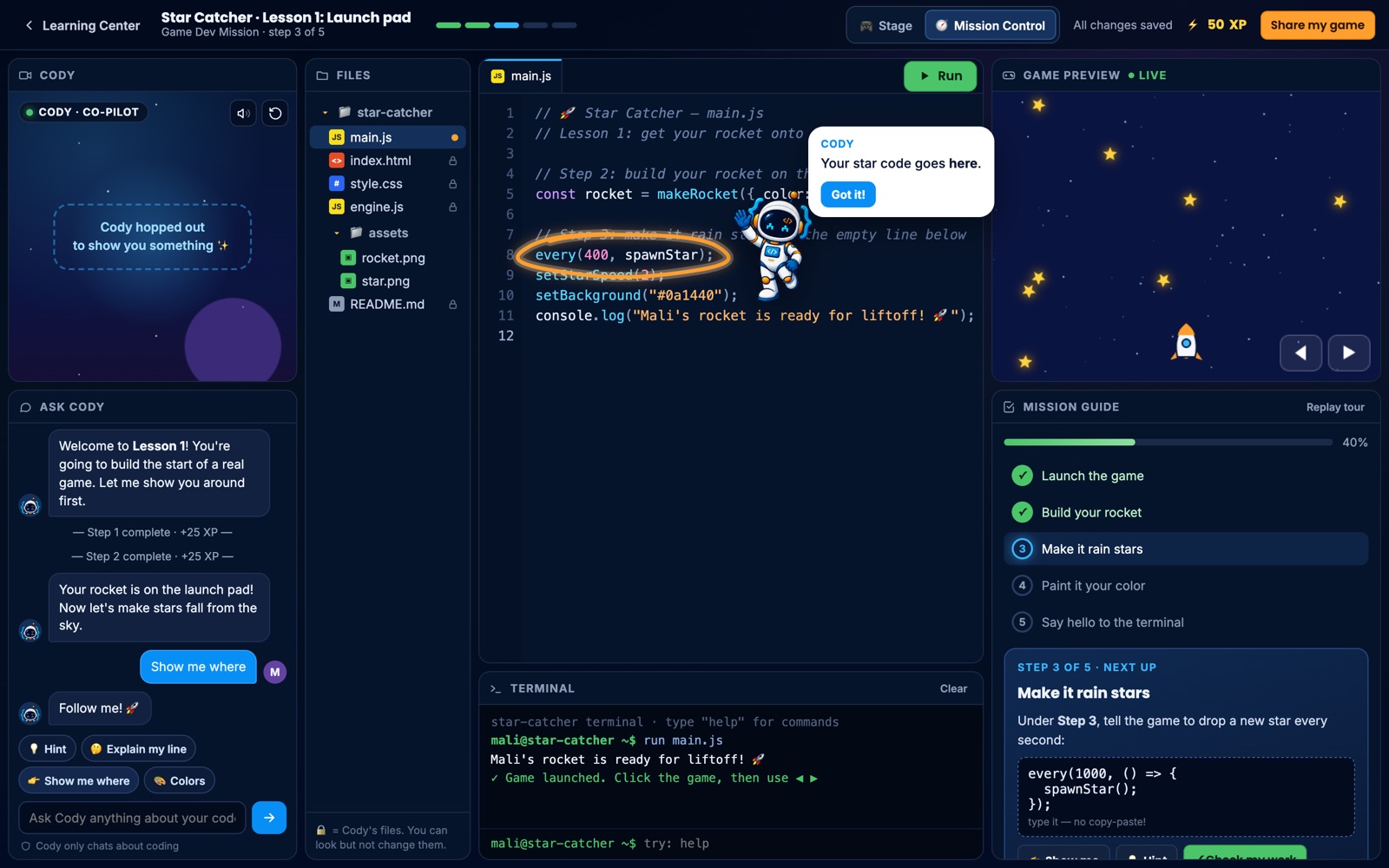
Cody is the one who needs him. She's voiced and only talks about coding; she hints first, and if he's still stuck, her final hint gives him the line to type himself. When a line he typed has a bug, he sees the mistake happen, sometimes hilariously, and she explains why. In about two hours, at his own pace, he finishes with a working arcade game he built himself: the arrow keys fly his ship, it keeps his score, it climbs through levels with sound, and its boss is one he dreamed up. It opens in a web browser, whether he's at a computer or holding the phone he already reaches for. There's nothing to download. You own the account, and only your PIN opens its Parent Corner. Nothing gets bought unless you say yes, and each step he takes shows up there. Episode 1 is free, and starting it asks for no card. The other four episodes come as one payment of $29.99. That one purchase covers every kid in the house, and nothing renews.
Have a look at the ship he'd rebuild, the mission around it and the price.
See how Star Catcher worksQuestions parents also ask
Is it a bad sign that he drifted away from Lego?
Not on its own. It's a common worry, and it rarely means the interest is gone. The AAP's explanation, given for younger children, fits older ones too: screens feel easier and more immediately satisfying than building, which takes some work.1 Watch what he chooses to watch. If it's builds, the builder is still in there, waiting for a project of his own.
Does building in Minecraft count as building?
In Creative mode, with a plan, mostly yes: he designs a structure, tests it and fixes what doesn't work, much like a Lego build. Wandering in Survival or watching other people's builds counts for far less. Give him a brief, a deadline and someone to show it to, and the game becomes a building job.
Will learning to code build the same skills Lego did?
Many of them. Frequent play with blocks and puzzles goes with stronger spatial reasoning,3 and the Scherer meta-analysis found that learning to program carries over to creative thinking and math, then spatial skills and reasoning.2 Code keeps Lego's habits too: a plan, a mistake, a fix and a finish.
What age can he start typing real code instead of blocks?
Eight is a good start if he reads comfortably and can find his way round a keyboard. Typed code suits a builder, because every piece on the screen is one he put there, letter by letter, the way he once placed every brick. Start with something short that moves the moment he runs it, so the first win comes fast.
Was this answer helpful?
What was missing?
Sources
- Preschooler Obsessed With Tablet (Q&A Portal), American Academy of Pediatrics ↩
- The Cognitive Benefits of Learning Computer Programming: A Meta-Analysis of Transfer Effects (Journal of Educational Psychology, 2019), Scherer, Siddiq and Sánchez Viveros, via ERIC ↩
- Playing with puzzles, blocks may build children's spatial skills, Association for Psychological Science (via ScienceDaily) ↩
- Seymour Papert, pioneer of constructionist learning, dies at 88, MIT News ↩
Keep reading
More in Screens and gaming ScreensHow do I get my kid to create instead of just consume?Start from what they already consume and hand them its making twin: a stop-motion app for the YouTube kid, a game maker for the gamer, a comic for the reader.
 CodingMy son wants to make his own video game. Where should an 11-year-old start?Start with one small game he can finish this month, in real typed code that runs in a web browser, such as JavaScript, plus a reason to come back when week two gets hard. Eleven is an early start.
 ScreensHow much screen time is OK for a 10-year-old?A sensible start is one to two hours of fun screen time a day, homework aside, as Nemours KidsHealth suggests.
 ScreensIs YouTube bad for my child?Not by itself. For kids 8–12 the bigger problem is who's choosing: by default YouTube picks the next video, and its product chief said in 2018 that recommendations drive over 70% of viewing time.