My 10-year-old only wants to play video games. Should I worry?
Short answer
Usually not. Loving games at 10 is normal, and most kids who game never develop a problem.
In a six-year study the American Academy of Pediatrics cites, about 1 in 10 adolescents showed worsening signs of unhealthy gaming.1
Worry if games crowd out sleep, school, friends or old hobbies. If those hold up, help your kid start building games.
Is this normal at 10, or a sign of a problem?
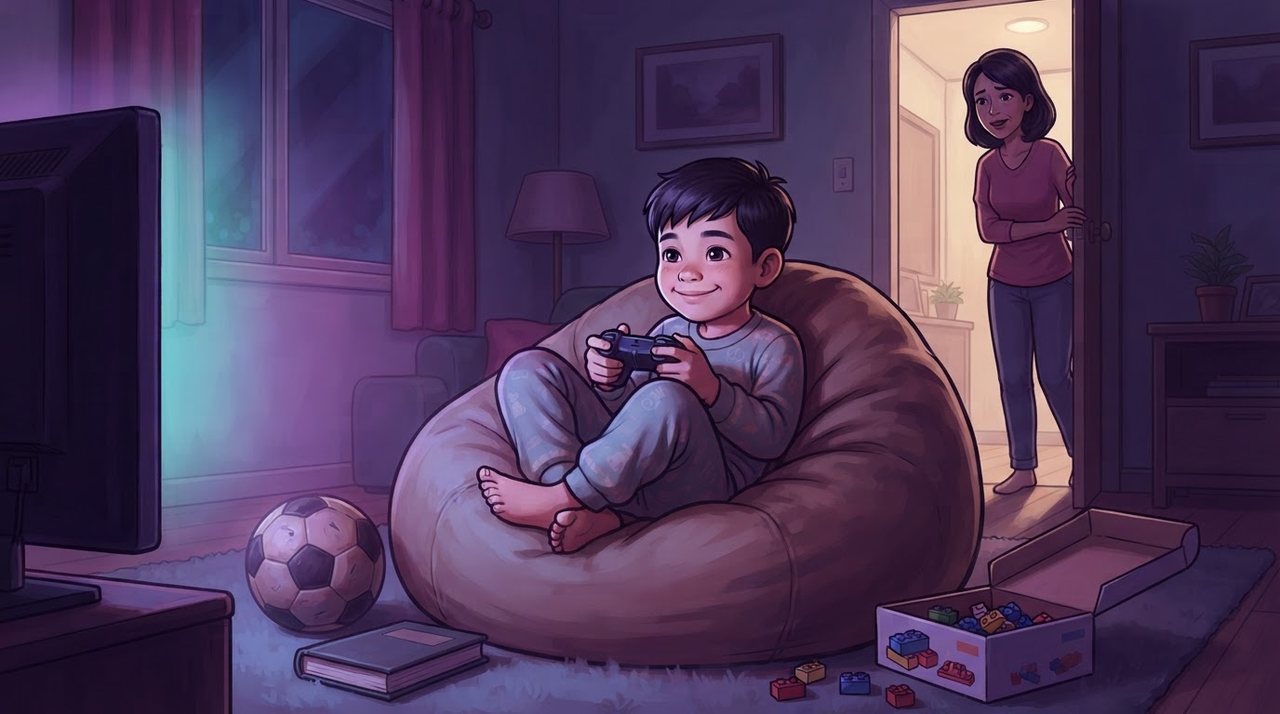
For most 10-year-olds it's normal. The Canadian Paediatric Society calls getting caught up in a favorite pastime natural and healthy for kids, and it counts video games among those pastimes.2 The evening probably looks familiar. The headset goes on before the shoes come off. Soccer practice and the Lego bin get a shrug. At dinner you hear about a boss fight in more detail than anything that happened at school, and bedtime comes with three requests for five more minutes.
The pediatricians add two conditions about the kind of play. The games should suit their age, and the people on the other end should be friends or family they know, rather than strangers online. They also ask parents to stay involved in what their kid plays, so trouble gets noticed early. The American Academy of Pediatrics describes what unhealthy gaming looks like,1 and it comes down to five signs:
- Taking the game away brings real distress every time, well past ordinary grumbling.
- They keep wanting more time and can't cut back, even after agreeing to.
- Things they used to love, like a sport or drawing, have stopped mattering.
- They lie about how long they've been playing.
- A game is where they go to get out of a bad mood.
The AAP says the kids most at risk are more often boys, and their gaming eats into homework, sleep, exercise or time with family and friends.1 Some also deal with anxiety or depression, and kids with ADHD may be especially vulnerable.1 One sign during a rough week is ordinary. Several that hang on for weeks are worth a call to your pediatrician.
If it's normal, why does it still feel like a waste?
Because nearly all of that time runs one way, with your kid playing what somebody else built. In Common Sense Media's 2019 census, making things of their own (art, music, writing or code) took up just 2% of the screen time of 8- to 12-year-olds.3 TV, videos, games and social media filled most of the rest.3
Now think about what a gaming 10-year-old already knows. They can explain why one level feels fair and another feels cheap, how a boss warns you before its big attack, and which upgrade is worth the coins. That's game design knowledge, collected over hundreds of hours, and nobody has asked them to use it yet. A kid who can beat a boss can learn to build one. So the useful question is how to move them over to the making side of the screen.
What does all that playing cost them?
Mostly what it pushes aside. The American Academy of Pediatrics tells parents to think carefully about what gaming displaces,1 and at 10 that usually means sleep, homework, time outside and the hobbies a kid would otherwise grow into. The slower cost is the habit it builds, years spent getting very good at other people's games with almost no practice making anything of their own.
Your evenings pay a price too. Every "one more level" turns into a standoff, and after enough of them you feel like the screen police. Losing some of those standoffs says nothing bad about your parenting, because the pull is engineered. The same AAP page notes that game makers often bring in psychologists to keep players coming back.1
All of it is fixable, and a gaming kid starts with the hardest part already in place. They have a deep interest, patience with tough levels and the habit of trying again after a loss. The work is pointing that energy at something that grows.
Why haven't bans, lectures or new hobbies worked?
Because each one asks your kid to give up the thing they're best at and offers nothing that feels as good. Telling a 10-year-old that games are a waste of time lands as "the thing you're good at doesn't count", and kids tend to dig in. A screen-free weekend makes the game rarer and so more precious, and the first evening after it tends to be a binge. A club you chose for them gets their body there on Saturday morning while their head stays in the game. Waiting for them to grow out of it can take years. All that time, the hours keep running one way.
Look at what the game gives them that those fixes don't: a quest with stakes, a team counting on them, and a next level that's always just out of reach. The fixes that hold borrow those hooks and point them at building. They treat your kid's game knowledge as expertise and put it to work deciding how a game should play. Playing never lets them decide that. Code is the natural material for that, since every game they love is made of it. The benefits reach past games, too. Researchers who pooled the studies on learning to code found the biggest gains beyond coding itself in creative thinking, math, reasoning and spatial skills.4
So what do I do this week?
Start inside the game and work outward, a step or two each evening.
- Ask for a tour. Have your kid teach you their favorite game for ten minutes, from the rules to the hardest level to what they'd change. You'll see what kind of obsession it is, and they'll see that you take it seriously.
- Set the order along with the amount: homework, then something that gets them moving, then games. Screens stay out of the bedroom at night. Keep the console in a shared room where you can, as the American Academy of Pediatrics advises.1
- When they log off without a fight, tell them you noticed. Pediatricians recommend positive guidance alongside limits,2 and praise for stopping well is the simplest kind.
- At dinner, ask what boss they'd put at the end of a game of their own, then hand over paper and let them draw the level. Gaming kids have strong opinions about how games should work, and a drawing is the first draft of a design.
- Find the builder in a game they already play. Minecraft has Creative mode, Roblox has Roblox Studio and Fortnite has Fortnite Creative. On a Nintendo Switch, Super Mario Maker 2 is a whole game about building Mario levels. Give time spent building in any of them its own line in your screen rules.
- Type one real line of code together. p5.js is a free JavaScript tool for learning to code, and its web editor runs in the browser.5 Open a new sketch, type
circle(mouseX, mouseY, 50);on the line underbackground(220);and press Play. A circle follows the mouse wherever it goes, and a gamer sees that what moves on a screen is instructions they can write. - Keep an eye on the five signs above. If several last for weeks, or gaming has become the main way your kid deals with stress or sadness, call your pediatrician.
How does a kid go from playing games to making them?
It can start with one question. Our example is a fictional 10-year-old who knows every boss pattern in his favorite platformer and calls everything else boring. One Saturday his mom asks him to draw the boss he'd put at the end of his own game. He fills two pages with a robot that splits in half when it's hit and has a weak spot that wanders around its armor. That evening they open a beginner coding project, and he types his first line, a single command that puts a spaceship on the screen. It's a tiny thing, and he can't stop grinning, because the ship appeared when he told it to.
A few weeks later he's arguing about how fast the meteors should fall, which is the same argument professional game designers have. He still plays plenty. Some evenings, though, he'd rather work on his own game, and at dinner the boss fight he describes is one he built.
Where Codestronauts fits for a kid who lives for games
Codestronauts is a story-led coding course for kids 8–12, and its first mission, Star Catcher, opens with that same kind of moment. Its first episode, Wake Up, Cody, starts in an empty hangar where Cody, a nervous little robot, has been asleep while the stars went dark. One press of Run on a line that's already waiting wakes her up. Then your kid builds the starship they'll fly for the rest of the mission by typing their first line of code: makeRocket();
Every line after that is real JavaScript, and each one moves the story forward the way clearing a level moves a game. Over five episodes and about two hours of play, at their own pace, they teach the ship to fly, count starbits and fight to relight the Great Beacon. A kid who always wants one more level will recognize the cliffhanger at the end of every episode.
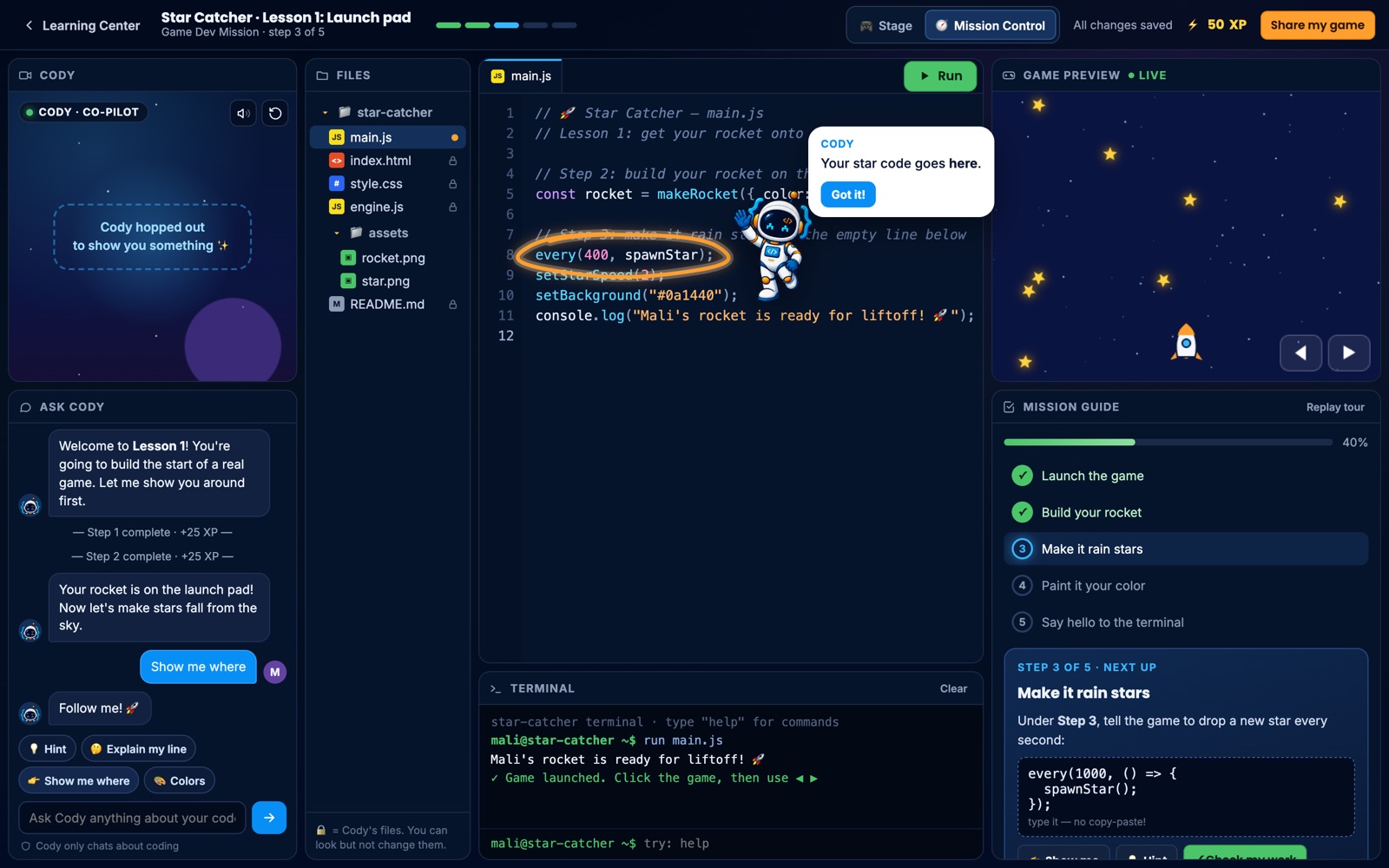
By the last episode they've built a real arcade game with arrow-key controls, sound, levels and a score, and the boss at the end is one they designed. Cody rides along as a fully voiced sidekick who points at the line that needs work, gives hints instead of answers and helps less as your kid gets better. Bugs often play out on screen like a funny glitch before she explains what went wrong. It all runs in the web browser on the laptop or desktop you already have, so there's nothing to install. Unlike the online games in the questions below, Star Catcher gives strangers no way to chat with your kid, and every purchase waits for your approval behind a PIN in the Parent Corner. The whole mission is one payment of $29.99, and brothers and sisters can share it.
Here is the mission your gamer would play, from the first typed line to a boss of their own.
See how Star Catcher worksQuestions parents also ask
How many hours of gaming a day is too much at 10?
Watch the trade-offs more than the clock. The American Academy of Pediatrics asks parents to make sure gaming isn't crowding out homework, exercise or sleep.1 If your kid sleeps well, keeps up at school, sees friends in person and can stop when asked, the hours are probably fine. When one of those slips, trim the gaming that's pushing it out.
Is video game addiction a real diagnosis?
The World Health Organization recognizes gaming disorder as a condition, while the U.S. has no official diagnosis for it yet.1 The American Academy of Pediatrics also points out that most children who play video games don't become addicted.1 What separates a passion from a problem is control, meaning whether your kid can stop and whether games keep beating everything else despite the harm.
Is it OK if my 10-year-old plays online with friends?
With friends they know offline, generally yes. The Canadian Paediatric Society treats age-appropriate games played with known friends or family as the kind parents usually don't need to worry about.2 Strangers are where to draw the line. Check the game's chat settings, keep voice chat to people you've met, and keep the console somewhere you can hear it.
Won't making games just mean more screen time?
Some, and it's a different kind of hour. An evening spent designing a level, writing code or chasing down a bug leaves your kid with something they made and a skill that stays. Count making time apart from playing time in your house rules, and your kid gets a reason to pick it.
Should I take the games away completely?
Rarely as a first move. A sudden ban tends to bring louder evenings and an empty hour with nothing planned for it. Hold firm limits around sleep and homework, and put that hour toward building something. Save a full break for when several warning signs persist, ideally planned with your pediatrician.
Was this answer helpful?
What was missing?
Sources
- Unhealthy Video Gaming: What Parents Can Do to Prevent It, American Academy of Pediatrics (HealthyChildren.org) ↩
- Should I be worried about how much my child or teen is gaming?, Canadian Paediatric Society ↩
- The Common Sense Census: Media Use by Tweens and Teens (2019), Common Sense Media ↩
- Some Evidence on the Cognitive Benefits of Learning to Code, Frontiers in Psychology (Scherer, Siddiq and Sánchez-Scherer, 2021) ↩
- About p5.js, p5.js (Processing Foundation) ↩
Keep reading
More in Screens and gaming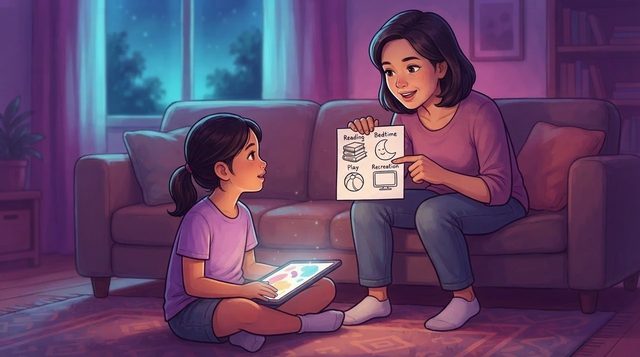 ScreensHow much screen time is OK for a 10-year-old?A sensible start is one to two hours of fun screen time a day, homework aside, as Nemours KidsHealth suggests.
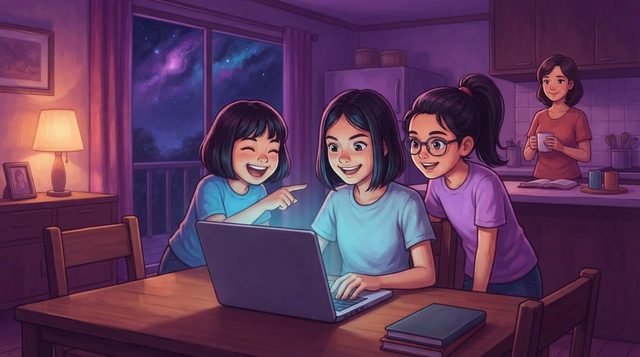 Screens“My 10-year-old wants TikTok because all her friends have it.”Not yet, and say it kindly. TikTok's rule is 13 for an account, though she isn't imagining the crowd: in a 2021 University of Michigan poll, 49% of US parents of kids 10 to 12 said their child had used social media apps.
 CodingMy 10-year-old keeps asking how video games actually work. How do I explain it?Tell them a video game is a loop. Over and over, the game checks which buttons are down, moves everything by its rules (speed, gravity, what happens when two things touch) and draws a fresh picture.
 ScreensMy son used to build Lego for hours. Now he only wants screens.He's still a builder. Screens won because games and videos of other people playing feel easier than making something, and toys don't have autoplay. So give the builder a screen job: worlds to construct, games to code.