How do I get my son off Roblox without a fight?
Short answer
Before he logs on, agree how long he'll play, which games and what comes next, as the AAP advises.1
End at a natural break and say little. Then give part of his screen time a making job, like building a game.
Tweens spend just 2% of screen time creating,2 and a job you both agreed on leaves less to police.
Why does every Roblox stop turn into a fight?
Roblox never ends on its own. Every ending has to come from you.
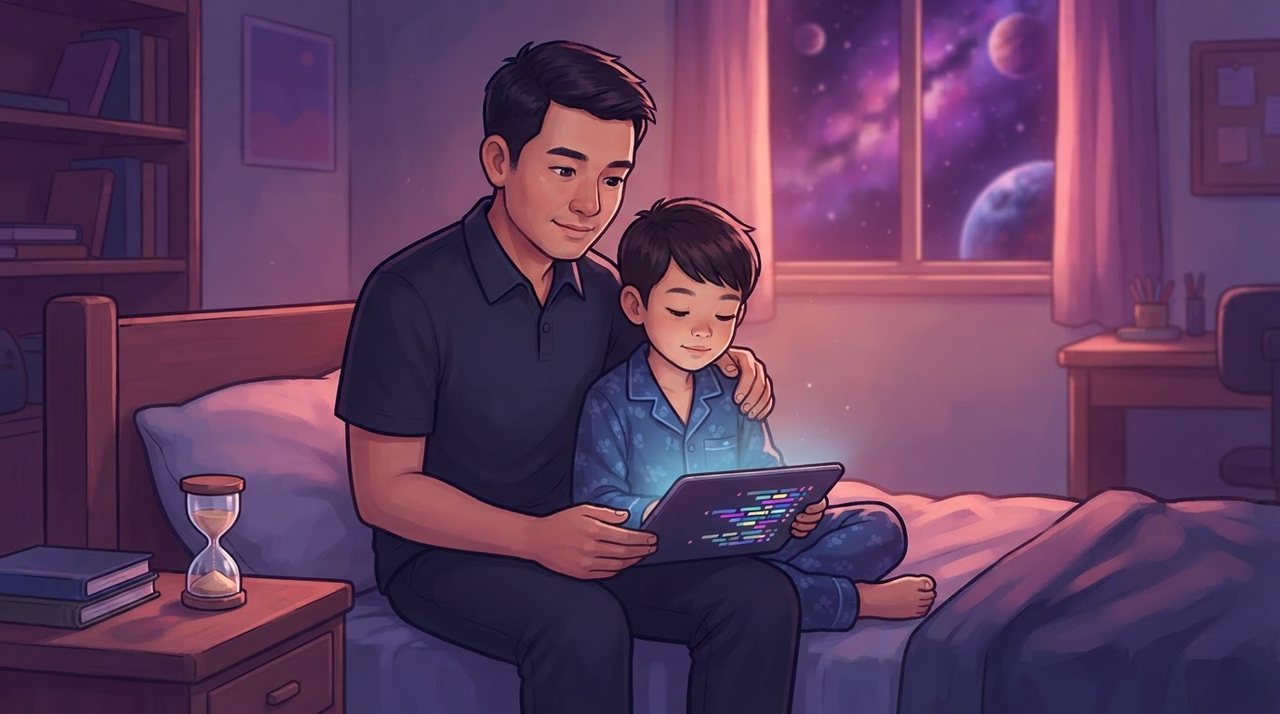
He's been on Roblox since seven, and at eight he's mid-round with three friends from school. You say five more minutes. He says he can't leave, his team needs him. Five minutes stretches to fifteen. You count down out loud, he bargains, you threaten to take the tablet, and he tells you you're the meanest parent alive. Then he sulks until bedtime, and tomorrow night you're back on duty as the screen-time police.
The American Academy of Pediatrics' answer on Roblox names the forces you're up against: his friends are on Roblox, its games pay out rewards for playing longer, and there's always another game to try.1 All three pull on him at the exact moment you ask him to stop.
Is he just wasting all that time?
Most of it goes to watching and playing, and very little to making. The 2019 Common Sense Census found that tweens devote just 2% of their screen use to content they create themselves, and that screen use is dominated by watching TV and videos, playing games and using social media.2 Yet in the same survey, nearly two-thirds of tweens and teens said they often or sometimes watch videos about how to build, make or do something they are interested in.2
Together, those two findings say the interest in making is there and the screen time for it isn't. Under “five more minutes” sits a bigger disagreement about what the screen is for. To him it's where his friends and his fun live. To you it's two hours a night that build nothing he'll keep. A stricter limit can shorten the hours, and it leaves that disagreement exactly where it was. If part of his screen time had a job you both signed off on, there would be far less left to police.
Is the nightly fight doing any real harm?
Some, and most of it lands on the two of you. The AAP's guide to screen-time tantrums warns that these meltdowns can turn into power struggles that move a family further from balanced, healthy tech use.3 Night after night he learns that screen time is something to defend, and you learn to dread eight o'clock. The hours themselves go to in-game items he'll have forgotten by summer, at an age when he could be building things he'd be proud to show you.
It's fixable. Trouble switching off doesn't by itself mean he's hooked, the same guide says.3 The fight lives in the last few minutes of play, which you can change tonight, and the bigger fix works with his love of games instead of against it.
Why does the fight come back no matter what I try?
Because each fix you've tried only changes when or whether he plays, and none of them gives him something he'd rather do.
A timer makes you the referee, and it tends to ring mid-round, when leaving means letting his team down. Even a plan he made himself gets tested, since the AAP notes that kids find it harder to stop while the platform keeps recommending the next game.1 A week without Roblox is a fair reset, but the hours come back with the game, and so does the fight. Parental-control apps are worth setting up for safety, and to a 10-year-old they mostly feel like a fence. Paying him in Robux to log off on time makes Roblox the prize for everything else he does.
What works is what the AAP's tantrum guide calls trading up: moving a kid from one favorite activity to another he likes even more.3 For a Roblox kid, the trade has to answer the same pulls that keep him there. In place of endless games, give him something with an ending he can see coming, like a level he finishes or an episode that breaks off on a cliffhanger. In place of the team waiting on him at eight o'clock, give him someone in the new thing who's counting on him. Researchers found a version of that pull, the protégé effect: in two studies, fifth and eighth graders worked harder learning for a computer character they were teaching than for themselves.4 And where Roblox pays out items for playing longer, give him the reward of building a game that works because he wrote it.
How do I end tonight's Roblox session without a fight?
Change the last few minutes first. Then give one evening a week a new job.
- Make the plan before he logs on. Agree together how long he'll play, which games, and how he wants to be reminded to stop, as the AAP suggests.1 Kids accept limits more easily when they've had a say in making them,3 so let him write the plan and tape it by the screen.
- Stop when a round ends. When you give the warning, ask him when his next natural stopping point is, then hold him to that one.
- Warn him in person. Walk over, rest a hand on his shoulder and wait for him to look up before you speak. A call from the kitchen rarely reaches a kid who's inside a game.
- Have the next thing ready. The AAP recommends an activity he chose himself, right after he stops.1 A snack, the dog or shooting hoops with you all count.
- Say less when he melts down. A child mid-meltdown can't think logically, so skip the lecture.3 One calm line is plenty: “I know it's hard to stop, and it's time.” Talk it through tomorrow, when you're both calm.
- Take a week off if every night is a fight. The AAP says a break of a week or so is fine when a child keeps arguing about stopping.1 Call it a reset, and tell him Roblox comes back with a plan he helps write.
- Give one evening a week a job. Ask what game he'd make if he could make any game at all, and have him sketch it on paper. Then find a tool to build it in. Roblox Studio is free and is where the games he plays were made, and a story-driven coding course makes a gentler first step.
How might that play out for a boy who lives on Roblox?
Think of a nine-year-old who plays Roblox every evening with the same three friends, and whose parents have said “last game” four times by bedtime. One Sunday they change the deal. Roblox stays on most nights, on a plan he wrote himself: an hour, ending when a round ends, with a snack waiting. One evening a week the laptop gets a different job, and he spends it building a game of his own, typing the code that steers his ship and keeps his score.
The first making night, he grumbles. By the third, he's the one calling his parents over, because something he made just worked and somebody has to see it. The arguing moves from “five more minutes” to “wait, watch this.”
Is there screen time he'll want that you won't have to police?
That making night is the one we built Codestronauts for. Star Catcher, our first mission, written for kids from 8 to 12, makes that trade on all three counts inside one space adventure. The story opens on a call for help that has looped for a hundred days in an empty hangar. The one who needs him is Cody, the nervous robot who sent it: she wakes the moment he presses Run for the first time, calls him Captain from then on, and gives hints rather than answers. The making is real JavaScript he types himself, never dragged blocks. His first typed line builds his ship, and by the last episode he owns an arcade game he made: arrow-key flying, sound, levels, a running score and a boss of his own design.
It's built to stop well, too. Star Catcher's five episodes run 15 to 40 minutes each, two hours or so altogether, and every one ends on a cliffhanger, so the stopping point belongs to the story and tomorrow comes with a reason to sit back down. He plays it in a laptop's web browser, and nothing gets installed. The account is yours, and only your PIN opens the Parent Corner. He plays without ads or strangers, brothers and sisters can play on the same purchase, and the whole of Star Catcher is one $29.99 payment.
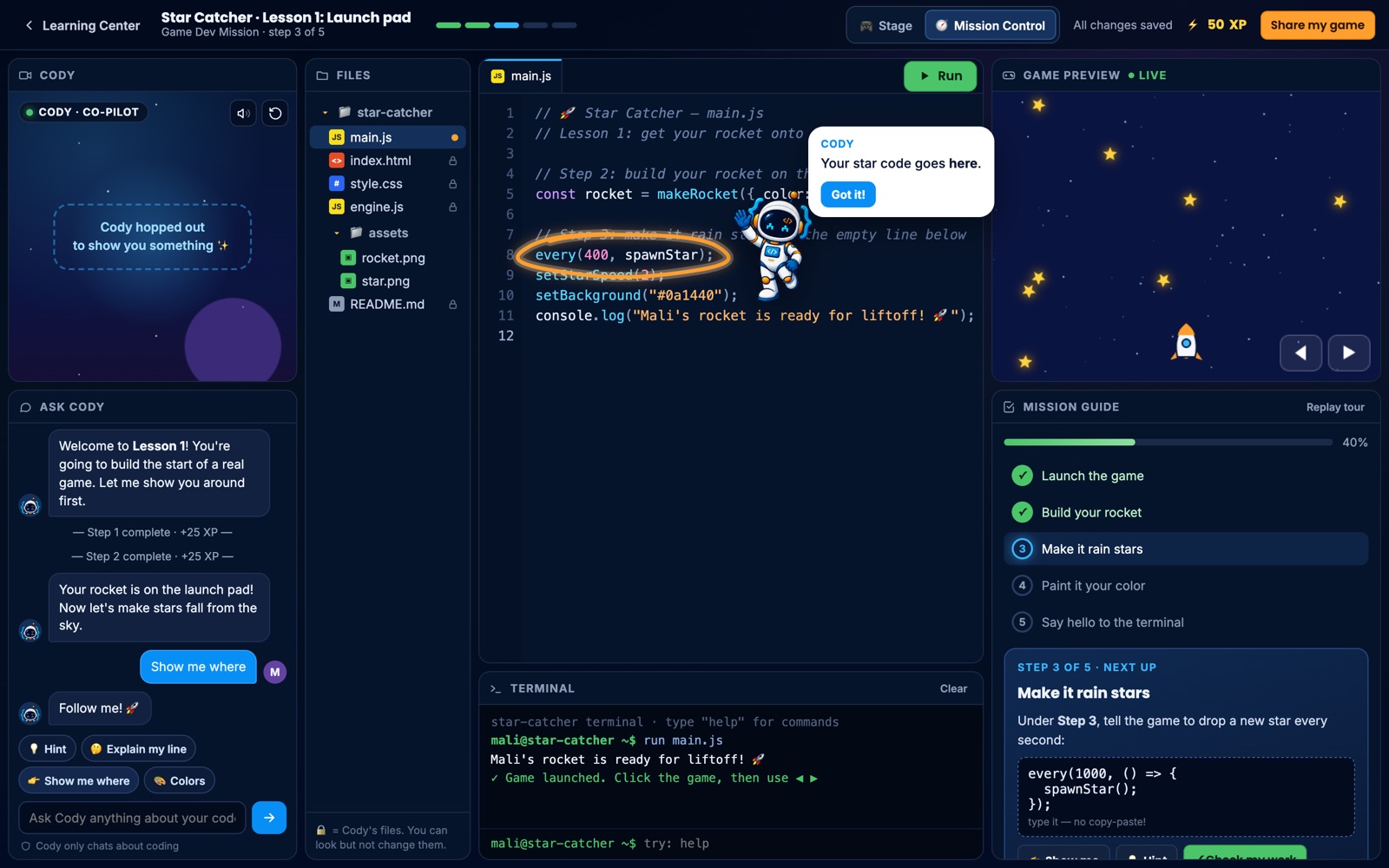
Star Catcher gives his screen time that job, five episodes long, with a game of his own at the end.
Get Star Catcher · $29.99Questions parents also ask
Is Roblox bad for kids?
It depends on which games he plays and who he talks to. The AAP points out that anyone can publish a Roblox game, so quality runs from interesting to terrible, and that Roblox has settings to limit which games kids can play and who they can interact with.1 Turn those settings on, and play a round with him now and then.
What if Roblox is where his friends are?
Then protect that part. Friends being on Roblox is one of the three pulls the AAP names,1 and for a lot of 10-year-olds it's where the after-school hangout happens. Plan his play around the hour his friends are on, so stopping never means ditching them mid-game. On a making night, invite one of them over to build something side by side.
When should I worry it's more than a habit?
The AAP's guide suggests talking to your pediatrician if meltdowns happen nearly every time he's asked to stop, however carefully you handle it, if his sleep, eating, hygiene or friendships seem to be changing because of screens, or if he can't get through a few minutes of boredom without one.3 Short of that, a kid who hates switching off is a normal kid with a very sticky game.
What do I say when he says his team needs him?
Agree with him, then fix the timing. Walking out mid-match does let his friends down, so the warning belongs before a new round starts, never in the middle of one. Make “last round” mean he finishes the one he's in and joins no other, and have him tell his team what time he's leaving before they start. Once his team knows, the reason to stay is gone.
What if he ignores the plan he wrote?
Point to the plan, say the time and end the game where it says. The AAP's advice for this moment is to hold your ground in as few words as possible.3 Settle the consequence when you write the plan, such as a shorter session the next day, so nobody invents one mid-argument. If he blows through it night after night, the plan needs work: sit down together and change the length or the stopping point until it's one he can keep.
Was this answer helpful?
What was missing?
Sources
- Using Roblox and YouTube For Extended Periods Of Time, American Academy of Pediatrics ↩
- The Common Sense Census: Media Use by Tweens and Teens (2019), press release, Common Sense Media ↩
- Screen Time & Temper Tantrums: Helpful Tips for Parents (Jenny Radesky, MD, FAAP), HealthyChildren.org, American Academy of Pediatrics ↩
- Teachable Agents and the Protégé Effect: Increasing the Effort Towards Learning (Chase, Chin, Oppezzo and Schwartz, 2009), Journal of Science Education and Technology ↩
Keep reading
More in Screens and gaming ScreensMy son used to build Lego for hours. Now he only wants screens.He's still a builder. Screens won because games and videos of other people playing feel easier than making something, and toys don't have autoplay. So give the builder a screen job: worlds to construct, games to code.
 ScreensHow do I get my kid to create instead of just consume?Start from what they already consume and hand them its making twin: a stop-motion app for the YouTube kid, a game maker for the gamer, a comic for the reader.
 ScreensAre there educational games my kid will actually want to play?Yes, when the learning is the gameplay. Kids drop quizzes dressed up as games and stick with games where the skill is how you win.
 Screens“My 10-year-old wants TikTok because all her friends have it.”Not yet, and say it kindly. TikTok's rule is 13 for an account, though she isn't imagining the crowd: in a 2021 University of Michigan poll, 49% of US parents of kids 10 to 12 said their child had used social media apps.