My 10-year-old daughter loves building things but says coding is for boys.
Short answer
Act now, while the idea is new. In Microsoft's survey of 11,500 European girls and young women, most girls' interest in STEM took hold around age 11½ and began to fade by 15.1 The number interested almost doubled when girls had a role model.2 Skip the argument and give her real code to build with, beside a woman who uses it.
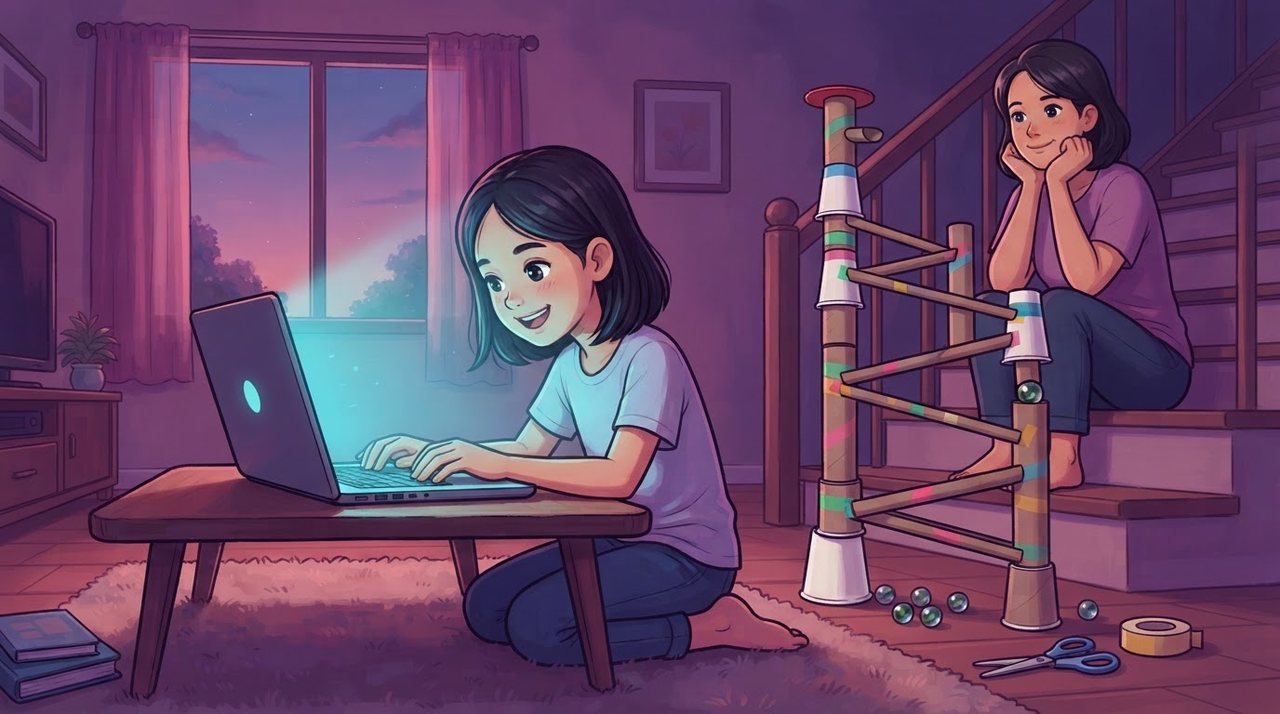
She builds everything. Why would she say coding is for boys?
Because somebody, somewhere, handed her that label, and it stuck to the word coding without touching anything she actually does. Look at what she does do. The marble run taped down the stairs, rebuilt three times until the marble stopped flying off the second turn. The Lego crane with a winch made from a pencil and a length of string. The cardboard house for the cat, with a door that really swings. She'll spend a whole Saturday on a build and come to dinner with glue on her sleeve.
Then the school sent home a flyer for its coding club, and you mentioned it in the car. She didn't even look up. "That's for boys." Nobody in your house has ever said that. You want her to keep building, and you'd hate to watch her cross a whole field off the list at 10 because of one word.
Where would a 10-year-old pick that up?
Almost everywhere, and earlier than most parents guess. "By age eight, most children in the U.S. already believe that boys are more interested in computer science and engineering than girls are," writes Allison Master of the University of Houston, whose study in PNAS measured it.3 Her team and the University of Washington surveyed nearly 2,500 students from first to 12th grade, and 51% thought girls had less interest than boys in computer science, while 63% believed girls were less interested in engineering.4 Engineering is the grown-up name for what your daughter does every weekend.
Listen closely to what she said. It's a claim about interest, about who coding belongs to. She didn't say she couldn't do it. The same researchers then gave children a choice between two computer science activities: one described as more interesting to boys, one described as liked by boys and girls equally.4 Only 35% of the girls picked the first; 65% picked the one described as for everyone.4 How an activity is described is something a parent has a hand in.
Does it matter if she decides this at 10?
It can, because these decisions harden quietly. Stereotypes that STEM is for boys begin in grade school, Master said, "and by the time they reach high school, many girls have made their decision not to pursue degrees in computer science and engineering because they feel they don't belong."4 In Microsoft's survey, just 42% of the girls and young women said they would consider a STEM-related career.1 The word in Master's sentence is belonging. Talent doesn't come into it.
The cost comes well before any career choice. A girl who has filed code under someone else's things stops seeing it in her own builds. Her marble run is already an algorithm, her crane is a machine that could be programmed, and she leaves the most flexible building material there is on the table.
This is fixable, and 10 is a good age to fix it. In a University of Washington experiment, 32 six-year-olds programmed a robot pet on a phone app for 20 minutes.5 Among the children who didn't get a robot, boys reported more interest and more confidence than girls; among the ones who had programmed it, that gap was gone, for interest and confidence both.5 Twenty minutes of making a machine do something was enough for those girls to match the boys. And the window Microsoft found, from about 11½ to 15, is still ahead of her.1 What she needs before it opens is evidence of two kinds: a few times when code she typed made something work, and a few people like her who do it for real.
Why doesn't telling her she's as good as any boy change her mind?
Because it answers a doubt she never raised. She didn't say she'd be bad at coding; she said it isn't hers. Master warns that even a kind line like "Girls are just as good as boys at coding!" may backfire and reinforce gender stereotypes.3 Ability talk keeps the contest alive. The message Master backs speaks to interest instead: that girls can enjoy STEM just as much as boys do.4 Say that one, and then show it, because a 10-year-old believes what she sees well before what she's told. The other usual moves miss in their own ways. A pink coding-for-girls kit tells her the regular kind was never hers. A poster of famous women in tech is a kind thought, but a face on the wall can't answer her questions. And signing her up for the club she has already labelled turns it into a contest over who was right, which a 10-year-old wins by not trying.
What works starts from what she already loves, which is making. Microsoft's follow-up named two key reasons girls' interest declines, the lack of female role models and the lack of practical, hands-on experience,2 and found a direct link between a girl's creativity and her interest in STEM.2 So look for three things in whatever you try. Code that builds: she types it, it runs, and something moves or breaks on screen in her first sitting, so coding reads as her kind of work. A reason inside it: a job to finish or someone counting on her, so the only question is whether the thing works. Someone like her nearby: a woman she can watch enjoying it, or a friend having fun with it beside her.
What can we do this week, before any class?
Start with the words around code, then put some in front of her.
- Ask, then listen. "Who told you that?" Ask it with curiosity, and don't correct the answer. It might be a classmate, a show or a club that was all boys, and each one points to a different fix.
- Call her builds by their real names. The marble run is an algorithm: steps in order, and the marble jumping the track was a bug she found and fixed. Say it once, plainly, and let it sit. Leave off "and you're just as good as the boys": she never doubted that part.
- Describe it as for everyone, and show her girls who like it. When a club, class or camp comes up, say who it's for: kids who like making things, girls and boys alike. Ask the organiser how they describe it too, since kids pick up on who a flyer seems to be talking to. Then let her see girls her age having fun at it, at an open day or in a club's own videos, because the message that sticks is that girls enjoy it, more than that girls can do it.
- Find her a woman who codes. An aunt, a friend's mum, a neighbour, someone from your work. Ask for twenty minutes at the kitchen table or on a video call to show one thing she built and one bug that drove her mad. Microsoft found a clear link between role models and girls' passion for these subjects,2 and a real person she can question beats a famous name.
- Bring a friend. If you sign her up for anything, Master's advice is to sign her up and bring along a friend.3 Two girls turn a room into a place that's theirs.
- Tell her about Ada Lovelace, in one sentence. Microsoft's write-up lists her as the woman who came up with the computer algorithm,1 the same step-by-step thinking her marble run runs on.
- Take her first steps in typed code with Microsoft MakeCode Arcade. Microsoft describes MakeCode as free and online, a place where anyone can build games,6 and its Arcade editor makes retro-style arcade games.6 Open a new Arcade project in the browser, flip it into JavaScript (MakeCode's own words: "text-coding mode"6) and have her type
scene.setBackgroundColor(7). The little game screen changes colour. Then let her try every number up to 15 and find her favourite. Sit beside her and let her drive. When it breaks, ask "What do you think happened?" before you touch anything.
What might the first month look like for a builder like her?
Here's an invented example, to show the shape of it. Ploy is 10 and builds elevators for her hamster out of juice cartons and string. Her mum doesn't bring up the coding club again. Instead she asks Ploy's godmother, who writes apps for a bank, to come for lunch and show what she's working on. The godmother tells the story of one button that crashed the whole app for a week. Ploy wants to know what a crash looks like.
That weekend Ploy types her first lines with a friend from school beside her, and her ship flies the wrong way across the screen. She reads the line, swaps a minus for a plus, and it turns around. "It's like the elevator string," she says. "You just pull the other side." Four weeks in, she has drawn a game level on graph paper and wants to know how a score counts itself up. Nobody has argued with her about boys. She has simply stopped bringing it up.
Where Codestronauts fits for a girl who builds
Codestronauts gives a builder that first evidence inside a story. It's a story-driven coding course built for ages 8–12, and everyone begins with Star Catcher, a mission that is one long build. A single press of Run, on code waiting in an empty hangar, wakes Cody, the nervous robot who'll fly beside your daughter. Then her first typed line puts the ship together. From there it's real JavaScript, typed by her, and each line pushes the adventure on: your daughter rebuilds the Star Catcher, teaches it to fly and, with Cody, relights the Great Beacon. Cody, the voiced co-pilot, is counting on this kid to get the code right. When your daughter gets a line wrong, she gets to watch exactly what it does, often something silly, and then Cody walks her through why it happened. Cody's hints come first, and if your daughter is still stuck, Cody's final hint gives her the line to type. Cody's help fades as the kid gets better.
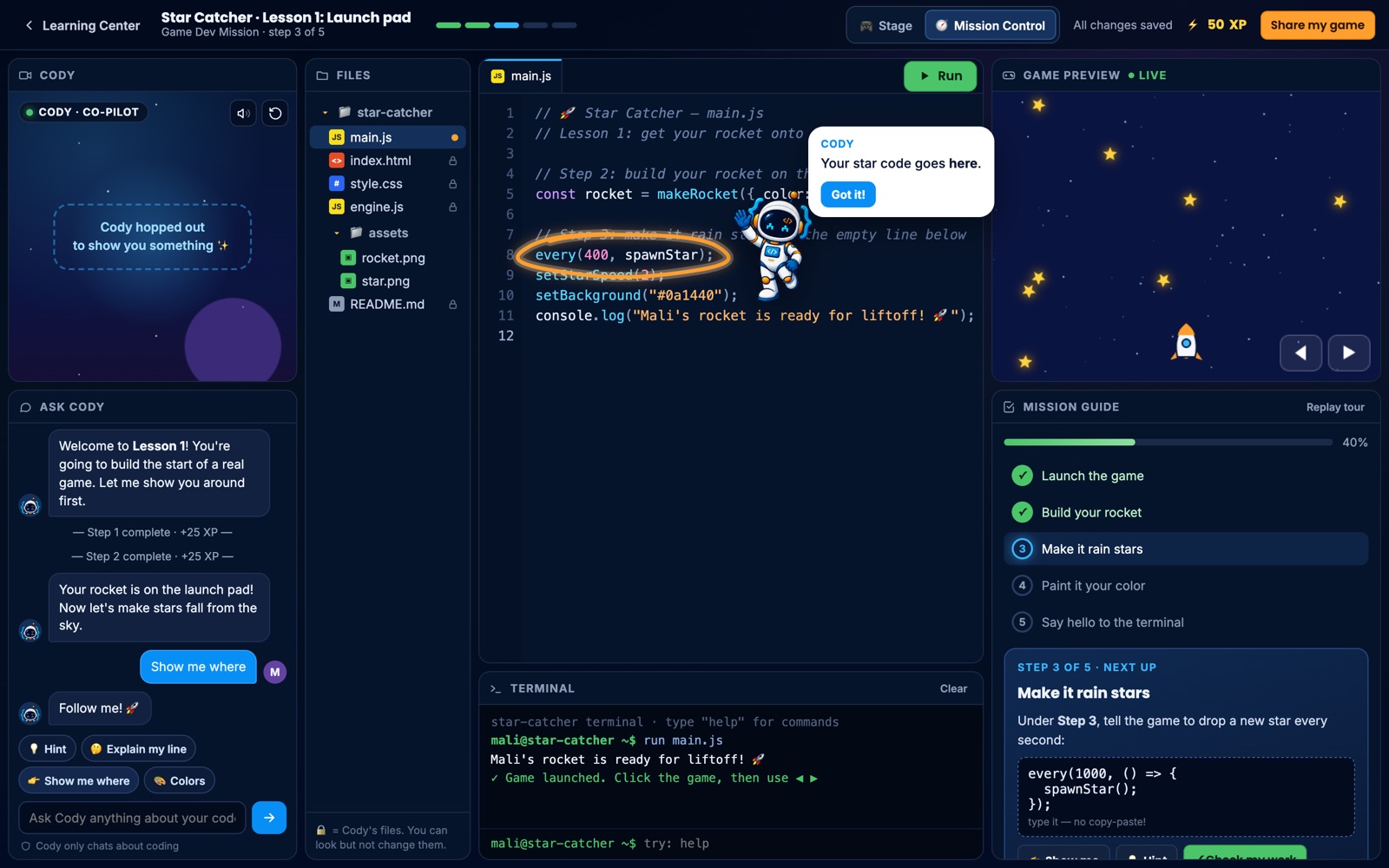
Who coding is for never comes up, because the story asks something else: does the ship fly? By the fifth episode your daughter has finished an arcade game of her own, one she steers from the arrow keys, keeping score across levels, with sound and a boss she drew up herself. Five self-paced episodes take about two hours in a web browser. Wake Up, Cody, the episode that opens the mission, is free, runs about 15 minutes and needs no card. One payment of $29.99 opens the other four, nothing renews, and siblings share them. The account is yours, with a Parent Corner behind your own PIN where every step she takes is there for you to read.
See the ship she'd rebuild, the five episodes and how Episode 1 begins.
See how Star Catcher worksQuestions parents also ask
Should I look for a girls-only coding class?
It can help, and it isn't the only way in. What matters is that she isn't the odd one out. A mixed class with a friend she brought, or a girls' club where she can watch older girls coding, both do that. Ask to sit in on a session first and notice who gets called on and whose hands are on the keyboard. If the boys drive and the girls watch, keep looking.
What if she tries coding once and still says no?
Let it rest without a verdict. One sitting is a sample, and a 10-year-old's no often means that tool, that day. Keep naming her builds for what they are, keep the woman who codes in her life, and offer a different project in a few months, closer to what she makes: a game, an animation, a machine that moves. In Microsoft's survey, interest only took hold around 11½,1 so she has time.
Do I have to code myself to help her?
No. Your part is the messages around the code. In Microsoft's survey, 57% of the young women said a teacher who encouraged them would make them more likely to follow a STEM path,1 and at home you're that voice. Ask her to show you what she made and how she fixed what broke, then praise the fixing.
She'd rather build with cardboard than sit at a screen. Is that a problem?
It's a head start. Building and coding share one habit: plan the steps, test, find what broke and fix it. A kid who rebuilt a marble run three times has already practised the hardest part of debugging. Keep the tape and cardboard coming. Code adds a material where the parts never run out, and she can keep both.
Was this answer helpful?
What was missing?
Sources
- Why don’t European girls like science or technology?, Microsoft News Centre Europe (Andrew Trotman), on Microsoft's survey with the London School of Economics, March 2017 ↩
- Changing the face of STEM, Microsoft News Centre Europe, April 2018 ↩
- Cracking the code: Encouraging girls in computer science and engineering, Allison Master, University of Houston, Springer Nature Research Communities, Feb 27, 2022 ↩
- Gender stereotypes in computer science, engineering, ScienceDaily, from the University of Houston's release on Master, Meltzoff and Cheryan in the Proceedings of the National Academy of Sciences (2021), Nov 30, 2021 ↩
- Sapna Cheryan, Allison Master, and Andy Meltzoff publish an op-ed in the LA Times on how toys can be used to decrease the gender gap in STEM fields, University of Washington Department of Psychology, carrying Cheryan, Master and Meltzoff's Los Angeles Times op-ed ↩
- Microsoft MakeCode, Microsoft ↩
Keep reading
More in Coding and making PotentialMy 9-year-old daughter wants to be a doctor. Should she learn to code?Yes. Medicine runs on software now, and she'll spend her working life inside it. In one study, family doctors spent nearly 6 hours of an 11.4-hour workday in the electronic health record.
 CodingI'm not technical. How can I help my child learn to code?You can help without knowing any code. Let a good course do the teaching and make yourself the audience: ask your child to show you how their program works, and praise the effort.
 CodingMy 10-year-old has outgrown Scratch. What should he learn next?Typed code, in a tool that keeps giving him things to show. Python is the usual answer, and a good one. For a ten-year-old game builder we'd pick JavaScript, because his games open in any web browser.
 CodingMy 10-year-old keeps asking how video games actually work. How do I explain it?Tell them a video game is a loop. Over and over, the game checks which buttons are down, moves everything by its rules (speed, gravity, what happens when two things touch) and draws a fresh picture.