My 8-year-old spends hours on huge Minecraft builds. Is he old enough to learn real coding?
Short answer
Yes, if his typing is ready. The Raspberry Pi Foundation sets typed code at "around the ages of nine or ten" because that's when "typing skills are often sufficient".1 A boy who reads a sentence and types a short word quickly can start real code at eight, in short lines. Marina Bers, then a Tufts professor: "Coding is a new literacy."2
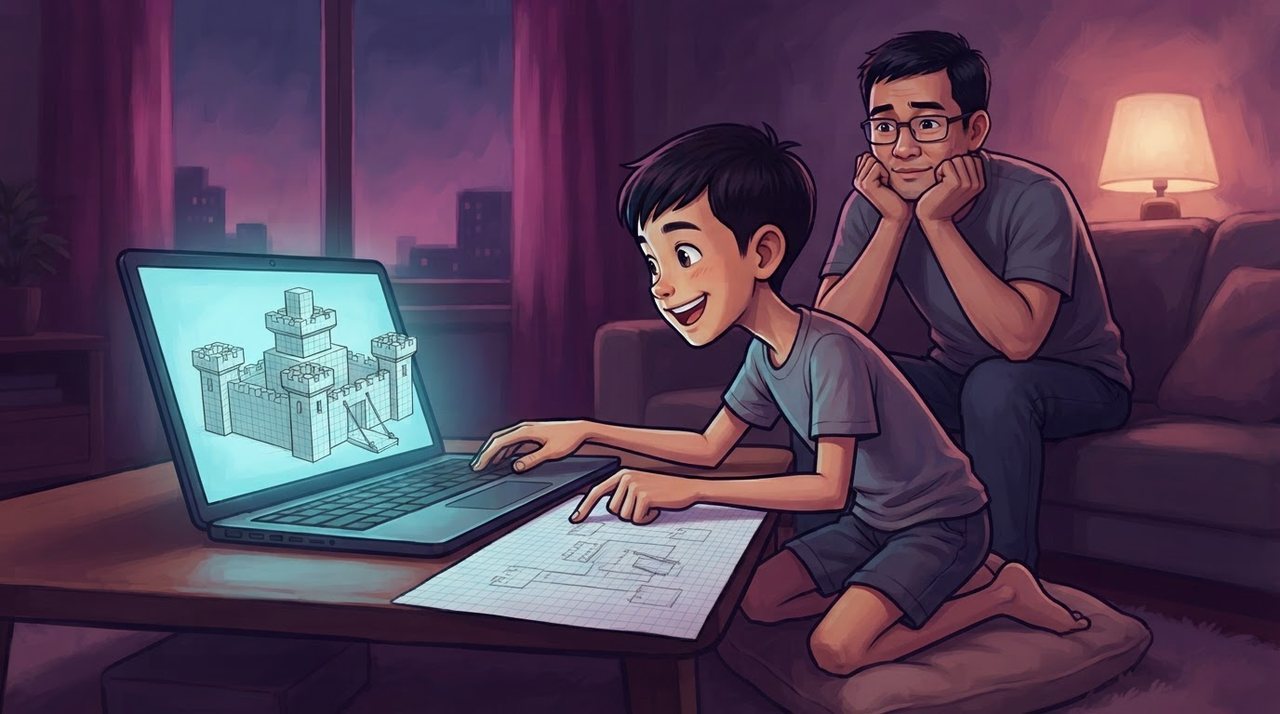
He'll build a castle all morning. So why do I worry he's too young for coding?
Because it looks like play, and coding sounds like work for older kids.
It's Saturday. He started a castle after breakfast, and at lunch he's still on it: four towers, a moat, a drawbridge he wired with redstone so it opens when you step on a plate. One tower came out a block wider than the others, so he tore it down and built it again. He counts blocks out loud. When you call him for food, he wants five more minutes to finish the gate.
Meanwhile his cousin, two years older, does a coding class, and you've started wondering whether all this building could go somewhere. Then the doubt: is eight too young to start coding, or will he just get frustrated, decide he's bad at it and go back to the castle?
Is a Minecraft build really the same kind of thinking as code?
Closer than it looks, and the people who build coding tools for children are clear about when to start. MIT's Media Lab released Scratch "designed for ages 8 and up",3 with blocks that snap together "much like LEGO",3 and Mitchel Resnick, who led the team, said: "As kids work on Scratch projects, they learn to think creatively and solve problems systematically".3 Marina Bers, who helped develop the younger ScratchJr, had her Tufts students use it to teach children four to seven,2 and she puts the payoff plainly: "if you learn how to code, you're learning how to think in terms of abstract ideas, in terms of problem-solving".2
On a screen-time chart, his Minecraft hours count as gaming. Look at what's inside them, though. Planning four matching towers is breaking a big job into parts. Tearing down the lopsided one is debugging. The pressure-plate drawbridge is an if-then: if someone steps here, open the gate. Pointed at code, those same habits turn playing into making. What he hasn't had yet is a keyboard that makes them happen.
What if he starts too early and hits a wall?
Then he learns the wrong lesson: that coding is for other kids. An eight-year-old who spends his first evening staring at a red error he can't read may not ask for a second evening, and the next time coding comes up he may remember the error instead of the idea.
This is fixable, and the wall is usually the setup rather than his age. That nine-or-ten line for typed code is about typing speed,1 and the same page says "There is no correct age at which a child can begin coding".1 So a kid whose reading and typing are ready can start earlier, as long as each line is short. Shrink the line to something he can type in a few seconds, make it do something he can see, and mark the line when it goes wrong, and the same boy who rebuilds towers will rebuild a line of code.
Why don't the usual starts work for a kid like him?
Most of them are built for a different child: a younger one, an older one, or one who's happy to watch.
- Waiting until he's ten. Safe on paper, but the castle years are when he's hungriest to make things. Two years of waiting can mean two years of watching other people build on YouTube.
- Writing Minecraft mods. It sounds like the perfect bridge. In practice, mods mean installing tools, editing files and waiting through errors meant for adults, often for a whole evening before anything moves in his world.
- Arrow-puzzle apps for little ones. Drag a block, move a bee three squares. They work at five. To a boy who wires drawbridges, they can feel like a step backwards, and he'll say so.
- A "learn to code" video. Twenty minutes of someone else typing. He watches, nods and builds nothing.
What works at eight copies what already keeps him on the castle. Every few seconds he can see the result of what he did. There's a bigger thing he's working toward, so each small step has a point. When something goes wrong, the fix is in one place he can find. And something pulls him back tomorrow that has nothing to do with being told to.
How can I tell this week whether he is ready?
Run four small tests, none longer than a snack, and none needing you to code.
- The sentence test. Ask him to read you a line like "Move the rocket ten steps to the right." A line of beginner code is about that long and that plain. If he reads it without much help, reading isn't the barrier.
- The one-word test. On a laptop, have him type his name and the word castle. If he finds each letter within a few seconds, his hands are ready for short lines; speed comes with use.
- The build tour. Ask him to explain how he made his best build, step by step, while you write the steps down as a numbered list. Read the list back to him: that's an algorithm, and he just wrote one.
- The second-try test. Code.org's Minecraft Adventurer has kids "programming Alex or Steve to move through a simulated piece of a Minecraft world",4 in a web browser.4 Give him twenty minutes and watch one thing: when a move goes wrong, does he try again? If yes, he has the patience, and he has shown you where it comes from.
If he passes three of the four, he's ready for real typed code. Keep the first sessions to about twenty minutes, stop while he still wants more, and leave Minecraft alone: coding should feel like a second build site beside the first.
So what happens when an eight-year-old builder takes the tests?
Take Nat, an invented eight-year-old whose Minecraft world has a castle in every biome, on one Saturday when his mum runs the four tests between builds.
He reads "Move the rocket ten steps to the right" in one go and asks which rocket. He types castle, finding each letter in a second or two. The build tour takes eleven minutes and fills half a page: dig the moat first, then the corners, then count the wall blocks so the towers match. His mum reads the list back and tells him it's an algorithm; he asks her to number the steps properly. On Code.org's Minecraft Adventurer, Steve stops two blocks short on his third try. Nat says "oh, wait", adds a move and runs it again without being asked.
That's four out of four, and the one that matters most is the last: he tried again on his own. He goes back to the castle for the afternoon. At dinner he asks whether next Saturday he can type something that makes a game, and his mum has her answer to whether eight is too young.
Star Catcher: real typed code, sized for eight
At Codestronauts, a story-driven coding course for kids from eight to twelve, the first mission is Star Catcher, and its lines start short. The first episode, Wake Up, Cody, opens in an empty hangar, and your son's very first move is a press of Run on a line waiting in the editor: Cody, the robot asleep in that hangar, blinks awake. The first line your son types himself builds the ship, and in the second episode he turns the 10s in both thruster lines into 25s (rocket.x -= 25; and rocket.x += 25;) and watches the ship jump farther with every press. Every word is real JavaScript typed on the keyboard, never dragged blocks, and Cody explains each new one right after he has seen it work.
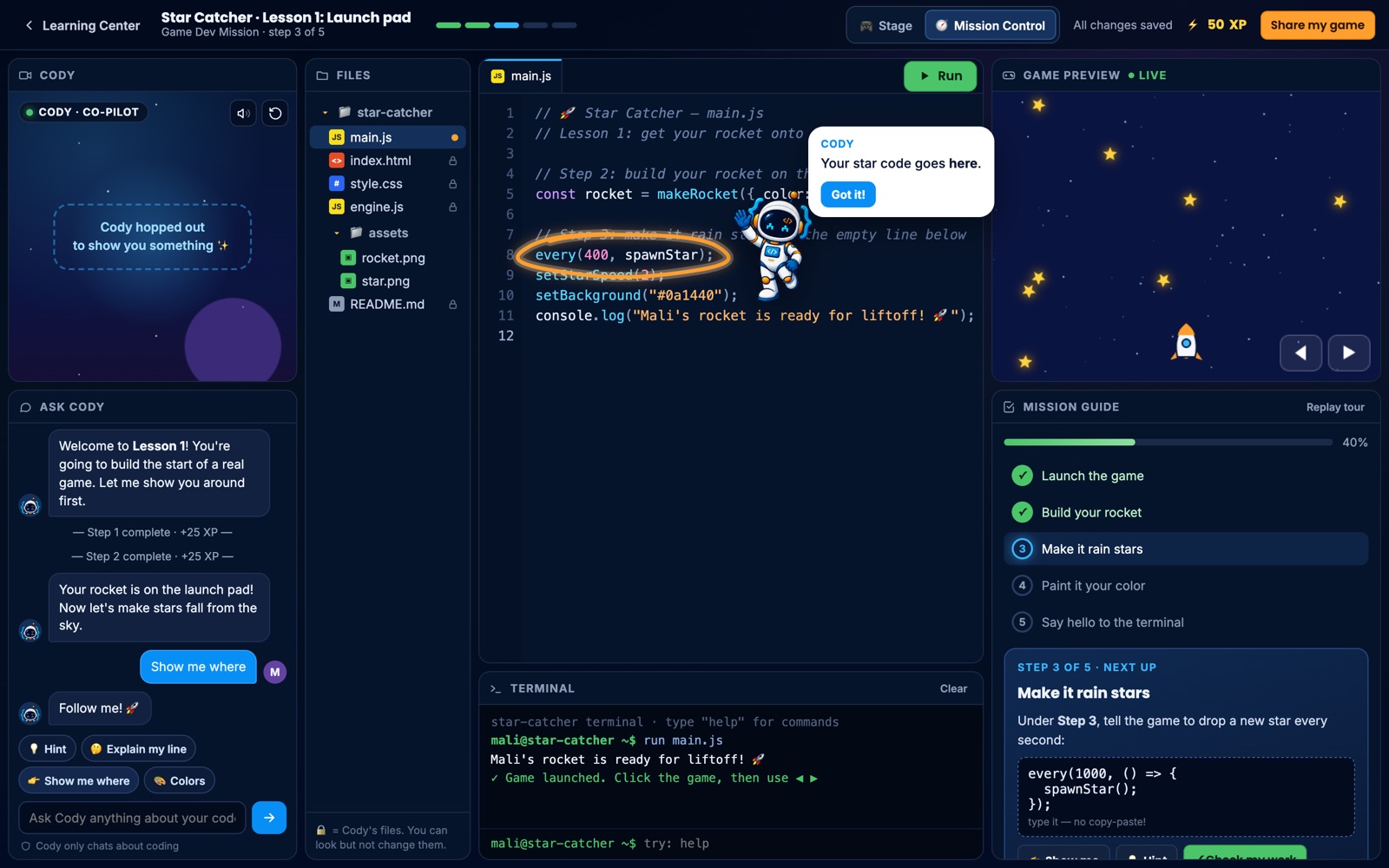
If he types something off, he sees the mistake happen, sometimes hilariously, and then Cody, who is fully voiced, tells him why. She starts with hints; if he's still stuck, her final one gives him the exact line to type, and her help thins as his skill grows. Each line he types pushes the story on, every episode leaves him on a cliffhanger, and five episodes at his own pace (around two hours from start to finish) take him from waking Cody to a finished arcade game that's his, with levels, sound, a running score and a boss he invents. It opens in a web browser on the family laptop, with nothing to install. That opening episode takes about fifteen minutes and costs nothing, no card needed; the four after it come as one payment of $29.99, and you hold the account behind the PIN-locked Parent Corner.
See the mission where an eight-year-old builder types his first real line and watches it build a starship.
See how Star Catcher worksQuestions parents also ask
Should he learn Scratch first, or go straight to typed code?
Either works at eight. MIT made Scratch so kids could program "without any of the obscure punctuation and syntax of traditional programming languages",3 and it's a fine place to play with ideas. If he already plans big builds and can type a short word, he doesn't have to wait for blocks to run out: short typed lines with help that marks the line are within reach now, and they're what he'll use later anyway.
Can he learn to code inside Minecraft itself?
Yes, in a simplified way. Code.org's Minecraft tutorials run in a web browser and teach the basics by programming Alex or Steve.4 They're a good taste. For typed code, he'll want a place where his lines build something of his own beyond moving a character a few squares.
He can't spell well yet. Is that a problem?
Less than you'd think. Beginner code uses a handful of short words over and over, and he learns them the way he learned block names in Minecraft: by using them. A wrong letter is also a very common first bug, and fixing one is good practice in reading carefully.
Is JavaScript too hard for an eight-year-old?
Not in small pieces. A line like rocket.x += 25; moves a ship 25 steps to the right: one name, one sign, one number. What makes any language hard at eight is a blank page and long lines; a course that starts from code that already runs and adds one line at a time takes most of that away.
How long should an eight-year-old code at a time?
About twenty minutes to start, a few times a week, ending while he still wants more. Let him set the pace after that. Kids who build for a whole morning often stretch a session themselves once the code makes something they care about.
Was this answer helpful?
What was missing?
Sources
- At what age can a child start coding?, Raspberry Pi Foundation (Marc Scott, 2022) ↩
- Technological Tools for Playful Learning introduces coding to children, The Tufts Daily (Owen Bonk, April 26, 2021) ↩
- Creating from Scratch: new software from the MIT Media Lab unleashes kids’ creativity online, MIT News (May 14, 2007) ↩
- Learn AI & CS with Minecraft, Code.org ↩
Keep reading
More in Coding and making SchoolMy 9-year-old can swipe through an iPad but can barely type on a laptop. When should kids learn to type?Start now. "Most research supports starting students on formal keyboarding around grade 4," says occupational therapist Theresa Tovey, and fourth-graders are 9 or 10.
 CodingMy 10-year-old has outgrown Scratch. What should he learn next?Typed code, in a tool that keeps giving him things to show. Python is the usual answer, and a good one. For a ten-year-old game builder we'd pick JavaScript, because his games open in any web browser.
 CodingIs coding good for kids?Yes. Coding turns screen time into making. A kid plans, builds, hits a bug and fixes it, and the program is still there when the hour ends.
 ScreensMy son used to build Lego for hours. Now he only wants screens.He's still a builder. Screens won because games and videos of other people playing feel easier than making something, and toys don't have autoplay. So give the builder a screen job: worlds to construct, games to code.