Is coding good for kids?
Short answer
Yes. Coding turns screen time into making. A kid plans, builds, hits a bug and fixes it, and the program is still there when the hour ends. When Ronny Scherer's team pooled 105 programming studies, the benefits reached past coding into creative thinking, math, spatial skills and reasoning.1
Would coding be good for my kid in particular?
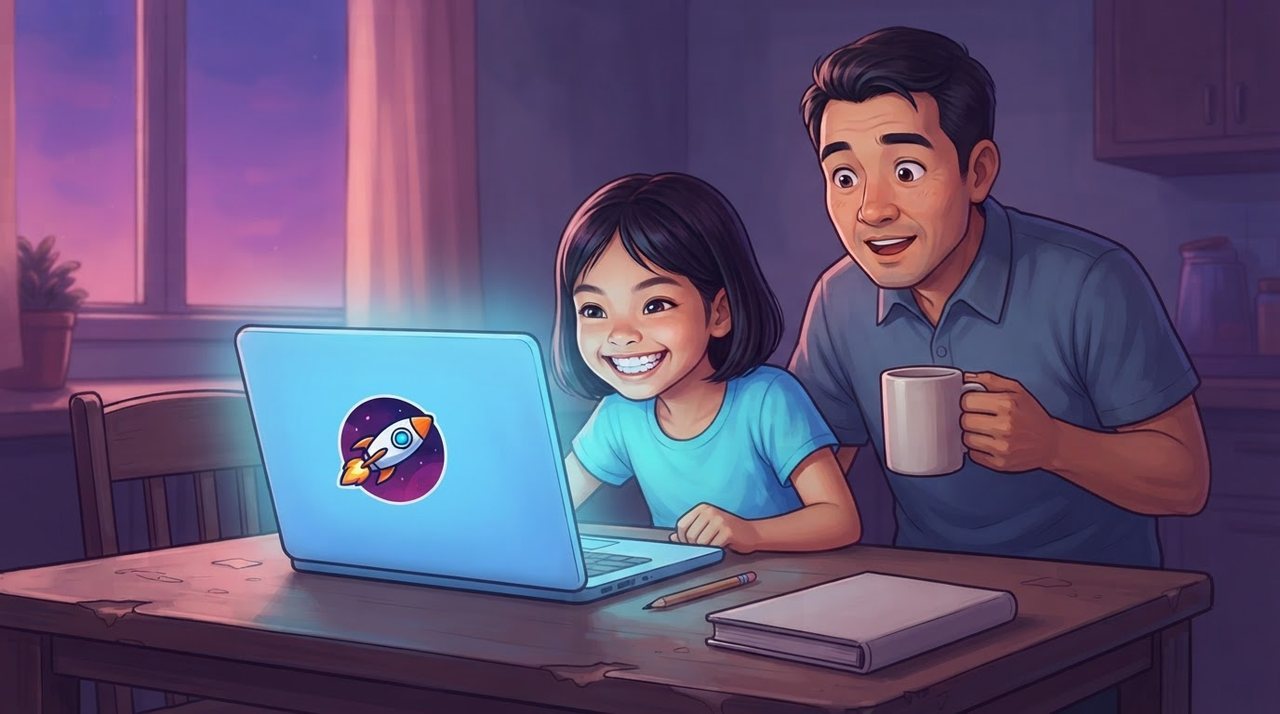
If your kid already spends evenings on a screen, coding is one of the best ways to give some of those hours something to show for them. The question usually shows up on a school night. Homework was done before dinner. It's 7:30, your kid is an hour into videos of other people playing a game, and when you ask what they're watching, the answer is "nothing." You don't want to take the laptop away. The thought in your head is closer to this: if he's going to be on the computer anyway, I'd rather it be something that actually teaches him something.
That nagging feeling is common. In a 2025 Pew Research Center survey of US parents, about four in ten said they could be doing better at managing their kid's screen time.2 Part of the trouble is the phrase itself. "Screen time" lumps very different hours together, and the usual rules count the hours without asking what filled them. A kid who watched for an hour and a kid who built something for an hour show up as the same number on the family's screen-time summary.
Does it matter what a kid does on a screen, or only how long?
What they do matters, and the American Academy of Pediatrics says so. Its media guidance asks families to learn what their kids play and watch, because research shows the quality of that content shapes whether a kid's relationship with media turns out positive or negative.3 Minutes still count, and the kind of minute counts too.
That gives you a simple test for any hour on a screen: ask what's left when it ends. An hour of videos leaves a kid about where they started. An hour spent building and fixing something leaves a skill and a thing they made, so it has earned a different rule from an hour of scrolling. Coding is one of the most direct ways to get that second kind of hour, because the whole activity is making something work.
What does a kid miss when screen time is all watching?
Mostly practice. A video asks nothing of a kid. That's what makes it such an easy place to zone out: it plays, it ends, and the next one starts by itself. The skills a feed never exercises are the ones a kid needs for homework and friendships alike, like planning a few steps ahead, holding back the first impulse, and sticking with something after it goes wrong. Months of evenings like that leave a kid well practiced at being entertained and short on practice at making something work.
That's very fixable, often on the same laptop, because coding asks for exactly what a feed skips. Before anything moves, a kid has to decide the steps and their order. When it breaks, they read what happened, guess why and change one thing at a time. Psychologists call these skills executive functions, and a team at the University of Padova measured them directly. First graders who spent a month coding improved significantly more in planning and inhibition (holding back an impulse) than first graders who spent the month on standard STEM activities.4 In a second study, second graders' planning and impulse control grew at least as much in one month of coding (eight lessons) as in the seven months of regular school before it.4
What does coding actually do for a kid?
It trains habits of mind that carry over to other kinds of thinking, and the evidence for that is broad. A 2019 review in the Journal of Educational Psychology pooled 105 studies and 539 effect sizes.1 It found a moderate overall effect, showing up most in creative thinking, math and metacognition (thinking about your own thinking), then in spatial skills and reasoning.1
You can see why from the inside. Breaking a big problem into small steps is what teachers call computational thinking. A variable that keeps the score is algebra with a job to do. Confidence grows the same way: every bug a kid fixes alone is fresh proof that a problem can be figured out.
For the long run, the US Bureau of Labor Statistics projects jobs for software developers to grow 10% from 2025 to 2035, much faster than the average job.5 AI can write code now, and a person still has to decide what to build and judge whether the result is right. A kid who has written and fixed programs can do both.
Why do so many kids quit coding, and what keeps them going?
If your kid has tried coding and dropped it, look at what they were handed. A tool that feels like a worksheet or a toy, with nothing in it that needs them, is easy to walk away from. Some common first tries hit that wall. A robot kit gets built once and then lives on a shelf. Tutorial videos leave a kid watching someone else type. A puzzle app hands out the next level, and when the levels run out, so does the reason to open it. A chatbot that writes the code for them skips the part where the learning happens.
Story is one pull that has been put to the test. Girls who learned to program by making animated stories put in 42% more programming time than girls using the same tool without the story features, and learned the basics just as well.6 That was a 2007 study of middle schoolers by Caitlin Kelleher, Randy Pausch and Sara Kiesler, using a teaching tool called Alice.6
Our advice builds on that. When you size up any coding program, ask two things: will your kid want to know what happens next, and is there a character in it counting on them? A kid who's needed has a reason to come back that has nothing to do with being told to.
How can I turn some screen time into coding, starting today?
You can start this evening with what's already in the house.
- Change the question you ask when screen time ends. Swap "How long were you on?" for "Show me something you made." It costs nothing and tells your kid what you value.
- Give making its own rule. If watching gets an hour, let building run a little longer, and say why out loud. Kids notice which kind of time stretches.
- Check that it's really making. Decorating a world inside a game is play; writing the script that changes how the game works is coding. Ask to see the code.
- Start free tonight. If your kid reads comfortably, Khan Academy's free JavaScript course has them typing code that draws and animates shapes. For a younger or less confident reader, Scratch, made at MIT, lets them snap blocks into games and stories first.
- Sit in for the first session, then step back. When something breaks, ask "What did you expect it to do?" before you touch the keyboard. The fix your kid finds alone is the one they remember.
- Aim for a finish line. One small game a friend can play is worth more than a pile of half-done tutorials, because a finished thing is what a kid wants to show you.
What does a good coding hour look like?
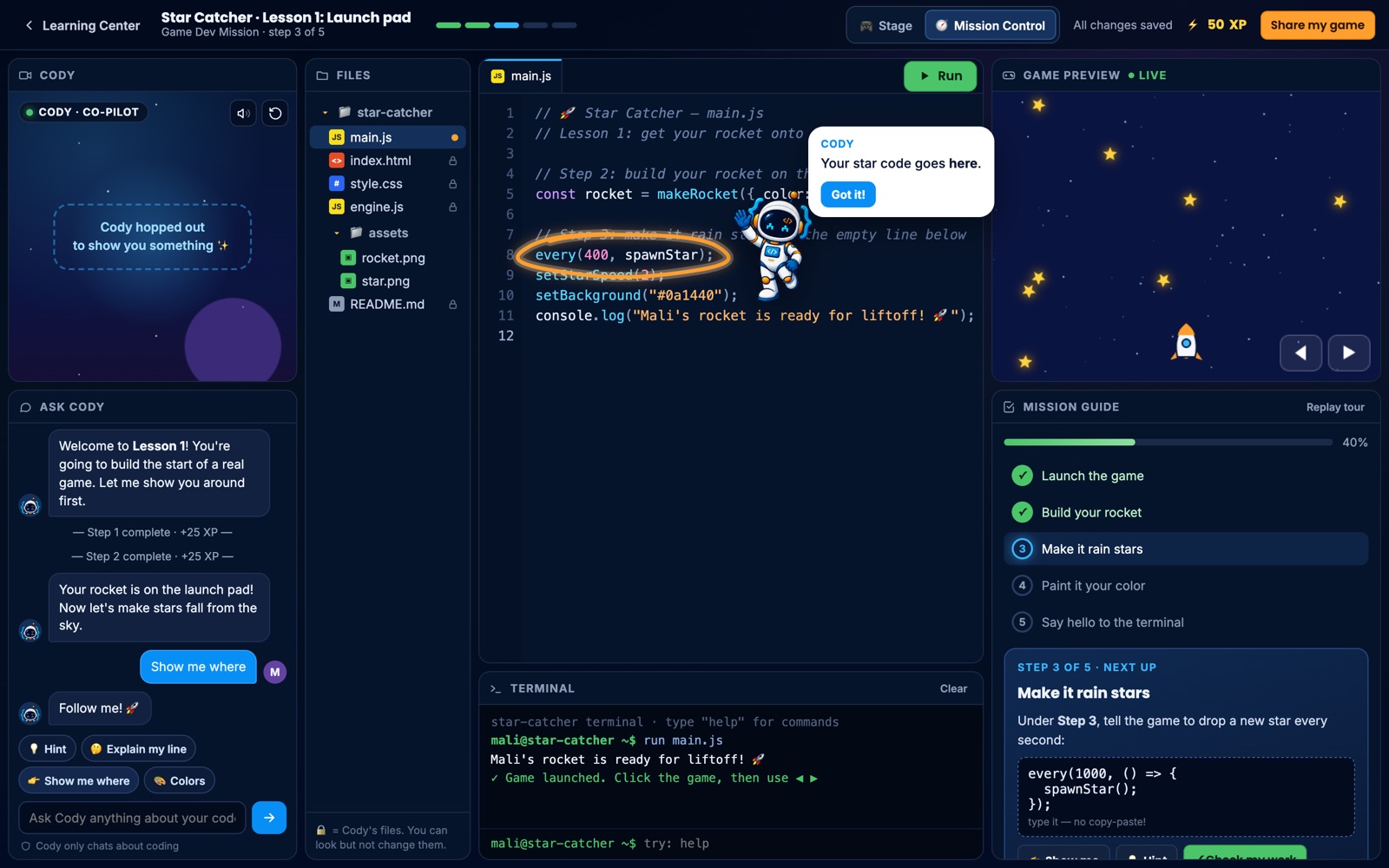
It has a small goal and ends with something on the screen that wasn't there when it started. Here's an invented example. A 10-year-old girl who usually spends the hour after dinner watching other kids play games gives that hour to a coding project instead. She types two lines, presses Run, and her rocket shoots straight off the left edge of the screen. She laughs, reads the line again and finds the minus sign that should have been a plus. Twenty minutes later the rocket flies both ways and stars are falling from the top. By the end of the hour there's a score in the corner, and she's calling you over to watch her catch them.
It was still an hour on a screen. What's left after it is a bug she fixed herself, a game that didn't exist at dinner, and a kid who already knows what she wants to add tomorrow.
Codestronauts: coding with a story to finish
Codestronauts, a coding course for kids 8 to 12, passes the what's-left test with an arcade game. By the end of Star Catcher, its first mission (five episodes, about two hours in all), your kid has built a real game with arrow-key controls, a score, levels, sound effects and a boss of their own design. A story carries them there. Episode 1 opens on a sleeping robot named Cody, and your kid wakes her by pressing Run. The first line they type, makeRocket();, builds the ship, and every line after it is real JavaScript that moves the adventure forward. Each episode ends on a cliffhanger, so there's always a reason to come back tomorrow. Cody needs your kid, and she helps without doing the work: she gives hints instead of answers, points at the line that needs a look, and steps back as your kid gets better. When a line is wrong, the mistake plays out on screen, often comically, before she explains what happened.
You hold the keys in a PIN-locked Parent Corner, where every purchase waits for your OK and every step and sign-in is there to see. You pay $29.99 once for all of Star Catcher; nothing renews, and brothers and sisters share it. It runs in the browser of a laptop or desktop, installs nothing, and works on phones as well. Jonathan Greene built it after more than 17 years as a software engineer; he's a dad of two who wrote his first program at 8.
See the story, the ship and the game your kid builds by the end of Star Catcher.
See how Star Catcher worksQuestions parents also ask
What should coding look like at 8 versus 12?
At 8, short typed lines that make something happen on screen right away, with a story and a patient helper close by, so reading code never feels like a test. By 10, a kid can hold a whole small game in their head and hunt down a bug in it. By 11 or 12, let them plan their own project from a blank page and show it to friends. Younger kids can start with picture blocks; ScratchJr was made for ages 5 to 7.
Does my child need to be good at math to learn to code?
No. Beginner coding uses counting, adding and a little logic, and it gives each of them a job: a variable keeps the score, and a greater-than sign decides when a level ends. For a kid who thinks math means worksheets, seeing a number decide how fast something flies can make it feel useful. Curiosity and patience matter more at the start than math grades.
Does coding make kids smarter?
It sharpens particular thinking skills, and those have been measured. In the Padova studies, a month of coding lessons improved young children's planning and impulse control more than standard STEM activities did.4 Pooling 105 studies, Scherer's team found gains that carried over to creative thinking, math and reasoning.1 Those are specific skills a kid can build, one program at a time.
Should my child start with blocks or typed code?
If your kid is 8 or older and reads comfortably, try typed code first. Blocks are a fine start for younger kids, and an older kid gets to feel the pride of typing the real thing. Begin with one line that makes something visible happen on screen, then add the next.
How much time should a kid spend coding?
A couple of sessions a week is plenty, each long enough to finish one small thing. End on a win, right after something works, so your kid comes back wanting more. Because it's making time, it can sit outside the limit you set for watching.
Was this answer helpful?
What was missing?
Sources
- The Cognitive Benefits of Learning Computer Programming: A Meta-Analysis of Transfer Effects, Journal of Educational Psychology, 2019 (Scherer, Siddiq and Sánchez Viveros), on ERIC ↩
- How Parents Manage Screen Time for Kids, Pew Research Center, 2025 ↩
- Kids & Screen Time: How to Use the 5 C's of Media Guidance, American Academy of Pediatrics, HealthyChildren.org ↩
- Coding in Primary Grades Boosts Children's Executive Functions, Frontiers in Psychology, 2019 (Arfé, Vardanega, Montuori and Lavanga, University of Padova) ↩
- National Employment Trends: Software Developers (Bureau of Labor Statistics 2025–2035 employment projections), O*NET OnLine, US Department of Labor ↩
- Storytelling Alice motivates middle school girls to learn computer programming, Kelleher, Pausch and Kiesler, CHI 2007 (WashU Research Profiles) ↩
Keep reading
More in Coding and making AIIs it still worth it for kids to learn coding now that AI can write code?Yes. AI now writes code in seconds, and a lot of it is almost right. In Stack Overflow's 2025 survey, the frustration developers cited most, at 66%, was "AI solutions that are almost right, but not quite".
 ScreensHow much screen time is OK for a 10-year-old?A sensible start is one to two hours of fun screen time a day, homework aside, as Nemours KidsHealth suggests.
 CodingMy 8-year-old spends hours on huge Minecraft builds. Is he old enough to learn real coding?Yes, if his typing is ready. The Raspberry Pi Foundation sets typed code at "around the ages of nine or ten" because that's when "typing skills are often sufficient".
 ScreensMy son used to build Lego for hours. Now he only wants screens.He's still a builder. Screens won because games and videos of other people playing feel easier than making something, and toys don't have autoplay. So give the builder a screen job: worlds to construct, games to code.