“My son can tell me what he clicked in coding class, but not why. I can't tell if he's learning anything.”
Short answer
Ask him to explain one line he wrote: what it does, and why it's there.
If he can, he's learning. If he can only retrace the clicks, he's following steps.
Asking helps him learn: a 2018 meta-analysis of 64 studies found that, for students, explaining material to themselves beat having it explained by a teacher or the materials.1
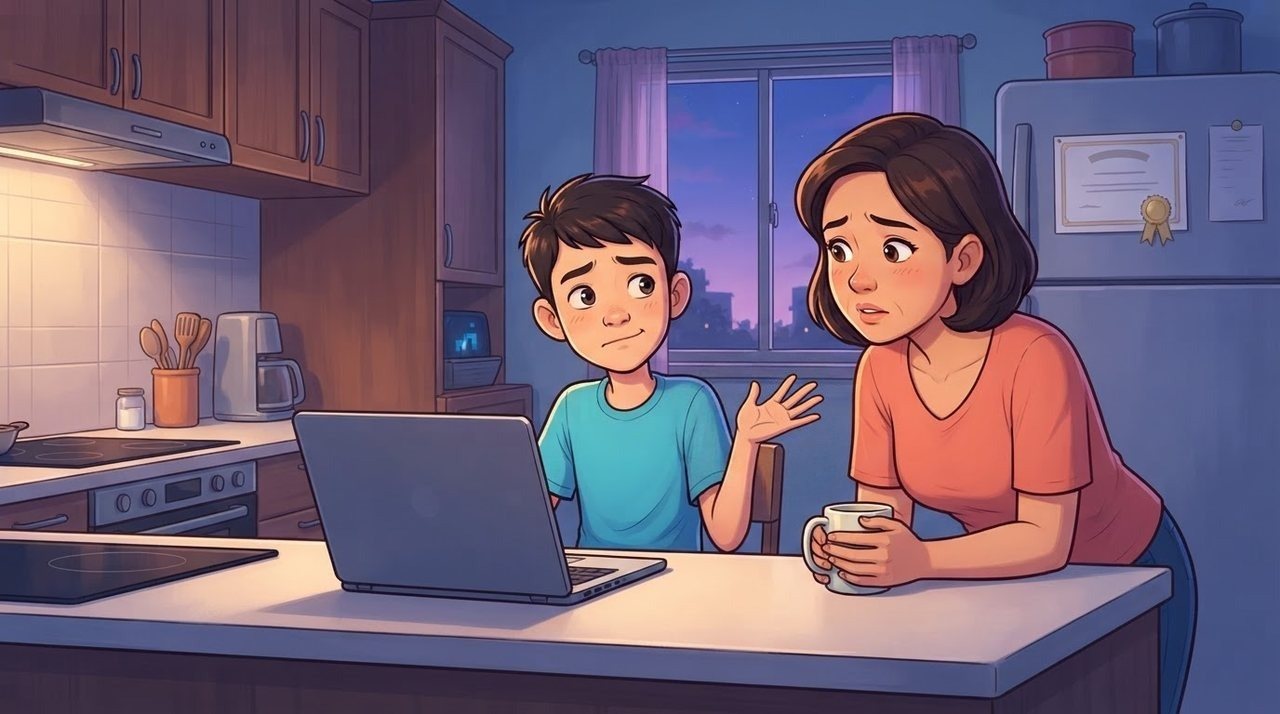
What does it mean when he can only tell you what he clicked?
Usually it means he has been following steps, and you've spotted the one gap that matters. The scene goes like this. Class ends, you ask what he made, and he tells you in order: he clicked here, dragged that over, pressed the green button, and the character moved. You ask why that piece goes there, and he shrugs. "Because that's what the next step said." The fee goes out every month, a certificate comes home, the project on the screen looks finished, and you're left with the same thought every week. I can't tell if he's learning anything or just following instructions.
He isn't hiding anything from you. Retelling the clicks is honest; it's all he has so far. A polished project can be built entirely from steps someone else thought through, which is why the finished game on the screen can't answer your question and his explanation can.
Is following instructions a bad sign?
Only when the why never shows up behind it. Every beginner follows steps at first; that's how a first program gets built. What separates learning from copying is whether he can say what a piece of code does once the steps are gone. In a 2012 study of novice programmers, the ones who could correctly explain short pieces of code in plain English were also the ones who could write code, and the correlation was strong.2 The authors concluded that explaining code and writing it rest on some of the same reasoning.2
So the explanation you aren't getting is a window onto the skill you're paying for, and asking for it builds that skill. When Kiran Bisra's team at Simon Fraser University pooled 64 studies in 2018, students prompted to explain material to themselves learned more than students who had it explained by a teacher or the materials.1 Putting it into words shows a learner what they don't know yet.1 Better still, you can ask for that explanation without reading a line of code yourself.
What happens if he's only been clicking?
The cost stays hidden until the steps run out. A kid can finish level after level, or months of guided projects, and then meet a blank screen, an idea of his own or a harder class with nothing to start from. It's easy for him to read that moment as a verdict on himself ("I'm just not a coding person") when the instructions were doing the thinking all along. The months and the fees went into a progress bar.
This is very fixable, and quickly. Understanding one line takes minutes once someone asks for it, and the habit of asking why carries to the next line. You can find out tonight which side of the gap your son is on, and the same few minutes will tell you whether his program is built to close it.
Why don't badges, levels and the next class tell you more?
Because they count finished steps, and finished steps are what he can already tell you about. Asking "Did you learn anything?" gets a "yeah." Badges, belts, certificates and completed levels record what was finished. Moving up to the next level adds more steps on the same pattern. And if you sit beside him and explain the code yourself, your instructions replace the screen's.
What works is a program that makes him commit to an answer before the computer shows him one. He types the line himself, guesses what it or a change to it will do, runs it, and compares. When the result surprises him, the gap between what he expected and what happened is where the understanding gets built, and a step list never opens that gap because it never asks him to expect anything. So look for two things: wrong code is allowed to run and show its mistake, and help points at the problem while leaving the fix to him.
Every kind of program can pass or fail on this:
- Drag-and-drop puzzle apps teach sequence well and are friendly at 8. A level can also be passed by trying blocks until something works, so a finished level says little on its own.
- Video courses let a kid go at his own pace. Their trap is pause-and-copy: his screen matches the video because he copied the video.
- Live classes are as good as the teacher's questions. A teacher who keeps asking "why does that go there?" builds the explaining habit; one rushing a big group to a finished project often can't.
- Typed-code courses use the language professionals use, and typing makes a kid look at every word. Typing a line out of a template is still copying, so they get the same test as everyone else.
How can I test his program tonight if I can't code?
Ask him to explain one line he wrote, under conditions that keep it honest. It takes about five minutes, works on any kind of program (ours included) and suits parents who don't code.
- Close the instructions first. Shut the tutorial, the video and the step list. Whatever he can do with them closed is his.
- Point at one line and ask what breaks without it. Then let him delete it, or change a number, and run it. A kid who understands can call the result before he presses Run. A kid who clicked finds out with you.
- Ask for a change nobody showed him. A faster character, a score that starts at 100, a second enemy. Understanding goes straight to the right line; copying goes looking for the instructions. A kid who picks the harder change is telling you something good.
- Ask about the last bug. "What went wrong last time, and how did you find it?" A kid who has fixed his own bugs has a story. If someone always fixed them for him, he won't.
- Ask where each line came from. If a template, a video or an AI tool wrote it, all he can tell you is that it came from there. At 8 to 12 a chatbot shouldn't be writing his code on his own account anyway, so that's a question for the class.
- Ask the program one question. "How do kids show they understand, besides finishing?" A good program answers it in a sentence.
Keep it curious and light. You're the audience for his work, so treat a shrug as information about the class.
What does the switch from clicking to knowing look like?
To see the test play out, follow an imaginary ten-year-old, three months into a weekly online class. His game is a frog hopping across lily pads, and every pad it lands on scores a point. His mom closes the class's step list, points at a short line near the bottom and asks what breaks without it. He has no idea. They delete it, play a round, lose on purpose and press restart, and the new game opens at 40 points instead of zero. He puts the line back and stares at it for a while. Then he explains that it sets the score to zero whenever a new game starts, and asks, without any prompting, whether he could keep a best score that never resets. The following week she asks the class how kids show they understand, and their answer decides whether he stays. Whatever they say, she has already heard what she came for. For the first time since he started, his answer about coding has a because in it.
Where does Codestronauts fit in?
We'd like you to run this test on Codestronauts, where kids 8 to 12 learn to code through a story. In its mission, Star Catcher, your child types real JavaScript from the start, with no drag-and-drop blocks. The first line he types builds a starship, and Cody, his nervous robot co-pilot, explains each new word right after he has seen it work. Because he watches a line do something before he hears what it did, every new word arrives with its why.
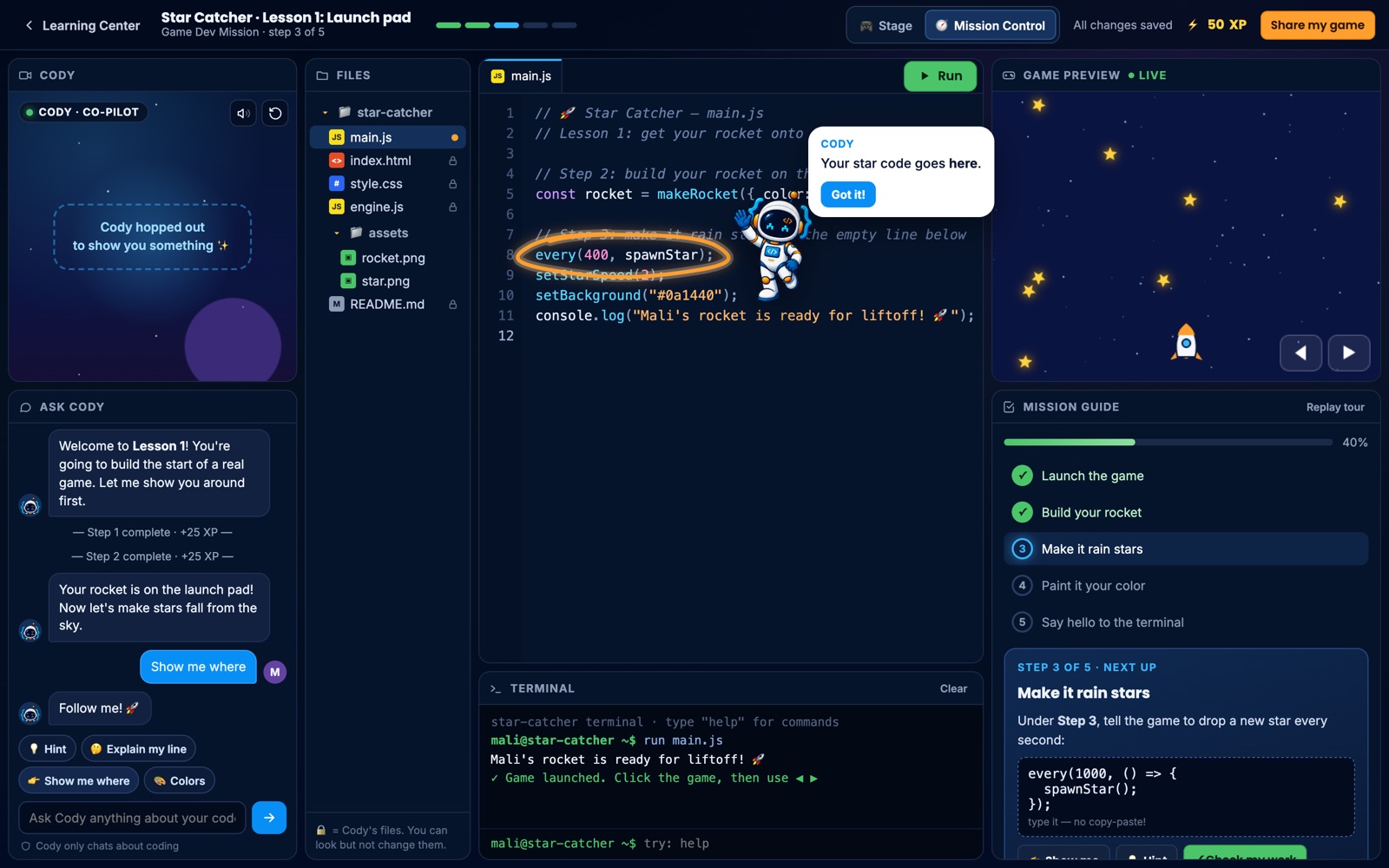
When his code is wrong, the mistake plays out on the screen and Cody tells him why. She nudges with a hint, leaves the answer to him, points him to the right line and steps back as he improves. Every line he types also pushes the story toward relighting the Great Beacon, and all five episodes end on a cliffhanger. Over about two hours, at his own pace, he ends up with a real arcade game of his own. He steers by arrow key. The game keeps score and climbs through levels. It plays sound, and its final fight is a boss he designed. Here's the test to run on us: after Thruster Trouble, ask him why rocket.x += 10 sends his ship to the right. Each step he took is there for you to see in the Parent Corner, which a PIN keeps yours. The whole mission is one payment of $29.99, with nothing to renew.
See the mission he'd play, from the first line that wakes Cody to the arcade game he finishes.
See how Star Catcher worksQuestions parents also ask
Do badges, belts and certificates show that my child is learning to code?
They show he finished a set of steps, which is worth something. They can't show whether he understood them. Pick one thing from the level a badge was for and ask him to change it with the instructions closed. If he can, the badge means what it says.
How soon should a beginner be able to explain his own code?
From the first week, one line at a time. Our rule of thumb: by the end of any session he should be able to explain at least one new thing he used that day, in his own words. Explaining a whole program comes later and grows from those single lines.
What if he gets upset when I ask him why?
Ask about the code, never about him, and ask because you're curious. "What would happen if we took this out?" is a puzzle to share. If he doesn't know, find out together by trying it, and let him be the one who works it out. A kid who feels tested clams up, and a kid showing off his work talks.
Should I switch programs if he can't explain anything?
Talk to the program first. Ask how kids show they understand, and ask the teacher to have him explain a line at the end of each session. Then run the test again in a few weeks. If his answers still never have a "because" in them, look for a program where explaining is part of every lesson.
Was this answer helpful?
What was missing?
Sources
- Self-explanation is a powerful learning technique, according to meta-analysis of 64 studies involving 6000 participants, British Psychological Society Research Digest (2018), on Bisra et al., Educational Psychology Review ↩
- Ability to 'explain in plain english' linked to proficiency in computer-based programming, ICER 2012 (Murphy, Fitzgerald, Lister and McCauley), University of Technology Sydney repository ↩
Keep reading
More in Coding and making CodingI'm not technical. How can I help my child learn to code?You can help without knowing any code. Let a good course do the teaching and make yourself the audience: ask your child to show you how their program works, and praise the effort.
 AIIs it still worth it for kids to learn coding now that AI can write code?Yes. AI now writes code in seconds, and a lot of it is almost right. In Stack Overflow's 2025 survey, the frustration developers cited most, at 66%, was "AI solutions that are almost right, but not quite".
 CodingI wish I'd learned to code as a kid. Where should my child start?Pick by what your child can type and wants to make. Not typing yet: Scratch or a free Code Club. Into games: MakeCode Arcade, or Star Catcher, our typed-JavaScript story. From about 9 or 10, Python or web pages.
 CodingMy 10-year-old keeps asking how video games actually work. How do I explain it?Tell them a video game is a loop. Over and over, the game checks which buttons are down, moves everything by its rules (speed, gravity, what happens when two things touch) and draws a fresh picture.