“We live in Bangkok, and I want my child ready to compete with kids from every country.”
Short answer
Give them a few things that count in any country: English they use for real, a belief that effort pays, and a skill judged the same everywhere, like code.
Thai 15-year-olds scored 476 against an OECD average of 500 on PISA 2025's computational problem-solving test, a far smaller gap than in maths or reading.1
Who will my child really be up against?
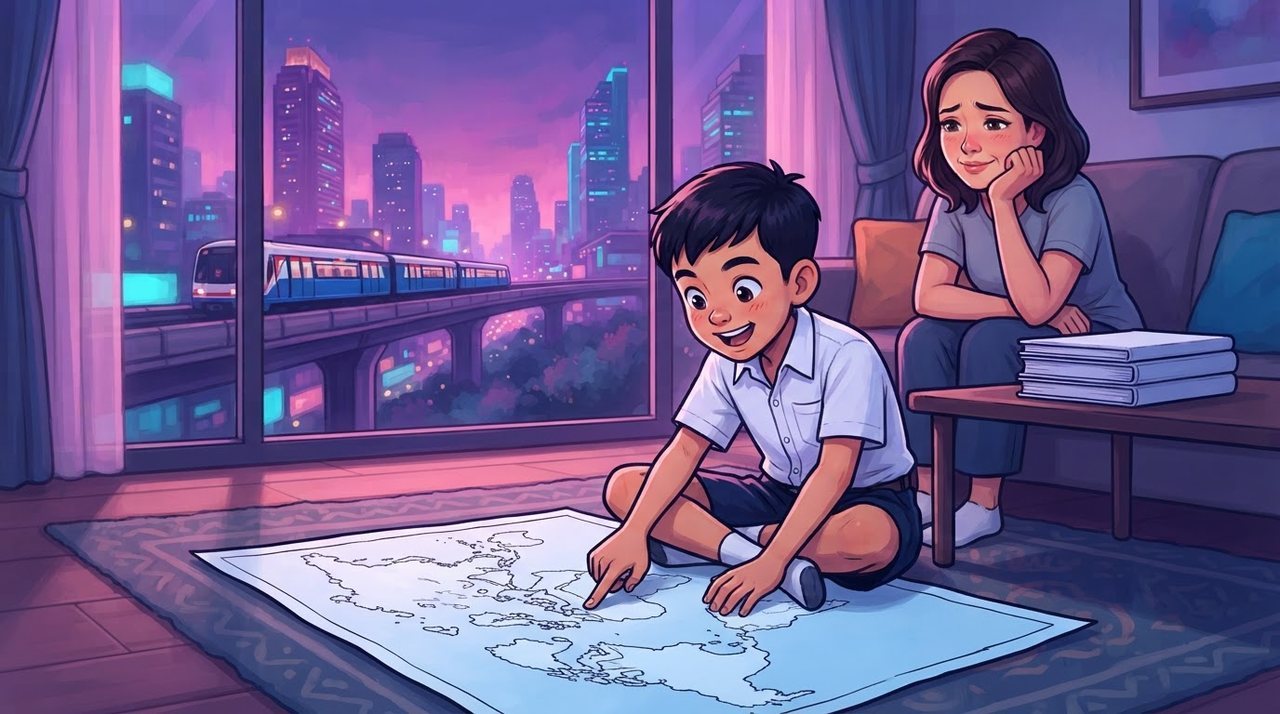
Kids from everywhere, and you can already see them from your living room. You've probably said it yourself: kids today are citizens of the world, and whatever they do, they'll be up against kids from every country.
An ordinary Tuesday shows it. School lets out at half past three, the van crawls down Sukhumvit, and there's an English tutor at five and a maths workbook at the kitchen table after dinner. The parents' LINE group pings with someone's son off to a robotics camp in Singapore and someone's daughter starting Mandarin. By eight your child is on YouTube, watching a teenager in Seoul build a robot arm. You're doing the sums on university in Melbourne or London. Past that is a first job where the video call has people from five countries on it. What you want is for your child to walk into that room one day and hold their own.
Where do kids in Thailand stand against the rest of the world?
Behind in the core subjects, and much closer in the one that looks most like coding. PISA tests 15-year-olds every three years, and its 2025 round covered 91 countries and economies.2 Thailand scored below the OECD average in every area it tested.1 The gaps were widest in reading (392 against 461) and maths (407 against 463).1 English tells a similar story for the country's grown-ups. The 2025 EF English Proficiency Index, built from the test results of 2.2 million adults in 123 countries and regions,3 ranked Thailand 116th, with a score of 402 against a global average of 488.4
The same round added a new test, computational problem-solving, which asks students to use digital tools to model problems, analyse data and build or debug digital products.2 There Thailand scored 476 against an OECD average of 500, a gap less than half the size of its gap in any core subject.1 Neighbours did well on it too, with Malaysia, Brunei and the Philippines scoring more than 30 points above what their science results predicted.1
Code comes closer to a level field than school subjects do, for a plain reason. A line of JavaScript means the same thing in Bangkok, Boston and Beijing, and the people who write it come from everywhere. Stack Overflow's 2025 developer survey drew answers from 177 countries, and more of them used JavaScript than any other language.5 When the computer runs a program, it doesn't ask about the author's accent, school or passport. The program runs or it doesn't.
What does it cost a child to compete only on test scores?
Mostly belief. When a child spends every afternoon in the races where they start furthest back, the scoreboard tells them the same thing year after year, and it gets easy to decide you're just not a maths person, or not good at English. PISA asked students about that belief directly. Just 36% of Thai students believed intelligence can be developed through effort and feedback, against 69% across OECD countries.2 At home it can look like a shrug at a hard problem before the first try, and that shrug costs more than any single exam.
This is fixable, and Thai kids already bring the hardest part. In the same survey, 81% of Thai students said they put in extra effort when work gets difficult, against an OECD average of 60%.2 The work ethic is there. What's missing is a field where effort shows up fast and plainly, so a child can watch themselves improve week by week. Between 8 and 12 there are years of runway to find one.
Why haven't more tutoring and English classes closed the gap?
Because they keep your child in the same races and ask them to run harder. A Saturday at a cram school in Siam buys a few points on the next exam, and the kid in Seoul has a tutor too. An English app streak fades once the novelty does. A robotics club built on snap-together kits is fun for a term, then the kit goes back in its box. Each of these measures your child on a scoreboard someone else keeps, in a race they joined from behind.
The fix that holds looks different. It's judged by whether the thing works, so a result means the same in every country. Your child makes something they can show, and every bug they fix is proof that effort changes the outcome. And the reason to come back has to come from somewhere other than you. A plot your child wants to see through does it, especially one with someone in it waiting on their next move.
Code fits, and it carries its own English. Most of JavaScript's keywords are short English words like if, while and return, plus a few clipped ones like const, so a child practises reading and typing English with a reason every time they sit down. The gains reach past the screen as well. Researchers who pooled the studies on learning to code found the largest effects on creative thinking, maths, metacognition, reasoning and spatial skills.6
What can we do this week with the laptop we already have?
Start small and start at home. None of this needs a new class or a new device.
- Show them that code is the same everywhere. Find a beginner JavaScript tutorial on YouTube in Thai, then one in English or Korean, and pause both on the first program. The voices and the explanations change, and the keywords on screen stay the same. Ask your child what that means for who they'll be working with one day.
- Read one line of code aloud together. Write
if (lives === 0) { gameOver(); }on paper and ask what it does. Most kids work it out with a nudge: when the lives run out, the game ends. The English in code is small and every word has one job, so a child still building their English can read it. - Give one weekly hour a making goal. Keep the time slot and change the job. Your child picks a project, a quiz for a cousin or a tiny game, and the hour ends with something on the screen they can show you.
- Praise the fix more than the score. When a program breaks and your child tracks down the bug, name what they did: they changed one line and tested it again. Each fix is a small, visible proof that effort moves the result, which is the belief PISA found missing in so many Thai students. When they're stuck, let them search for the answer before you give it. Finding out how to learn the next thing is the habit that outlasts any one language.
- Have them explain it to someone far away. Once a project works, your child shows it on a video call to a relative or family friend abroad and explains, in English, how it works and what they'd change next. Explaining your work to someone who grew up somewhere else is a skill of its own, and it improves with every call.
- Build one thing with a partner. A friend, a sibling or a cousin works on the same small project, and they swap the keyboard every ten minutes: one types while the other reads the code and spots mistakes. Agreeing on what to build, and disagreeing kindly about how, is teamwork that works in any country.
- Ask the school about Bebras Thailand. It's a national computational-thinking challenge run from KMITL's Faculty of Information Technology, with an online round open to primary through upper-secondary students, entered through a teacher (details at www.bebras.in.th).
- Start a folder of finished things. Save every project with the date and one sentence in English about what it does. By 12, that folder says more about your child than a worksheet score, in any country.
How might one Bangkok ten-year-old get there?
Here's an invented example. Ploy is ten and goes to a bilingual school off Sukhumvit. Her English grammar quizzes come back covered in red ink, and Saturday mornings belong to a maths tutor in Siam. Her parents keep the tutor, and on Wednesday evenings they hand her the laptop for an hour of making instead.
In the first week she types one line and a spaceship appears. By the third she's arguing with herself about how fast the meteors should fall, and the English words she reads all evening are if, else and score. One night a bug holds her up for twenty minutes. She finds it, fixes it and runs to show her dad before she even flies the ship.
Over the school break she video-calls her cousin in Melbourne, who is learning JavaScript in Year 6. They share screens and put their code side by side. Ploy's spaceship and her cousin's are built from the same words, and for once Ploy isn't the one catching up.
Codestronauts: real JavaScript, the same in every country
Codestronauts is a coding course for kids 8–12 built around a story. Star Catcher, the opening mission, is typed in real JavaScript from the start. That's the language most developers in that 177-country survey use.5 Every line is typed, never dragged in as a block. Your child wakes Cody, a nervous robot, with one press of Run, then builds the starship with the very first line they type.
From there every line moves the story. They teach the Star Catcher to fly, count starbits and race to light the Great Beacon again, and each episode ends on a cliffhanger, so the next one gets asked for. Cody needs them. She's fully voiced, points at the line that's wrong, nudges with hints rather than handing over answers, and steps back as your child gets better. A wrong line goes wrong inside the game, often comically. Then Cody explains why. For a child who spends most afternoons being measured against other kids, this is an hour where the only test is whether the ship flies, and they can see their own effort make it fly.
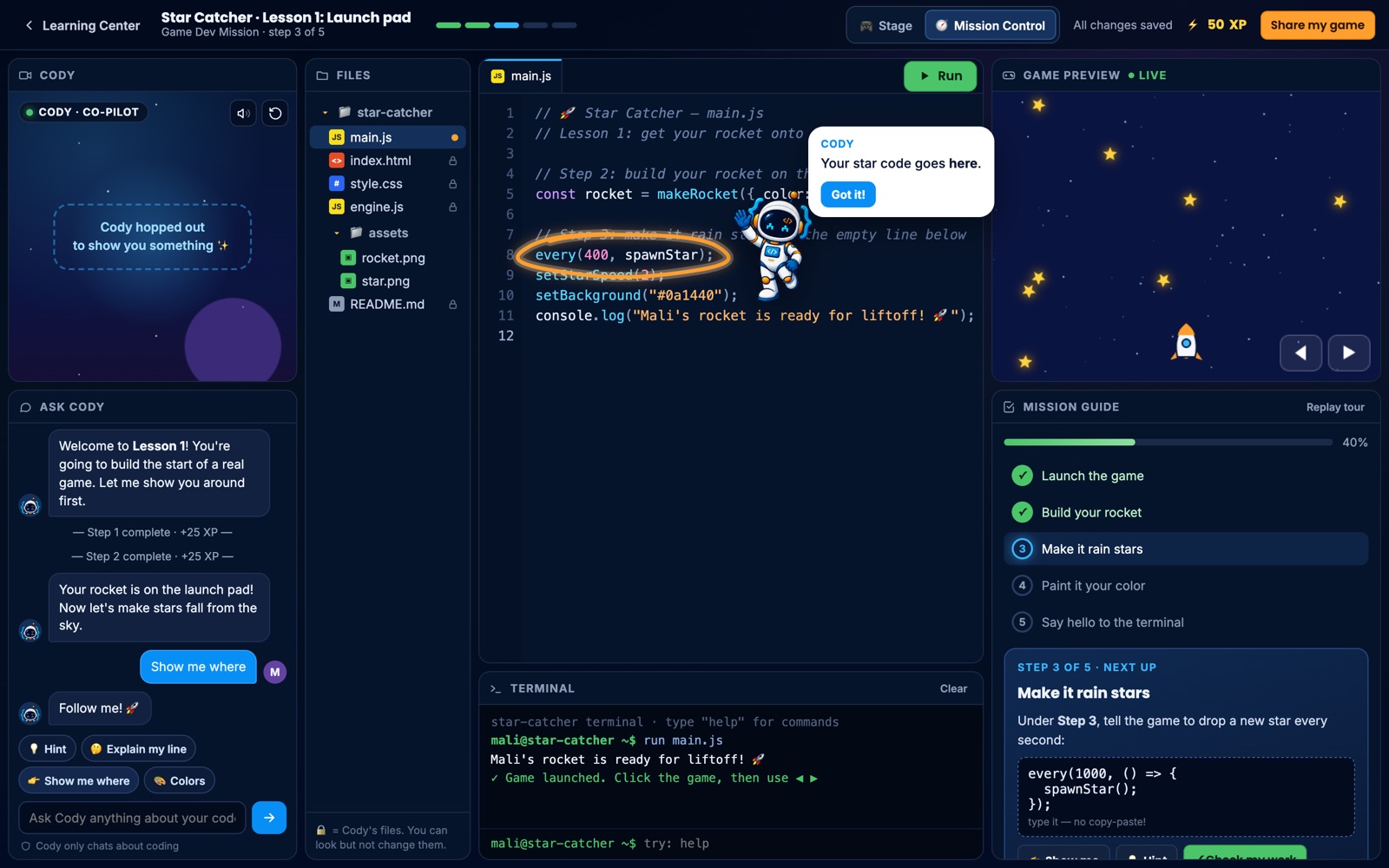
It fits around school and tutoring, one weeknight episode at a time. Across five episodes, about two hours at your child's own pace, they build a real arcade game with arrow keys, a score, levels, sound and a boss they design themselves. It plays in the browser on your laptop or desktop, and on phones, with nothing to install. The account is yours, with a Parent Corner behind a PIN where you approve every purchase and can see every step, and there are no ads or chats with strangers. One payment of $29.99 buys the whole mission, nothing renews, and brothers and sisters share it.
See the mission your child would start on, from the first typed line to the boss they design.
See how Star Catcher worksQuestions parents also ask
Does my child need good English before learning to code?
No. They need to read simple instructions, and the code itself uses a small set of keywords, mostly short English words that each do one job, like if, else and return. Kids pick them up the way they pick up game terms, by using them. Code can be a gentler place to practise English than an essay, because the computer shows straight away whether a line worked.
Will learning to code help with maths?
It tends to. The meta-analysis summarised in Frontiers in Psychology found that learning to code had a strong effect on coding skills and that maths was among the biggest gains beyond them.6 Code also gives numbers a job, like a score that climbs or a ship that moves ten steps to the right. Keep the maths tutor if it's working, and let coding be where the maths gets used.
Do we need an international school for our child to compete globally?
An international school can help with English and with friends from many countries. Much of what travels, though, gets built in the hours around school. Code shows it clearly. A child at a Thai government school and a child at a large international campus type the same JavaScript, get the same result, and what they build counts the same. Put your energy into the habit of making, at any school.
Is JavaScript what professionals actually use?
Yes. In Stack Overflow's 2025 developer survey, JavaScript topped the list of languages respondents used, ahead of HTML/CSS, SQL and Python.5 It runs in every web browser with nothing to install, which is why it makes a good first language for a child with a laptop. Starting with the real thing means nothing your child learns has to be unlearned later.
Was this answer helpful?
What was missing?
Sources
- Thai PISA scores below OECD averages while Cabinet expands SkillMap, The Nation (Thailand), on the OECD's PISA 2025 results ↩
- Thai students improve in PISA 2025, but remain below OECD average, Khaosod English, on the OECD's PISA 2025 results ↩
- EF English Proficiency Index 2025: the world's largest ranking of countries and regions by English skills, EF Education First ↩
- Thailand | EF English Proficiency Index (2025 edition), EF Education First ↩
- 2025 Stack Overflow Developer Survey, Stack Overflow ↩
- Some Evidence on the Cognitive Benefits of Learning to Code, Frontiers in Psychology (Scherer, Siddiq and Sánchez-Scherer, 2021) ↩
Keep reading
More in School and learning CodingIs coding good for kids?Yes. Coding turns screen time into making. A kid plans, builds, hits a bug and fixes it, and the program is still there when the hour ends.
 AIIs it still worth it for kids to learn coding now that AI can write code?Yes. AI now writes code in seconds, and a lot of it is almost right. In Stack Overflow's 2025 survey, the frustration developers cited most, at 66%, was "AI solutions that are almost right, but not quite".
 SchoolMy son has coding lessons in Grade 3 at his Thai school. What is he actually learning?Mostly how to solve problems in clear steps, with some programming.
 SchoolMy 11-year-old memorises everything for tests but can't explain any of it. How do I help?Ask him to explain, predict and build, because memorising works until a question changes shape.